
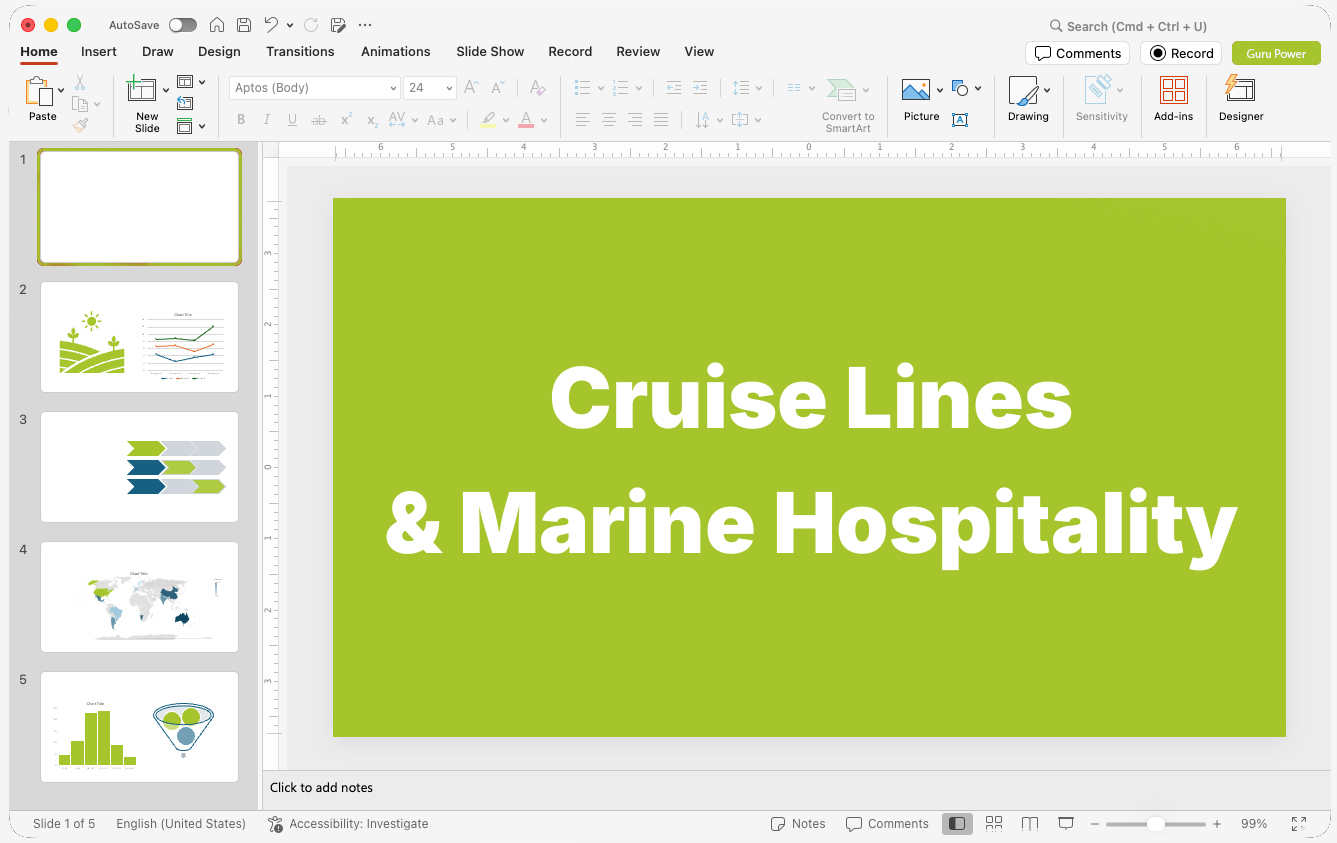
When Cruise Lines & Marine Hospitality Decision-Makers Need Strategic Presentations Addressing Business Outcomes
Cruise Lines & Marine Hospitality Presentation Design involves structuring operational, financial, and regulatory data into specialized executive presentations, pitch decks, and board slides for ocean cruise operators, river lines, passenger ferry systems, and marine venue managers.
Presentation Gurus builds tailored corporate decks for cruise lines & marine hospitality executives who need to communicate high-stakes strategy to investors, port directors, and corporate boards. We translate dense marine operational metrics into executive-ready slide decks that drive decisions. Whether you require a passenger experience slide-deck for fleet-wide service enhancements, a maritime sustainability investor presentation for fleet retrofits, or a port terminal pitch deck for municipal negotiations, our team structures your arguments logically. We design every slide deck to convey financial rigor and operational precision. Executives rely on our presentation agency to produce structured PowerPoint files that align cross-functional stakeholders around key commercial goals.
Why Cruise Lines & Marine Hospitality Presentations Need Professional Presentation Design
The data shows that maritime operators face strict capital requirements, changing compliance mandates, and shifting guest expectations. Standard off-the-shelf deck designs fail to communicate these operational realities to board members, institutional investors, and port authorities. Generic templates clutter critical metrics, dilute yield management data, and confuse fleet expansion roadmaps. A strategy-led approach structures complex maritime variables into cohesive logical flows. It translates technical shipboard logistics, onboard revenue statistics, and decarbonization investments into direct financial impacts. By replacing bulleted lists with executive data visualization, pitch narratives directly address yield optimization, crew safety, and asset utilization. Operators using strategic decks present clearer investment cases, expedite stakeholder alignment, and successfully secure capital allocations. Clear communication converts high-level maritime strategy into measurable business outcomes.
How Working With Us Works
From First Conversation To Finished Deck
Company
Meet JR, our founder. Fortune 500s, SMBs, startups — he’s built presentations for all of them with his team for the past 30 years, and he’s ready to build yours.
Service
Find your fit. We match the right service and scope to your audience, your goals, and your deadline, from 24-hour service to a 15-day turnaround.
Cost
Know the number upfront. Transparent, flat pricing before we start — no surprises, no hidden hours. All from $49 per slide.
Get Started
Tell us about your presentation project. It will take two minutes and we’ll get back to you on our next business day.













14 Essential Presentation Types for Cruise Lines & Marine Hospitality
Fleet Modernization Capital Pitch-Deck
Primary Audience: Board of Directors and Institutional Investors.
Purpose: Secure capital approval for vessel retrofits and fleet technological upgrades..
Description: This Cruise Lines & Marine Hospitality presentation details return on investment for vessel refurbishments, propulsion upgrades, and digital infrastructure. It outlines capital expenditure schedules alongside projected yield gains per berth. The narrative focuses on long-term asset value and operational cost reduction. Data visualizations summarize dry-dock timelines and operational payback periods clearly.
Port Terminal Lease Agreement Presentation
Primary Audience: Port Authorities and Municipal Commissions.
Purpose: Win long-term port berth rights and terminal development concessions..
Description: This Cruise Sector slide-deck presents passenger volume projections, economic impact data, and shore-side power infrastructure plans to municipal port leadership. It highlights local workforce integration and environmental compliance measures. The document demonstrates long-term commitment to port infrastructure development and local business growth. Clean spatial layouts organize complex berth schedules and financial revenue-sharing models.
Onboard Revenue Yield Management Deck
Primary Audience: Executive Leadership and Commercial Directors.
Purpose: Align operational teams around ancillary revenue strategies across passenger fleets..
Description: This Maritime Hospitality deck analyzes guest spending behaviors across beverage, excursion, casino, and retail sectors. It highlights pricing strategy revisions and cross-selling opportunities across specific passenger demographics. Slides illustrate historical onboard spending trends alongside projected quarterly yield benchmarks. The strategic presentation establishes clear operational KPIs for shipboard department heads.
Guest Experience Elevation Presentation
Primary Audience: Fleet Operations and Hotel Management Executives.
Purpose: Approve new passenger service protocols and onboard amenities..
Description: This Ocean Cruise Lines presentation evaluates guest satisfaction scores, dining feedback, and entertainment engagement metrics. It introduces updated hospitality service concepts designed to improve Net Promoter Scores across the passenger fleet. Practical service delivery models are outlined alongside staff training requirements. The narrative directly connects service quality improvements with repeat passenger bookings.
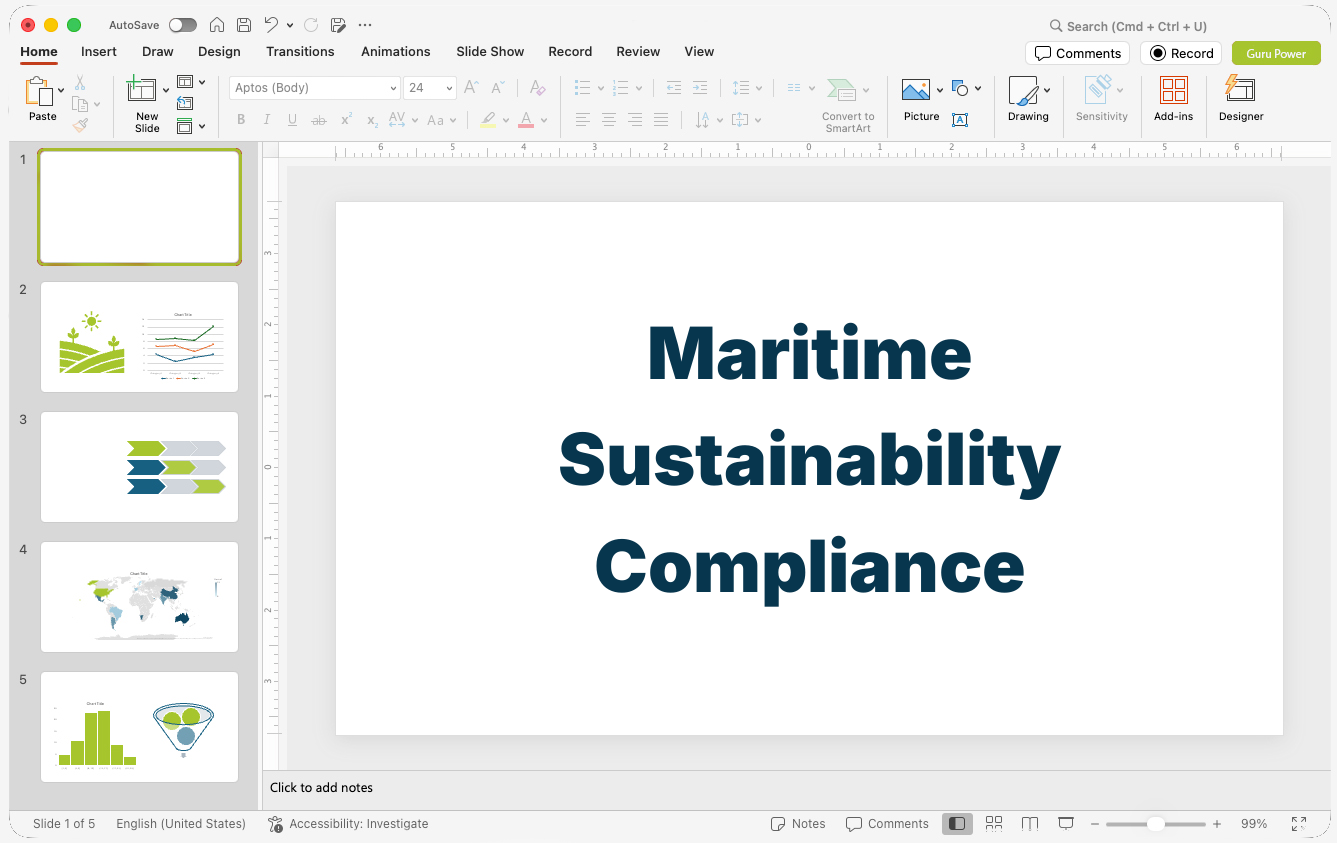
Maritime Sustainability Compliance Deck
Primary Audience: Regulatory Bodies, ESG Committees, and Investors.
Purpose: Demonstrate compliance with international marine environmental regulations..
Description: This Cruise Tourism PowerPoint details carbon intensity reduction metrics, alternative fuel adoption, and advanced wastewater treatment deployment. It systematically maps fleet compliance against IMO and regional environmental mandates. Clear charts compare historical emissions against target net-zero trajectories. The deck reinforces corporate accountability and risk mitigation for institutional stakeholders.
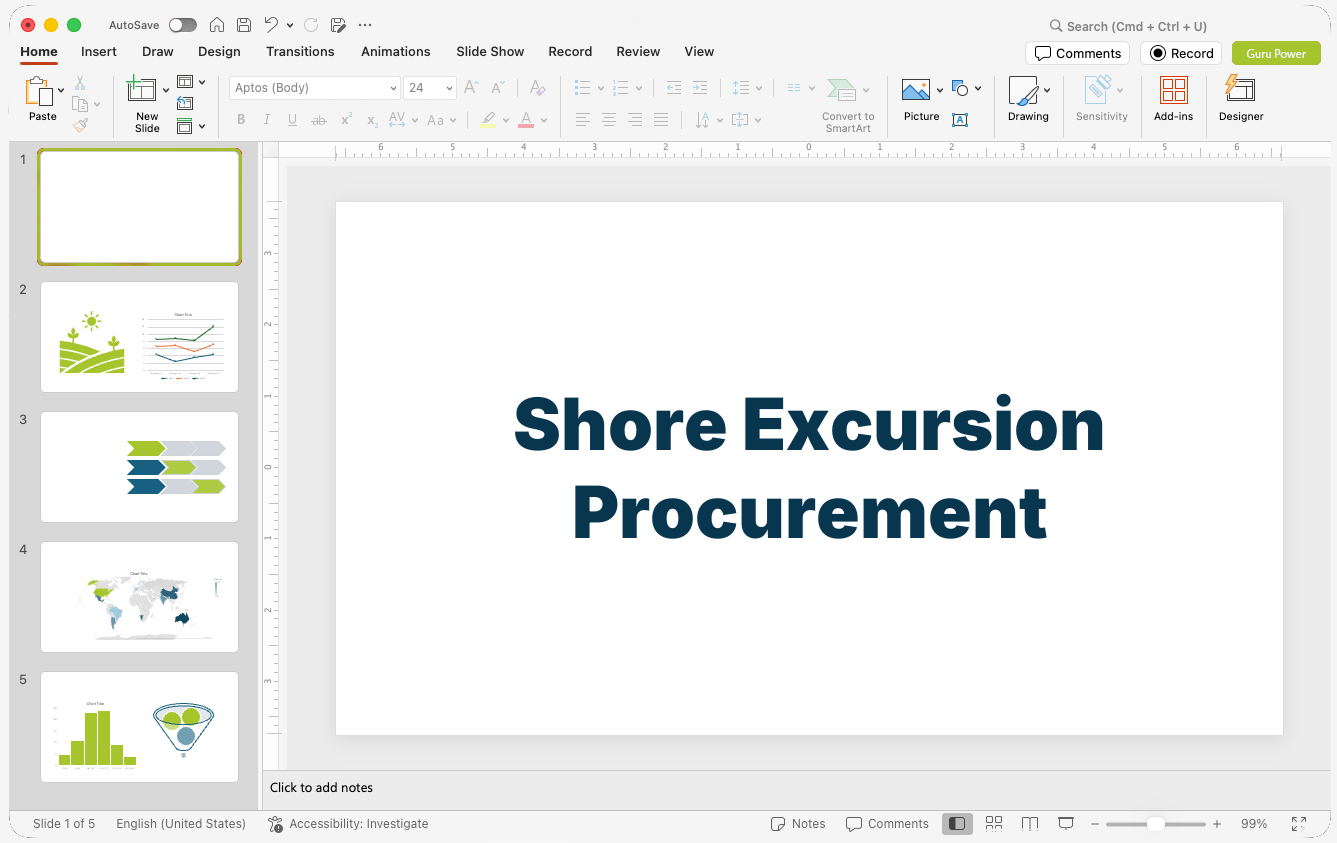
Shore Excursion Procurement Pitch-Deck
Primary Audience: Destination Tour Operators and Regional Partners.
Purpose: Establish exclusive, high-margin shore excursion supply contracts..
Description: This Marine Tourism pitch-deck outlines passenger demographic profiles, seasonal volume forecasts, and safety compliance expectations for ground operators. It communicates commercial partnership structures and co-branding guidelines. Slides detail tender logistics, liability requirements, and guest feedback integration. The presentation establishes clear mutual financial benefits for regional tourism suppliers.
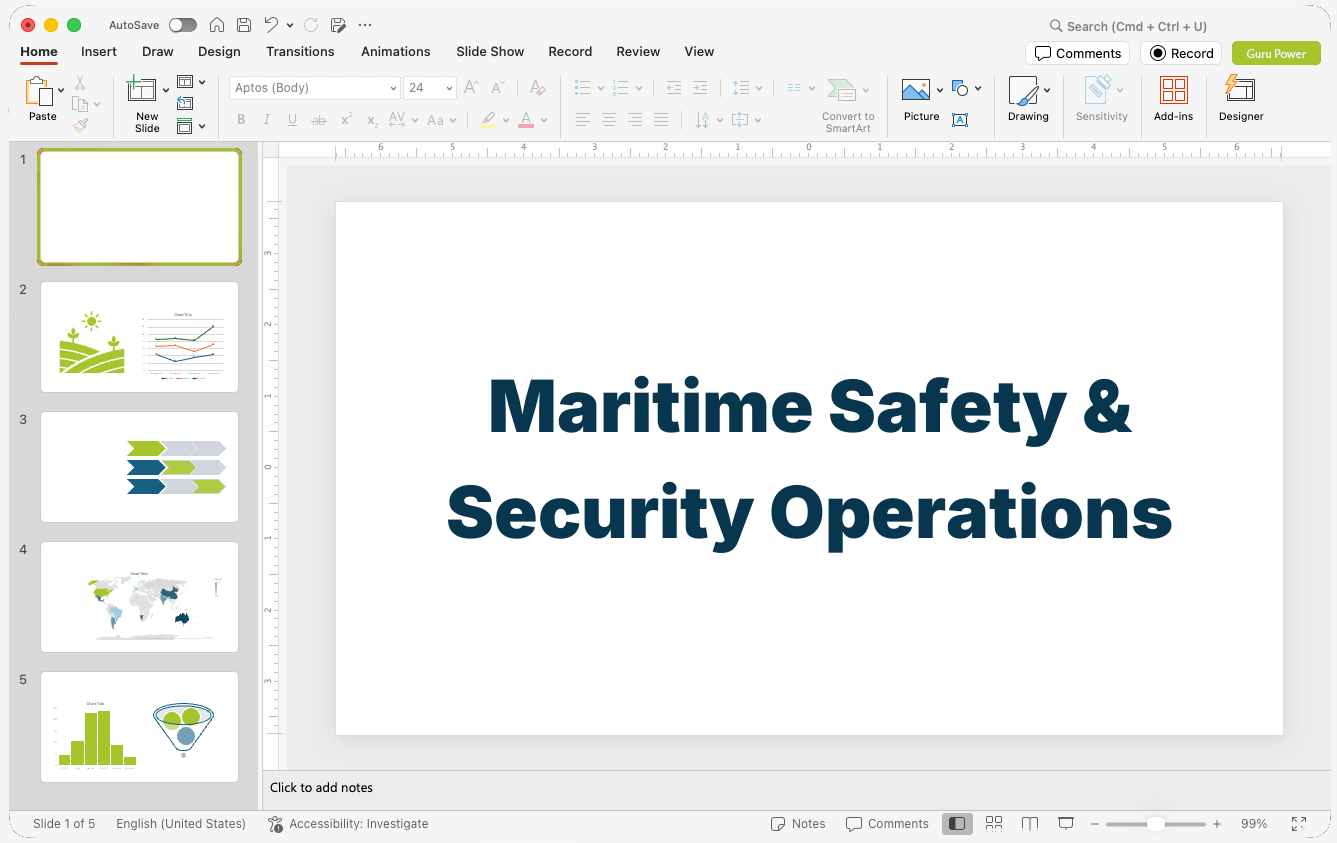
Maritime Safety & Security Operations Deck
Primary Audience: Safety Committee and Marine Regulatory Auditors.
Purpose: Verify operational readiness and fleet safety protocol updates..
Description: This Passenger Fleet Operations presentation outlines crew training compliance, drill procedures, and emergency response infrastructure. It reviews audit findings, risk mitigation updates, and maritime safety management system protocols. Structured graphics map incident response trees and reporting hierarchies across the fleet. The presentation validates strict operational adherence to international maritime safety codes.
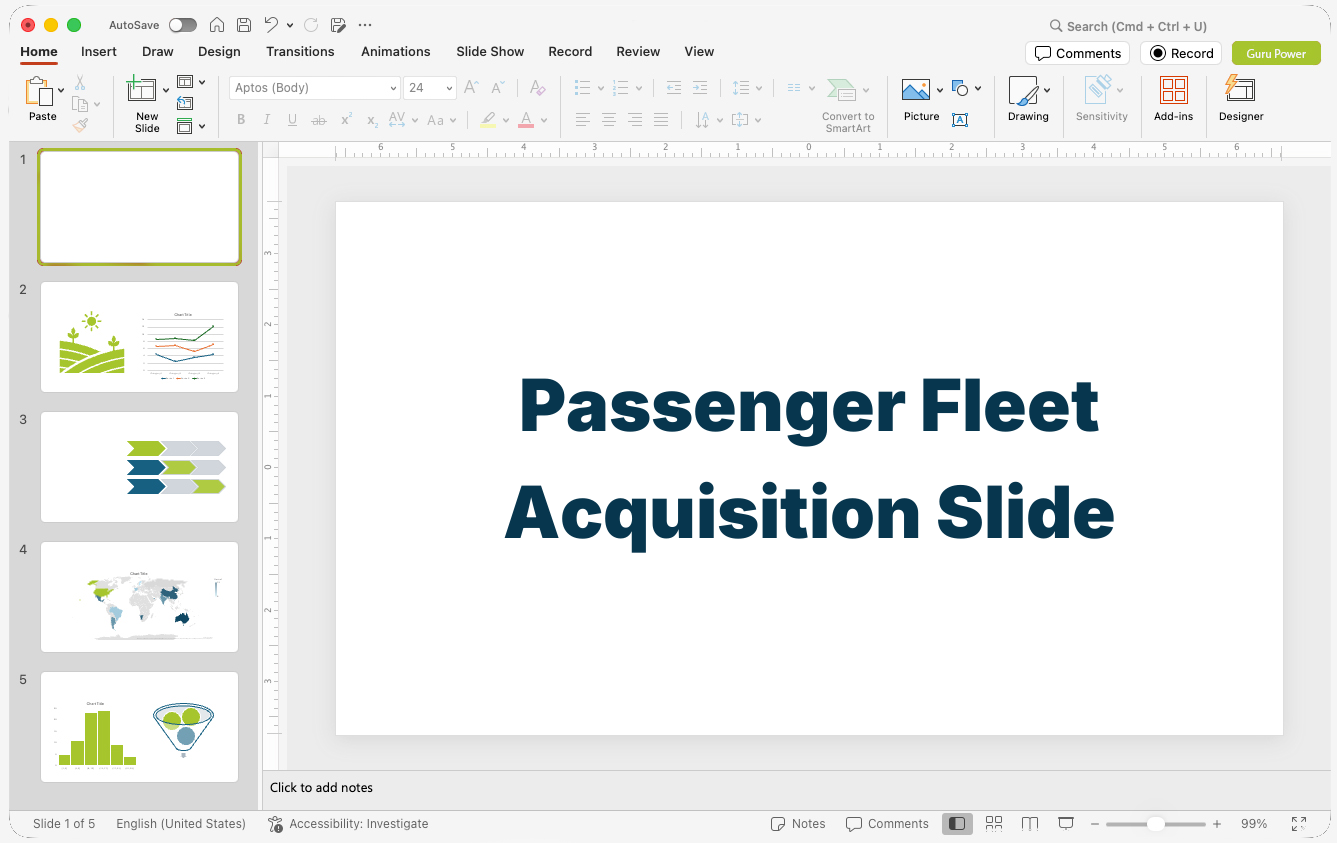
Passenger Fleet Acquisition Slide-Deck
Primary Audience: Private Equity Partners and Investment Syndicate.
Purpose: Secure debt and equity financing for vessel or fleet acquisitions..
Description: This River Cruise Sector slide-deck models vessel acquisition costs, charter rate projections, and fleet integration timelines. Financial models display EBITDA projections, asset valuations, and leverage ratios under varying economic scenarios. Operational synergies and cross-fleet efficiencies are clearly articulated. Strategic risk factors are presented alongside established hedging strategies.
Private Island Destination Strategy Presentation
Primary Audience: Corporate Executive Committee and Master Planners.
Purpose: Obtain budget sign-off for private port island resort infrastructure..
Description: This Maritime Hospitality presentation presents master plans, environmental impact studies, and guest throughput capacity models for private port destinations. The narrative links destination exclusivity with ticket yield premiums and guest satisfaction. Detailed slides map construction phases, utility infrastructure, and environmental preservation zones. Strategic financial modeling projects incremental onboard and onshore guest spend.
Shipboard Culinary & Beverage Strategy Deck
Primary Audience: Commercial Operations and Procurement Leadership.
Purpose: Approve fleet-wide food and beverage concepts and supply chain programs..
Description: This Cruise Sector presentation analyzes passenger dining preferences, food waste statistics, and supply chain procurement costs. It proposes updated specialty dining concepts and beverage package structures designed to raise margin contributions. Cost-per-passenger-day trends are presented alongside vendor consolidation strategies. Visual layouts summarize menu engineering plans and inventory control protocols.
Digital Guest Journey PowerPoint
Primary Audience: Chief Technology Officer and Commercial Strategy Teams.
Purpose: Secure funding for shipboard mobile app and contactless technology rollouts..
Description: This Ocean Cruise Lines PowerPoint maps the end-to-end guest digital journey from pre-cruise booking to onboard boarding and dining management. It details technical architecture requirements for satellite connectivity and onboard edge computing. Financial slides outline projected operational labor savings and increased ancillary digital sales. Implementation roadmaps establish rollout milestones across active vessels.
Maritime Workforce Development Pitch-Deck
Primary Audience: Human Resources Executive Committee and Maritime Academies.
Purpose: Establish global crew recruitment pipelines and retention initiatives..
Description: This Passenger Fleet Operations pitch-deck addresses global officer shortages, crew welfare programs, and maritime training partnerships. It presents crew retention data, wage benchmarking, and shipboard living condition upgrades. The presentation outlines career pathing frameworks to attract qualified maritime personnel. The narrative aligns human capital strategy directly with operational safety and guest satisfaction outcomes.
Charter & Corporate Events Sales Deck
Primary Audience: Corporate Event Planners and Travel Charter Brokers.
Purpose: Convert full-ship charter leads into high-value commercial bookings..
Description: This Marine Tourism presentation showcases vessel layout options, meeting facilities, customized dining capabilities, and dedicated group itineraries. It contrasts the financial efficiency of full-ship charters against traditional land-based resort venues. Custom booking terms, included amenities, and branding options are systematically laid out. Structured pricing tiers emphasize venue exclusivity and comprehensive package value.
Dry-Dock Operational Strategy Deck
Primary Audience: Technical Operations and Shipyard Management.
Purpose: Align technical teams and shipyard contractors on schedule execution..
Description: This Cruise Tourism presentation details critical-path tasks, contractor assignments, and safety requirements for scheduled vessel dry-docks. Gantt charts outline shipyard timelines, hull maintenance tasks, and interior overhaul schedules to minimize off-hire days. Budget allocation slides detail capital expenditure line items. Strategic operational protocols ensure timely re-entry into commercial passenger service.
Your PowerPoint, Google Slide and KeyNote Strategy, Story and Design Professionals
Presentation Gurus handles every stage of deck creation, combining structural narrative design, custom data graphics, and strict brand governance. We transform raw operational inputs into executive presentation decks that highlight ROI, compliance readiness, and yield growth. Our design team creates standardized PowerPoint master templates to maintain fleet-wide visual consistency across all corporate divisions. Contact Presentation Gurus today to schedule a consultation and elevate your next stakeholder presentation.
Ready ToGet Started?
Questions & Answers
Cruise Lines & Marine Hospitality Presentations FAQs
What does Cruise Lines & Marine Hospitality Presentations presentation design cost?
Pricing is simple and clear. A basic slide design or redesign begins at $49 per slide. Premium presentation design, which includes copywriting and basic storytelling, starts at $79 per slide. Custom presentations involving strategy, copywriting and custom graphics are quoted based on your specifications. See complete pricing details here.
What is the typical turnaround time for a cruise industry pitch deck?
Standard projects typically require two to three weeks from initial narrative discovery to final slide delivery. We also offer expedited timelines for urgent board meetings, port authority RFP deadlines, or investor roadshows requiring rapid turnarounds.
How long does it take to get a presentation designed?
If your team needs a complete presentation by 9:00 AM the next day, we can meet that deadline. Most projects take 10 – 15 days, providing we have all the information. Pricing is also based on slide complexity and speed — a basic slide deck with a 15-day delivery costs much less than a premium slide deck delivered the next morning.
How do you handle technical maritime operational data in executive presentations?
We convert complex maritime metrics—such as fuel efficiency targets, lower berth occupancy rates, and onboard yield figures—into standardized visual graphics. The focus remains on strategic business outcomes rather than raw technical jargon, ensuring board members and non-technical stakeholders quickly understand the commercial implications.
Will our team receive the fully editable source file?
Yes. Unlike graphic designers who deliver flat PDFs or JPEGs, Presentation Gurus delivers the native, fully editable presentation file (.pptx, .key, etc.) so your team can make last-minute text edits on the fly, or update the presentation later as details change.
How does the collaboration process work?
Everything happens online. Every meeting is a Microsoft Teams call or similar virtual environment where we can share desktops and information in real time. Revision meetings and discovery calls are always scheduled in the morning, so by noon we can begin work on tasks for the next revision meeting.
We have sensitive business information. Can you work under an NDA?
Virtually all of our client work is done under an NDA. We have a basic NDA included with our presentation work order, plus an enhanced, expanded non-disclosure agreement available whenever a project calls for it.
Does our industry need a Presentation or a Pitch Deck?
The terms are frequently used interchangeably, but they serve different strategic purposes. A pitch deck is a highly visual, persuasive tool designed to secure a strategic commitment or investment. A standard presentation is an informative, detailed document structured to align stakeholders and share data.
Do you assist with content structure and narrative flow for passenger hospitality pitches?
Yes. Our team helps structure raw operational notes and corporate financial data into a coherent business narrative. We refine slide sequence, focus key messages, and eliminate clutter so decision-makers receive a concise, convincing argument.
Can you design presentations that strictly follow our corporate cruise brand guidelines?
Yes. We build custom PowerPoint templates adhering strictly to your brand standards, typography, color palettes, and fleet media guidelines. Our team ensures visual continuity across all executive decks, investor slides, and internal operational briefings.
Presentation Gurus' research identifies 13 locations with active Cruise Lines & Marine Hospitality operations, including Miami, FL, Fort Lauderdale, FL, and Seattle, WA.
Marine passenger travel relies on massive logistics networks, specialized terminal infrastructure, and coordinated corporate leadership. South Florida serves as the central capital for the sector, anchored by major fleet operators and regional offices. Global corporate headquarters for Carnival Corporation, Royal Caribbean Group, and Norwegian Cruise Line Holdings direct operations from Miami, FL at PortMiami. Just up the coast, passenger sailings and administrative branches thrive around Port Everglades in Fort Lauderdale, FL, while Port Tampa Bay supports extensive Western Caribbean routes out of Tampa, FL.
Along the Gulf Coast, dedicated passenger terminals drive steady departures through Galveston, TX. Further east, river itineraries and ocean voyages share deep-water infrastructure in New Orleans, LA. Atlantic coastal sailings also connect through historic harbor facilities in Charleston, SC, while dense northern corridors rely on active hubs. The Manhattan and Brooklyn terminals in New York, NY manage ocean liner traffic and corporate maritime teams, and Boston, MA supports fly-cruise connections heading toward Canadian waters.
Pacific routes demand their own complex supply chains and administrative bases. The Port of Los Angeles World Cruise Center in Los Angeles, CA coordinates extensive Riviera sailings, supported down the coast by passenger facilities in San Diego, CA. Northern maritime itineraries route heavily through Seattle, WA, which serves as homeport for Alaskan trips and headquarters for Holland America Line and Seabourn. Further north, teams in Anchorage, AK manage land tours, passenger transfers, and eco-tourism logistics, while Honolulu, HI handles Hawaiian inter-island transport and island hospitality services.
These operational models mirror consumer patterns seen across adjacent commercial markets. The guest experiences delivered aboard modern fleets connect closely with standards set by Amusement Parks & Venue Management, as well as large-scale dining programs found in Catering & Commercial Culinary Services, Beverage & Commercial Brewery Corporations, and Quick-Service Restaurant (QSR) Franchises. At the same time, onboard retail venues draw strategies from Specialty Retailers (Jewelry, Toys, Books), Sporting Goods & Outdoor Recreation Retail, and Furniture & Home Decor Retailers, while modern booking platforms align with distribution systems used by E-Commerce & Direct-to-Consumer (D2C) Brands. A skilled PowerPoint presentation designer helps maritime operators translate these multi-layered business units into clear executive decks.