
When Video Game Development Studios Decision-Makers Need Strategic Presentations Addressing Business Outcomes
Video Game Development Studios Presentation Design is the practice of structuring technical game pipelines, production budgets, live-service projections, and creative intellectual property into visual executive presentations engineered to secure publisher funding and greenlight approvals.
Presentation Gurus serves as the specialized design partner for interactive entertainment companies and game production entities. Publishers and investors evaluate hundreds of opportunities annually, requiring precise visuals and rigorous operational messaging. We build tailored collateral like the Publisher Pitch Deck for Interactive Entertainment, the Co-Development Capabilities Slide Deck, and the Milestone Greenlight Pitch-Deck to clearly define production budgets, engine pipelines, and launch trajectories. Readers looking to outsource visual design gain decks structured for decision-makers. Across every presentation, slide deck, PowerPoint, and pitch deck we construct, data clarity takes precedence over empty decoration.
Why Video Game Development Studios Presentations Need Professional Presentation Design
Video Game Development Studios face severe scrutiny from publisher gatekeepers and investment committees. Standard presentations often fail because they rely heavily on raw concept art while neglecting unit economics, player retention projections, and production milestones. A strategy-led approach structures technical feasibility, monetization architecture, and market risk into a cohesive narrative. The problem is that creative teams focus on gameplay features, whereas financiers evaluate internal rate of return, milestone schedules, and live-service operations. Strategic presentation design bridges this gap by translating complex technical assets and game balance metrics into financial models that executives validate. The measurable outcome is reduced approval cycles, clearer publisher alignment, and secured milestone funding.
How Working With Us Works
From First Conversation To Finished Deck
Company
Meet JR, our founder. Fortune 500s, SMBs, startups — he’s built presentations for all of them with his team for the past 30 years, and he’s ready to build yours.
Service
Find your fit. We match the right service and scope to your audience, your goals, and your deadline, from 24-hour service to a 15-day turnaround.
Cost
Know the number upfront. Transparent, flat pricing before we start — no surprises, no hidden hours. All from $49 per slide.
Get Started
Tell us about your presentation project. It will take two minutes and we’ll get back to you on our next business day.















12 Essential Presentation Types for Video Game Development Studios
Publisher Pitch-Deck for Interactive Entertainment Companies
Primary Audience: External Game Publishers and Portfolio Managers.
Purpose: Secure production funding and global distribution rights..
Description: This presentation outlines core gameplay loops, target player demographics, competitive positioning, and complete production budgets. Interactive Entertainment Companies utilize this deck to demonstrate commercial viability and technical execution plans. The slides incorporate visual mockups, revenue share proposals, and detailed go-to-market schedules.
Milestone Greenlight Slide-Deck for Game Developers
Primary Audience: Internal Executive Committees and Greenlight Boards.
Purpose: Obtain formal authorization and capital allocation for the next phase of game development..
Description: Game Developers present vertical slice metrics, production schedule compliance, and budget burn rates in this structured slide-deck. The document evaluates prototype performance, technical risk assessments, and schedule feasibility. Clear visual charts compare planned milestone velocity against actual build progress.
Co-Development Capabilities Presentation for Game Engineering Teams
Primary Audience: Lead Producers and External Development Directors at Major Studios.
Purpose: Win work-for-hire and co-development contracts for specific game systems..
Description: Game Engineering Teams showcase specialized technical capabilities, past studio credits, and pipeline infrastructure. This presentation detail engine expertise, asset delivery bandwidth, and security compliance protocols. Visual case studies highlight successful integration with external production pipelines.
Live-Service Strategy Slides for Digital Entertainment Outfits
Primary Audience: Venture Investors and Publisher Strategy Teams.
Purpose: Demonstrate long-term player retention and recurring monetization mechanics..
Description: Digital Entertainment Outfits detail post-launch content roadmaps, season pass structures, and microtransaction unit economics. The slides break down expected average revenue per daily active user, retention curves, and server operating costs. Visual charts illustrate planned contentcadence over a multi-year life cycle.
IP Acquisition Pitch Deck for Game Production Entities
Primary Audience: Media Licensing Executives and IP Holders.
Purpose: Secure licensing rights to adapt established franchises into video games..
Description: Game Production Entities articulate how a licensed IP converts into an interactive game experience while preserving brand integrity. The pitch deck outlines target mechanics, narrative integration, and projected royalty streams. Detailed slides demonstrate studio execution capabilities and market alignment.
Tech Stack and Game Engine Presentation for Game Developers
Primary Audience: Chief Technology Officers and Technical Directors.
Purpose: Approve proprietary engine investments or third-party middleware integrations..
Description: Game Developers outline memory budgets, rendering pipelines, multiplayer networking architecture, and toolchain efficiencies. This presentation provides detailed technical benchmarks and cost-benefit analyses for engine selection. Complex systems are simplified into clear architectural diagrams.
Studio Acquisition Slide-Deck for Interactive Entertainment Companies
Primary Audience: Corporate Development Directors and M&A Teams.
Purpose: Facilitate strategic studio buyouts or equity investments..
Description: Interactive Entertainment Companies present studio headcount breakdown, proprietary technology assets, intellectual property portfolios, and historical EBITDA performance. This slide-deck details post-merger integration plans and synergistic cost savings. Clear financial tables present valuation metrics for board review.
Player Research and Analytics Deck for Digital Entertainment Outfits
Primary Audience: Game Designers, Product Managers, and Executive Producers.
Purpose: Align team decisions on player feedback, playtest telemetry, and market trends..
Description: Digital Entertainment Outfits summarize quantitative playtest results, churn rates, and user experience telemetry. The deck translates raw telemetry data into actionable design recommendations and feature adjustments. Graphs highlight specific friction points within early game loops.
Work-for-Hire Proposal Slides for Game Engineering Teams
Primary Audience: Outsourcing Managers and Production Executives.
Purpose: Secure art production, QA, or porting contracts from primary developers..
Description: Game Engineering Teams present hourly rate cards, asset throughput capacity, quality assurance pipelines, and platform porting experience. These slides clearly define scope limits, revision cycles, and delivery milestones. Comparison tables illustrate cost savings against internal studio overhead.
Esports Ecosystem Presentation for Indie Game Outfits
Primary Audience: Sponsors, League Operators, and Broadcast Partners.
Purpose: Establish commercial partnerships and tournament sponsorship commitments..
Description: Indie Game Outfits detail competitive game balance, spectator feature sets, league structures, and viewership forecasts. The presentation highlights demographic overlap and sponsor brand placement opportunities across streams. Infographics display tournament calendar cadences and prize pool structures.
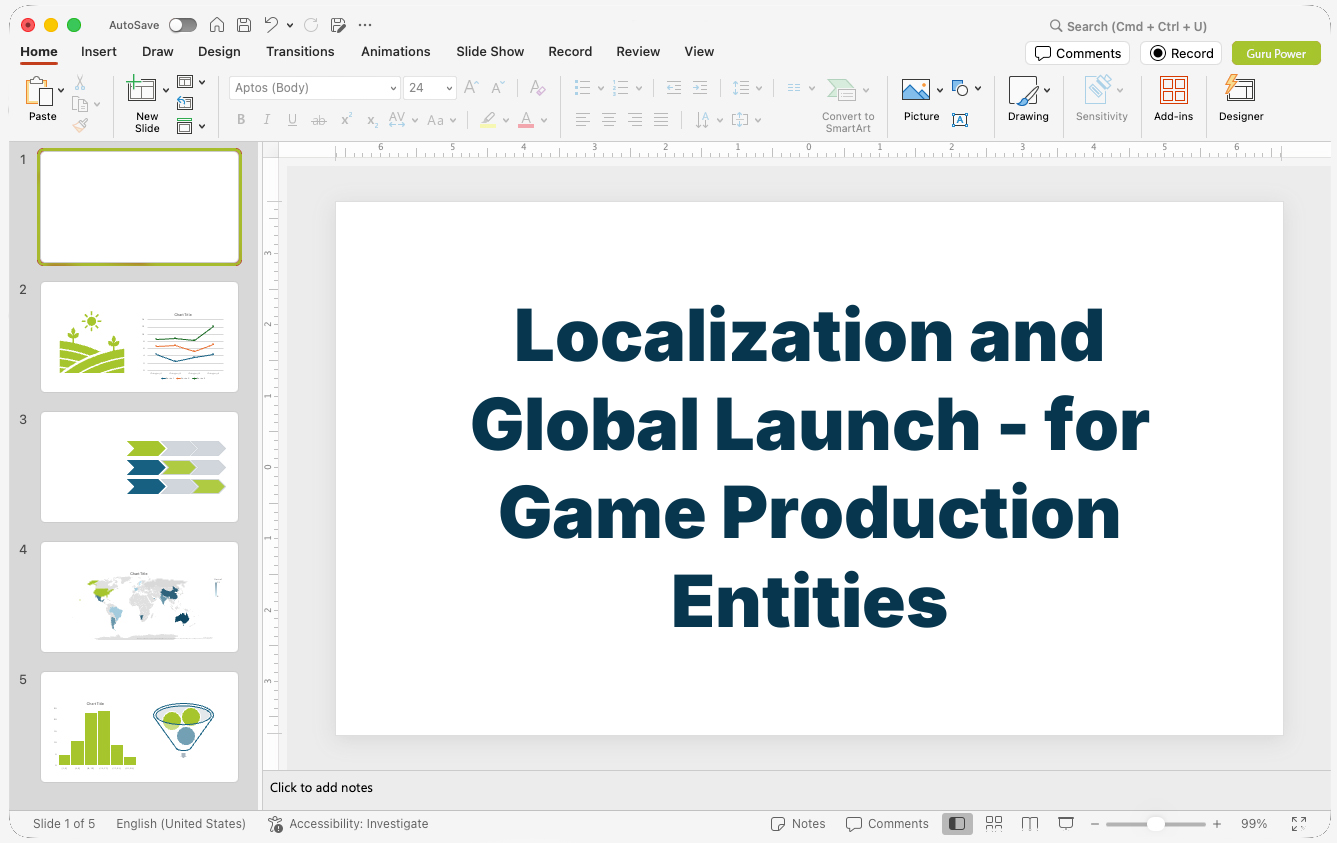
Localization and Global Launch Pitch-Deck for Game Production Entities
Primary Audience: Regional Publishing Partners and International Distributors.
Purpose: Contract regional publishing, culturalization, and market distribution..
Description: Game Production Entities highlight target international territory strategy, text and voice localization schedules, and regional payment integrations. The pitch-deck reviews territorial compliance requirements and regional marketing alliances. Demographic maps highlight growth opportunities in non-domestic markets.
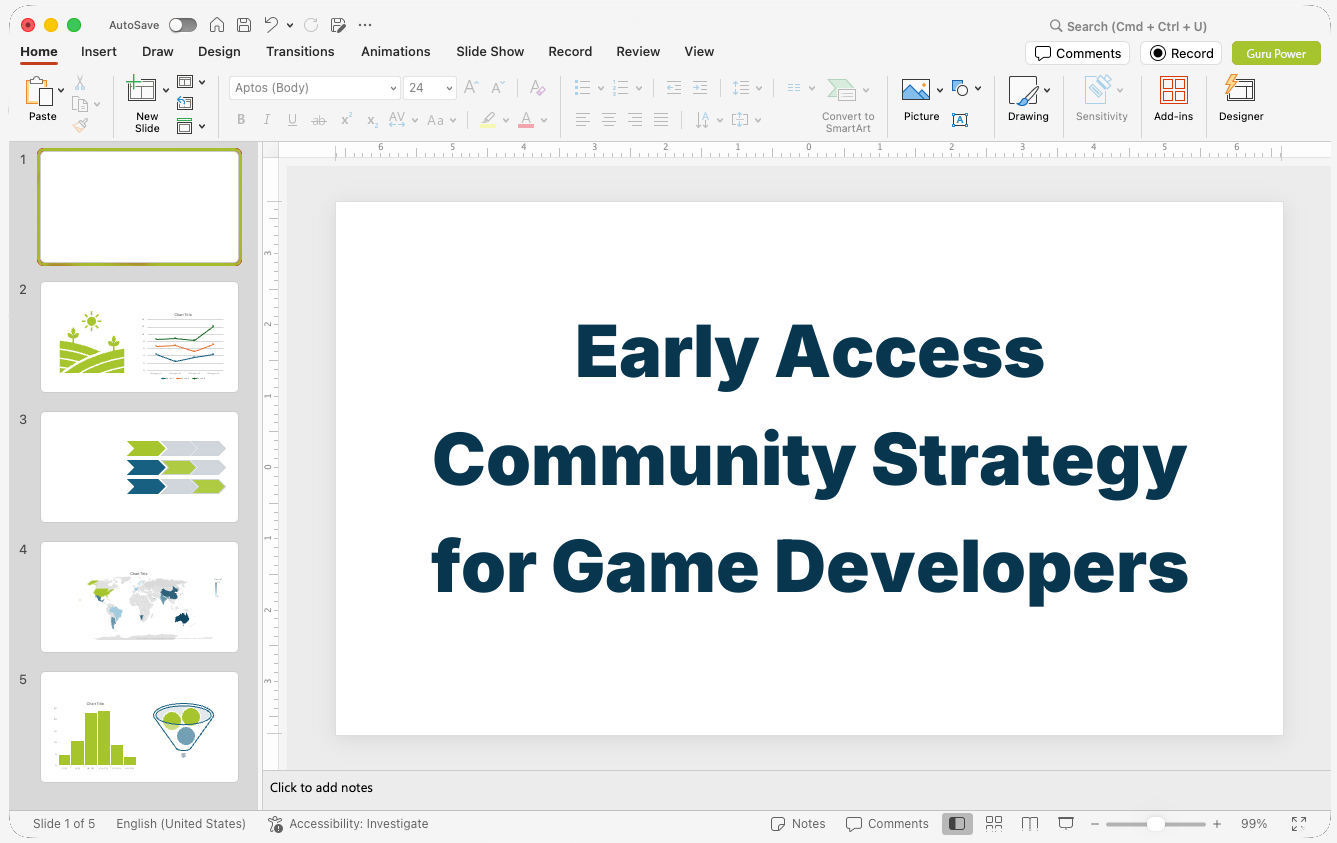
Early Access Community Strategy Presentation for Game Developers
Primary Audience: Community Managers and Studio Leadership.
Purpose: Approve community management budgets and player feedback loops prior to public release..
Description: Game Developers outline public roadmap disclosures, Discord moderation strategies, and patch release cadences. The presentation addresses crisis communication plans, bug tracking transparency, and player co-creation initiatives. Detailed timelines outline community milestones leading up to full v1.0 launches.
Your PowerPoint, Google Slide and KeyNote Strategy, Story and Design Professionals
Presentation Gurus solves communication bottlenecks through systematic information architecture and rigorous brand discipline. We convert complex engine benchmarks, milestone roadmaps, and monetization structures into clean visual diagrams. Our designers enforce consistent branding, typography, and asset layout across every document, ensuring your executive team maintains total authority in boardrooms and publishing reviews. Contact Presentation Gurus today to review your production materials and build a presentation that secures your next greenlight.
Ready ToGet Started?
Questions & Answers
Video Game Development Studios Presentations FAQs
Does our industry need a Presentation or a Pitch Deck?
The terms are frequently used interchangeably, but they serve different strategic purposes. A pitch deck is a highly visual, persuasive tool designed to secure a strategic commitment or investment. A standard presentation is an informative, detailed document structured to align stakeholders and share data.
What does Video Game Development Studios Presentations presentation design cost?
Pricing is simple and clear. A basic slide design or redesign begins at $49 per slide. Premium presentation design, which includes copywriting and basic storytelling, starts at $79 per slide. Custom presentations involving strategy, copywriting and custom graphics are quoted based on your specifications. See complete pricing details here.
What assets do we need to supply for a studio pitch deck?
Clients provide concept art, high-level design documents, target audience parameters, production timelines, and budget estimates. Our team organizes these inputs into a structured executive narrative, designing custom data visualizations, process graphics, and consistent slide layouts.
We have sensitive business information. Can you work under an NDA?
Virtually all of our client work is done under an NDA. We have a basic NDA included with our presentation work order, plus an enhanced, expanded non-disclosure agreement available whenever a project calls for it.
Will our team receive the fully editable source file?
Yes. Unlike graphic designers who deliver flat PDFs or JPEGs, Presentation Gurus delivers the native, fully editable presentation file (.pptx, .key, etc.) so your team can make last-minute text edits on the fly, or update the presentation later as details change.
How long does it take to design a complete publisher greenlight deck?
Standard turnarounds range from two to three weeks, depending on deck length and content readiness. The workflow includes initial narrative structuring, slide outline verification, visual style frame creation, and final slide production.
Can your agency handle non-disclosure agreements for unannounced IP?
Yes. Industry requirements mandate strict confidentiality for unannounced intellectual property and proprietary technology. We execute standard corporate non-disclosure agreements before reviewing any design documentation, raw source files, or storyboards, ensuring total security throughout the deck creation process.
How does the collaboration process work?
Everything happens online. Every meeting is a Microsoft Teams call or similar virtual environment where we can share desktops and information in real time. Revision meetings and discovery calls are always scheduled in the morning, so by noon we can begin work on tasks for the next revision meeting.
How do you present game design concepts alongside strict financial projections?
We structure the deck to address both creative vision and commercial viability. Creative assets, target demographics, and core loop diagrams appear first, followed immediately by detailed budget breakdowns, burn rates, monetization mechanics, and milestone deliverables. This dual approach gives creative directors and chief financial officers the specific data points required for greenlight evaluation.
How long does it take to get a presentation designed?
If your team needs a complete presentation by 9:00 AM the next day, we can meet that deadline. Most projects take 10 – 15 days, providing we have all the information. Pricing is also based on slide complexity and speed — a basic slide deck with a 15-day delivery costs much less than a premium slide deck delivered the next morning.
Presentation Gurus' research identifies 15 locations with active Video Game Development Studios operations, including Los Angeles, CA, San Francisco, CA, and Irvine, CA.
Video game development studios operate across key technology and entertainment hubs. In California, major clusters thrive in Los Angeles, CA, home to Riot Games and Sony Santa Monica, as well as San Francisco, CA, host of the Game Developers Conference. Nearby, Irvine, CA anchors massive multiplayer studios, while San Diego, CA houses first-party sports teams and San Jose, CA connects game tech providers with corporate investment arms.
The Pacific Northwest features another major ecosystem anchored by Seattle, WA, alongside Redmond, WA with Xbox Game Studios and Bellevue, WA hosting PC game digital storefront operators. Teams presenting pitch decks to investors or publishing partners in these markets often rely on tailored support. Early projects benefit from a Seed-Stage Validation Pitch or a SAFE Note Financing Pitch to secure early backing.
In the central and eastern regions, Austin, TX supports live-service operating studios, while Raleigh, NC houses Epic Games. Creative hubs like Chicago, IL bring arcade-heritage engineering teams, Orlando, FL drives sports gaming development, and Salt Lake City, UT expands engine development talent. Studios navigating technical reviews can consult an Enterprise Technical Architecture Review, while those protecting proprietary tech reference Corporate Inventions & Patent Commercialization.
East Coast media hubs including New York, NY and Boston, MA connect developers with broader media ecosystems. Game creators regularly intersect with Film & Television Production Studios, Digital Marketing & Performance Agencies, and Event Planning & Experiential Marketing providers. Cross-industry partnerships also extend into Sports Management & Marketing Agencies, Music Industry Management & Record Labels, Book & Digital Publishing Houses, Commercial Photography & Videography Agencies, and Broadcast & Cable Television Networks. Clear slide presentation design helps game studios communicate complex technical visions to partners and stakeholders across all these sectors.
Video Game Development Studios Presentations By the Numbers
- The global games market generated $201.6 billion in revenue in 2025, representing a 9.1% year-on-year growth. (Global games revenue cracked $200 billion in 2025 – Newzoo)