
When Hospital Systems & Healthcare Networks Decision-Makers Need Strategic Presentations Addressing Business Outcomes
Hospital Systems & Healthcare Networks Presentation Design is a strategic service that translates complex clinical, financial, and operational health system data into structured visual presentations for board members, executive committees, and healthcare investors.
Presentation Gurus serves as a specialized presentation design partner for Hospital Systems & Healthcare Networks enterprise leadership. We build tailored slide deck assets for complex governance, clinical, and financial reviews. Whether your team requires a Health System Board Governance Slide-Deck, a Regional Healthcare Network Expansion Pitch-Deck, or an Academic Medical Center Clinical Research Grant Presentation, we structure every frame around rigorous executive standards. Readers preparing to hire an agency for critical meetings receive complete presentation visual framing, narrative structuring, and custom data visualization. Our team converts raw operating data and clinical performance figures into clear PowerPoint deliverables designed for high-level decision-makers.
Why Hospital Systems & Healthcare Networks Presentations Need Professional Presentation Design
The market requires healthcare executive presentations to balance clinical quality metrics with operating margins. Generic presentation decks fail because they rely on unverified design layouts that obscure core financial projections and clinical workflows. When Hospital Systems & Healthcare Networks executives present complex operational restructuring or capital investments, unstructured slides slow down executive buy-in. Strategy-led design restructures complex medical data, regulatory mandates, and financial models into concise visual narratives. This addresses governance bottlenecks by delivering structured slide decks that speak directly to board oversight committees, investment boards, and clinical leadership. The measurable outcome is accelerated decision-making, reduced review cycles, and clear alignment across medical and administrative executives.
How Working With Us Works
From First Conversation To Finished Deck
Company
Meet JR, our founder. Fortune 500s, SMBs, startups — he’s built presentations for all of them with his team for the past 30 years, and he’s ready to build yours.
Service
Find your fit. We match the right service and scope to your audience, your goals, and your deadline, from 24-hour service to a 15-day turnaround.
Cost
Know the number upfront. Transparent, flat pricing before we start — no surprises, no hidden hours. All from $49 per slide.
Call 480-386-6000
Call us now. We’re open and we answer the phone. Or complete our quote request form that takes less than two minutes.
















14 Essential Presentation Types for Hospital Systems & Healthcare Networks
Health Systems Strategic M&A Capital PowerPoint Deck
Primary Audience: Board of Directors and Investment Committees.
Purpose: Secure approval for regional hospital system acquisitions.
Description: This Health Systems slide deck outlines financial modeling, market consolidation logic, and patient capture strategies. It details balance sheet integrations, facility valuation metrics, and projected operational synergies. The layout presents complex healthcare network balance sheets clearly for board approval.
Healthcare Networks Value-Based Care Operations Presentation
Primary Audience: Chief Medical Officers and Clinical Operations Executives.
Purpose: Align clinical leadership on value-based reimbursement frameworks.
Description: This Healthcare Networks presentation structures shared-savings metrics, capitation risk models, and clinical quality scorecards. Visual charts map patient outcome benchmarks against Medicare shared savings thresholds. The material provides objective operational data needed to update physician compensation structures.
Hospital Networks Service Line Expansion Slide-Deck
Primary Audience: Executive Leadership and Regional Health System Directors.
Purpose: Obtain capital budget allocation for specialized surgical units.
Description: This Hospital Networks slide deck outlines geographic patient demand, capital expenditure projections, and specialty physician recruitment goals. It compares outpatient market share against competing medical centers in adjacent counties. Clear timelines map equipment procurement and facility buildouts.
Medical Centers EHR System Integration Pitch-Deck
Primary Audience: Chief Information Officers and Health Network Steering Committees.
Purpose: Approve multi-year enterprise electronic health record migration budgets.
Description: This Medical Centers pitch deck details technical implementation roadmaps, data migration risks, and clinical workflow downtime estimates. It maps cross-departmental integration milestones and staff training phases. Financial projections illustrate long-term operational savings following platform deployment.
Health Networks Physician Alignment Strategy Slides
Primary Audience: Employed Physician Groups and Medical Staff Leadership.
Purpose: Formalize joint venture and clinical integration agreements.
Description: These Health Networks slides demonstrate compensation models, productivity benchmarks, and governance participation structures. Data charts illustrate patient referral flow improvements and shared clinical quality protocols. The structure clarifies legal compliance requirements under federal Stark Law guidelines.
Integrated Delivery Networks Supply Chain Optimization Presentation
Primary Audience: Chief Financial Officers and Procurement Directors.
Purpose: Authorize group purchasing organization consolidation across sites.
Description: This Integrated Delivery Networks presentation details supply standardization, inventory holding costs, and vendor contract renegotiations. Comparative graphs show unit cost reductions across acute care and ambulatory facilities. The presentation proves operational expense reduction targets over a three-year horizon.
Health Systems Patient Experience & Quality Scorecard PowerPoint
Primary Audience: Quality Improvement Committees and Executive Leadership.
Purpose: Review HCAHPS scores and implement system-wide quality interventions.
Description: This Health Systems PowerPoint reviews patient satisfaction metrics, readmission penalties, and clinical safety compliance numbers. Trend lines track hospital-acquired infection rates across multiple network facilities. Recommended operational protocols outline immediate clinical workflow adjustments.
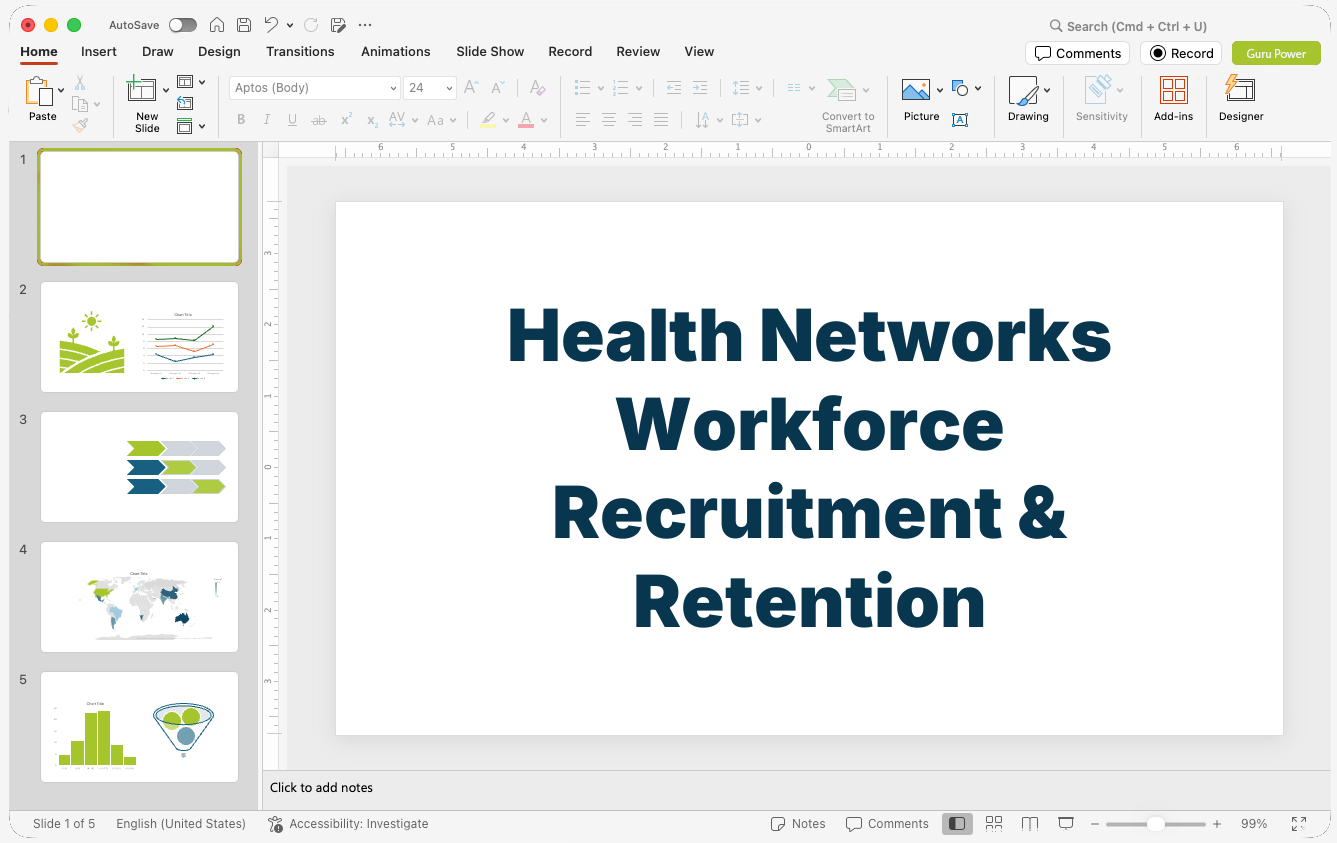
Healthcare Networks Outpatient Ambulatory Center Pitch-Deck
Primary Audience: Real Estate Committees and Health Network Executives.
Purpose: Approve site selection and funding for off-campus urgent care clinics.
Description: This Healthcare Networks pitch deck highlights patient demographic shifts, payer mix projections, and facility lease agreements. High-resolution maps display drive-time analyses and local primary care access gaps. Financial projections prove return on capital investment within four operating quarters.
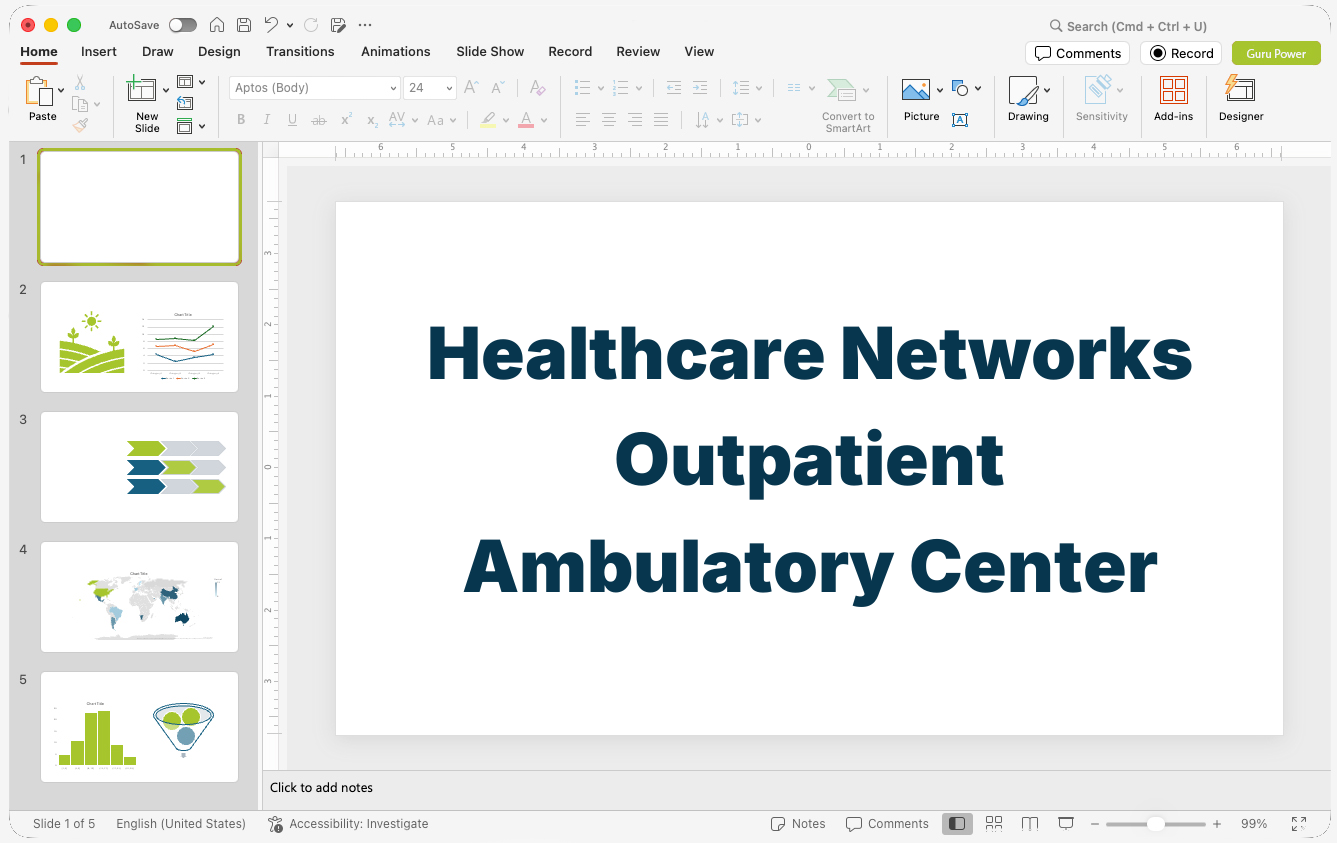
Hospital Networks Telehealth & Digital Health Strategy Slides
Primary Audience: Chief Innovation Officers and Strategic Planning Committees.
Purpose: Expand remote patient monitoring and virtual visit infrastructure.
Description: These Hospital Networks slides detail virtual care utilization data, technology vendor evaluations, and reimbursement coverage rules. Technical diagrams display software integration with core hospital information systems. Operational timelines detail patient onboarding protocols for chronic condition management.
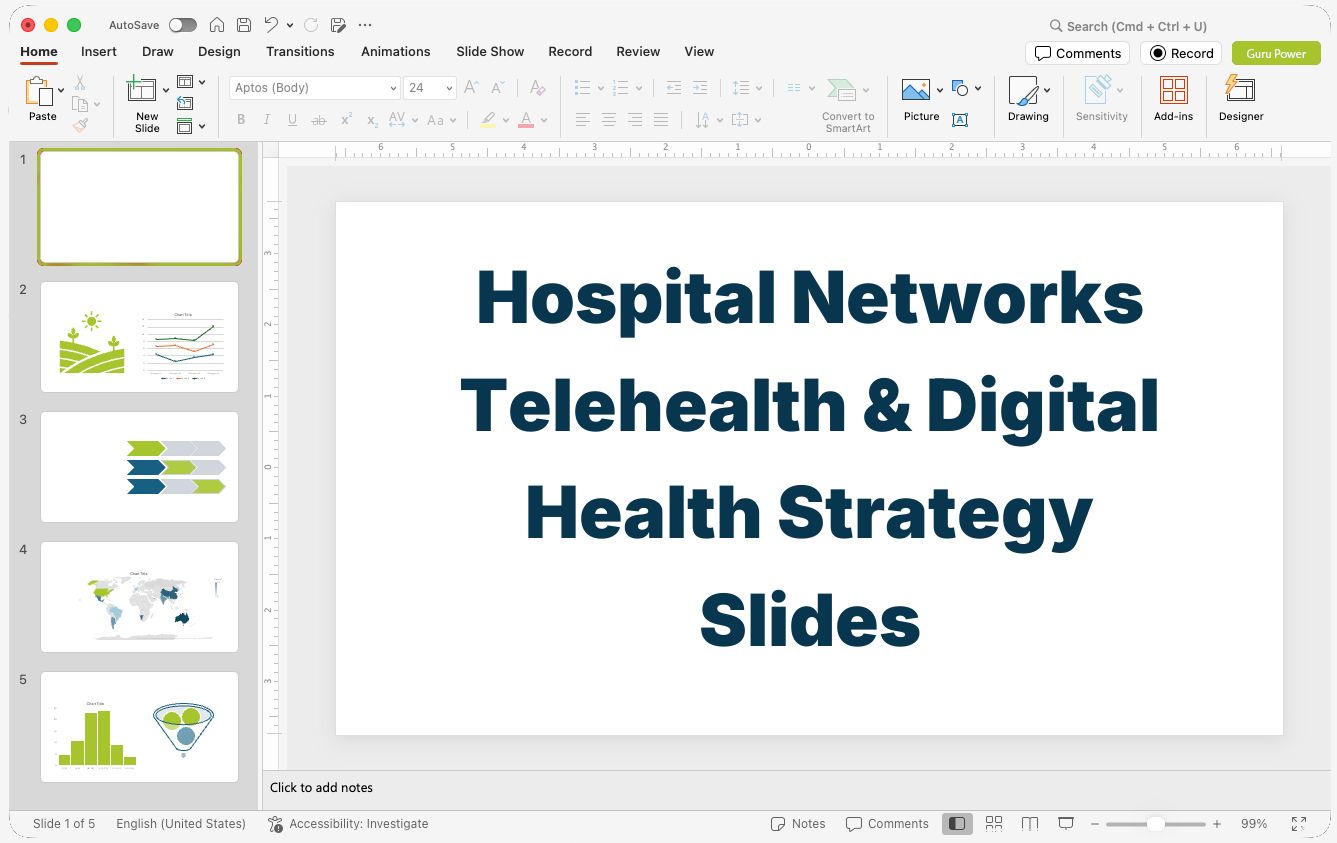
Medical Centers Academic Research & Grant Funding Slide-Deck
Primary Audience: Government Grant Review Panels and Institutional Donors.
Purpose: Secure philanthropic and federal funding for clinical research initiatives.
Description: This Medical Centers slide deck presents clinical trial phase data, translational research outcomes, and research facility expansion plans. Data visualizers map patent disclosures and peer-reviewed publication metrics. Funding allocation charts demonstrate responsible administrative overhead management.
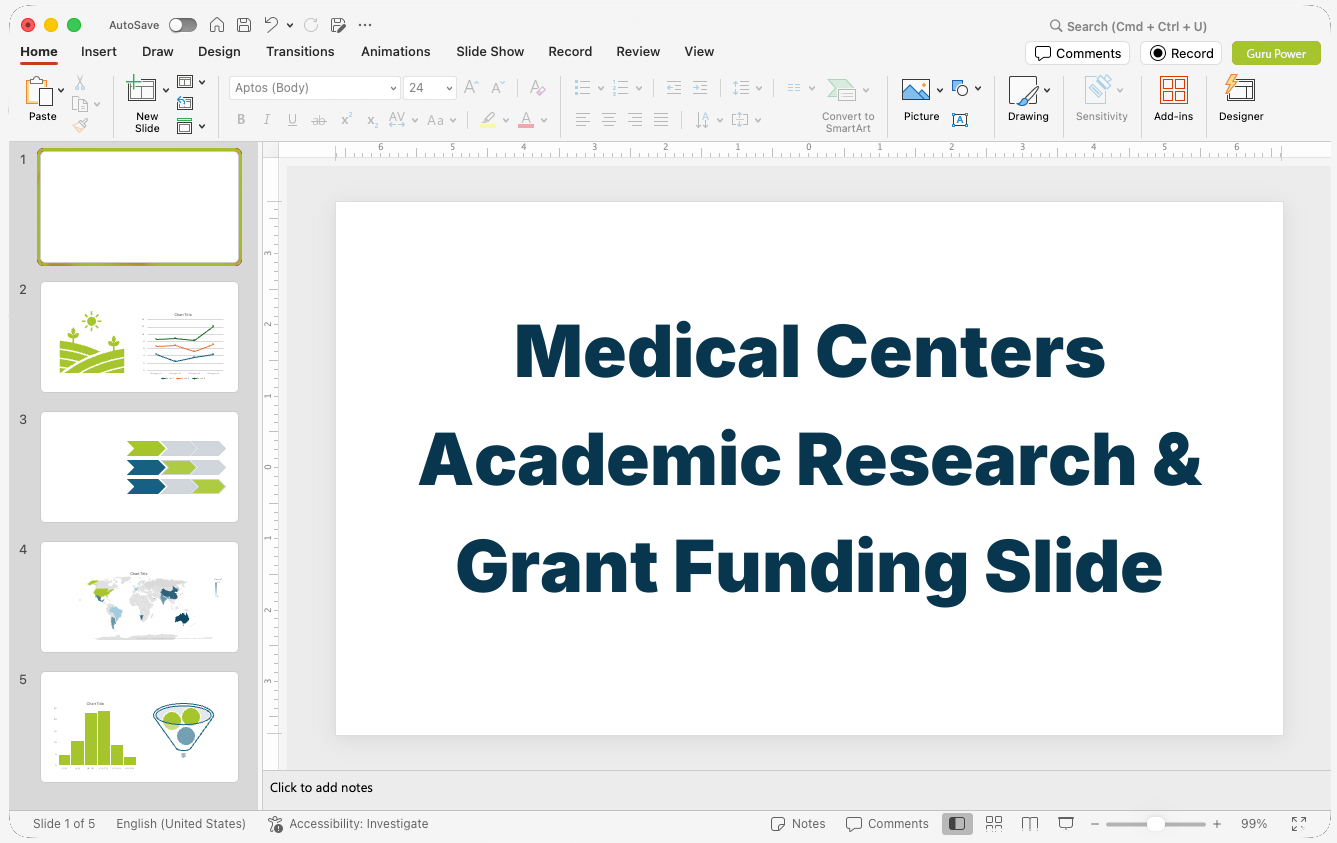
Health Networks Workforce Recruitment & Retention Presentation
Primary Audience: Chief Human Resources Officers and Hospital Operations Chiefs.
Purpose: Address clinical staffing shortages and reduce contract nurse reliance.
Description: This Health Networks presentation details nurse turnover rates, overtime expenditures, and local nursing school pipeline partnerships. Financial models compare premium contract agency labor costs against permanent retention bonus programs. Strategic slides outline career progression pathways across acute facilities.
Integrated Delivery Networks Behavioral Health Integration PowerPoint
Primary Audience: Community Health Boards and Executive Leadership.
Purpose: Fund inpatient psychiatric unit expansions and outpatient clinics.
Description: This Integrated Delivery Networks PowerPoint presents emergency department boarding statistics, community mental health demand, and bed capacity deficits. Financial slides detail Medicaid reimbursement structures and state grant subsidies. Operational layouts illustrate integrated behavioral health models within primary care settings.
Health Systems Population Health Management Pitch-Deck
Primary Audience: Managed Care Directors and Accountable Care Organization Boards.
Purpose: Expand risk-bearing payer contracts across regional employer groups.
Description: This Health Systems pitch deck outlines disease management outcomes, emergency room avoidance rates, and total cost of care reductions. Actuarial tables establish target risk corridors and shared savings distributions. Visual diagrams map care coordinator workflows for high-risk patient cohorts.
Healthcare Networks Cyber Security & IT Infrastructure Slides
Primary Audience: Audit and Compliance Committees.
Purpose: Secure capital budget for health system network cybersecurity upgrades.
Description: These Healthcare Networks slides detail threat vectors, HIPAA security compliance metrics, and legacy hardware risks across all clinical sites. Infrastructure diagrams display multi-factor authentication and data encryption layers. Investment tables highlight risk mitigation values compared to prospective breach penalties.
Your PowerPoint, Google Slide and KeyNote Strategy, Story and Design Professionals
Presentation Gurus addresses complex medical network communication through objective slide structure, visual data clarity, and consistent institutional branding. We transform fragmented clinical metrics and complex financial tables into strategic visual narratives that reinforce enterprise authority. Every slide aligns with institutional brand standards while organizing data for maximum executive comprehension. End your team's struggle with cluttered pitch deck layouts and unaligned messaging. Contact Presentation Gurus today to secure strategic presentation design for your upcoming executive board review.
Ready ToGet Started?
Presentation Gurus is open.
Give us a call.
We actually answer the phone.
Questions & Answers
Hospital Systems & Healthcare Networks Presentations FAQs
Does our industry need a Presentation or a Pitch Deck?
The terms are frequently used interchangeably, but they serve different strategic purposes. A pitch deck is a highly visual, persuasive tool designed to secure a strategic commitment or investment. A standard presentation is an informative, detailed document structured to align stakeholders and share data.
We have sensitive business information. Can you work under an NDA?
Virtually all of our client work is done under an NDA. We have a basic NDA included with our presentation work order, plus an enhanced, expanded non-disclosure agreement available whenever a project calls for it.
What is the typical timeline for an executive board presentation deck for a healthcare system?
Standard projects typically require ten to fifteen business days from initial content delivery to final slide export. Expedited turnarounds are available for time-sensitive governance meetings or urgent M&A transactions.
How does the collaboration process work?
Everything happens online. Every meeting is a Microsoft Teams call or similar virtual environment where we can share desktops and information in real time. Revision meetings and discovery calls are always scheduled in the morning, so by noon we can begin work on tasks for the next revision meeting.
Will our team receive the fully editable source file?
Yes. Unlike graphic designers who deliver flat PDFs or JPEGs, Presentation Gurus delivers the native, fully editable presentation file (.pptx, .key, etc.) so your team can make last-minute text edits on the fly, or update the presentation later as details change.
How do you ensure slides align with strict institutional brand guidelines?
We incorporate your health system’s official typography, color palettes, logo lockups, and design rules directly into custom PowerPoint master templates. This ensures full visual compliance across all department decks.
How do you handle sensitive clinical data and HIPAA compliance when designing health system presentations?
We work exclusively with fully anonymized, aggregated, or synthetic baseline data during the presentation design process. Client confidentiality agreements and secure file transfer protocols protect proprietary operational statistics. Visual structures emphasize key metrics without exposing patient-level data.
How long does it take to get a presentation designed?
If your team needs a complete presentation by 9:00 AM the next day, we can meet that deadline. Most projects take 10 – 15 days, providing we have all the information. Pricing is also based on slide complexity and speed — a basic slide deck with a 15-day delivery costs much less than a premium slide deck delivered the next morning.
Can you convert complex EHR or financial spreadsheet data into visual PowerPoint slides?
Yes. We reformat raw electronic health record statistics, balance sheets, and operating margin tables into clean, executive-level data visualizations. Our team creates custom charts and diagrams within PowerPoint to highlight key performance indicators clearly.
What does Hospital Systems & Healthcare Networks Presentations presentation design cost?
Pricing is simple and clear. A basic slide design or redesign begins at $49 per slide. Premium presentation design, which includes copywriting and basic storytelling, starts at $79 per slide. Custom presentations involving strategy, copywriting and custom graphics are quoted based on your specifications. See complete pricing details here.
Presentation Gurus' research identifies 14 locations with active Hospital Systems & Healthcare Networks operations, including Boston, MA, Rochester, MN, and Cleveland, OH.
Major clinical systems shape regional healthcare delivery through vast facilities and dedicated research centers. In Boston, MA, Mass General Brigham stands as the largest healthcare employer and research network in Massachusetts. Further inland, Mayo Clinic anchors operations from its headquarters in Rochester, MN, while Cleveland Clinic drives an extensive multi-hospital network out of Cleveland, OH. On the East Coast, academic care expands through Johns Hopkins Medicine in Baltimore, MD, alongside Penn Medicine and Jefferson Health based in Philadelphia, PA. High-volume clinical networks also define New York, NY, where NewYork-Presbyterian and Northwell Health handle extensive patient care.
Healthcare infrastructure extends across the South and Midwest through interconnected hospital campuses. The Texas Medical Center makes Houston, TX home to the largest medical complex globally, while Baylor Scott & White Health operates as the largest non-profit health system in Texas from Dallas, TX. In Nashville, TN, HCA Healthcare oversees more than 180 hospitals nationwide. Regional coverage is anchored in Atlanta, GA by Emory Healthcare and Piedmont Healthcare, matching statewide activity in Georgia where Wellstar Health System and Wellstar MCG Health manage care. In Alabama, organizations like Encompass Health, Infirmary Health, and Baptist Health maintain large clinical workforces, while AdventHealth and Baptist Health South Florida steer medical operations throughout Florida. In Arkansas, UAMS and Baptist Health balance regional patient care with medical training and research programs.
Integrated networks maintain a major presence across western and northern markets as well. In Chicago, IL, Northwestern Medicine and CommonSpirit Health manage multi-state operations. Moving eastward, UPMC operates more than 40 hospital facilities from its headquarters in Pittsburgh, PA, while IU Health directs an academic health system network from Indianapolis, IN. On the West Coast, Kaiser Permanente directs broad integrated nonprofit operations from Oakland, CA. In Alaska, Providence Alaska serves as the largest private employer, anchored by Providence Alaska Medical Center. Banner Health plays a similar leading role across Arizona, operating multiple acute care hospitals. In Colorado, UCHealth and the Anschutz Medical Campus lead patient services, while ChristianaCare operates as the largest private employer in Delaware. Regional hospital systems also lead care in Connecticut through Yale New Haven Health System and Hartford HealthCare, just as MedStar Health and Children's National Health System provide major clinical services across the District of Columbia.
As these integrated networks modernize, health executives coordinate closely with specialized adjacent medical industries. Systems partner with providers in Healthcare IT & Electronic Health Records (EHR) to streamline clinical informatics and patient tracking. Acute hospital systems also align care pathways with Outpatient & Ambulatory Care Centers, step-down facilities managed by Physical Therapy & Rehabilitation Networks, and specialized programs in Mental Healthcare & Behavioral Health Services. On the clinical science side, hospital researchers frequently collaborate with teams in Biotechnology Research, rely on partners in Clinical Research Organizations (CROs) for trial management, and source essential equipment and therapies through Medical Device & Diagnostics Manufacturing and Contract Development & Manufacturing (CDMO) organizations. Our presentation design team works alongside leaders across these fields to create clear, visually compelling slides for hospital boards, clinical conferences, and operational briefings.
Hospital Systems & Healthcare Networks Presentations By the Numbers
- The American Hospital Association reports there are 6,100 total hospitals operating in the United States. (Fast Facts on U.S. Hospitals, 2026 | AHA)