
When Outpatient & Ambulatory Care Centers Decision-Makers Need Strategic Presentations Addressing Business Outcomes
Outpatient & Ambulatory Care Centers Presentation Design is a specialized strategic communications service that translates clinical, regulatory, and healthcare financial metrics into clear slide presentation formats for institutional decision-makers.
Presentation Gurus builds tailored visual decks specifically for the Outpatient & Ambulatory Care Centers sector. When medical directors, health system executives, and private equity sponsors need to convey critical operational shifts, off-the-shelf design fails. We specialize in building high-stakes pitch deck materials for outpatient facility joint ventures, clinical quality reporting presentations, and ambulatory surgical center equity capital raises. Every slide deck we craft reflects precise industry terminology, compliance realities, and operational metrics. Whether your organization requires a corporate board presentation or a physician recruitment slide-deck, we structure complex clinical and financial data into authoritative visual narratives tailored to healthcare decision-makers.
Why Outpatient & Ambulatory Care Centers Presentations Need Professional Presentation Design
Outpatient & Ambulatory Care Centers face structural margin pressure, shifting Medicare regulations, and evolving payer mix constraints. Traditional presentations fail because generic templates treat medical facility metrics like standard retail sales, confusing clinical quality with financial performance. Strategy-led presentation design addresses this gap by converting complex volume forecasts, Certificate of Need (CON) filings, and quality metrics into clear visual structures. Visual layout directly affects stakeholder risk perception during joint venture proposals and board reviews. By organizing regulatory requirements and procedural margin analysis into rigorous visual logic, operators communicate stability and growth potential. The measurable outcome is accelerated capital approval, reduced deal cycle timelines, and aligned physician joint-venture investments.
How Working With Us Works
From First Conversation To Finished Deck
Company
Meet JR, our founder. Fortune 500s, SMBs, startups — he’s built presentations for all of them with his team for the past 30 years, and he’s ready to build yours.
Service
Find your fit. We match the right service and scope to your audience, your goals, and your deadline, from 24-hour service to a 15-day turnaround.
Cost
Know the number upfront. Transparent, flat pricing before we start — no surprises, no hidden hours. All from $49 per slide.
Get Started
Tell us about your presentation project. It will take two minutes and we’ll get back to you on our next business day.















14 Essential Presentation Types for Outpatient & Ambulatory Care Centers
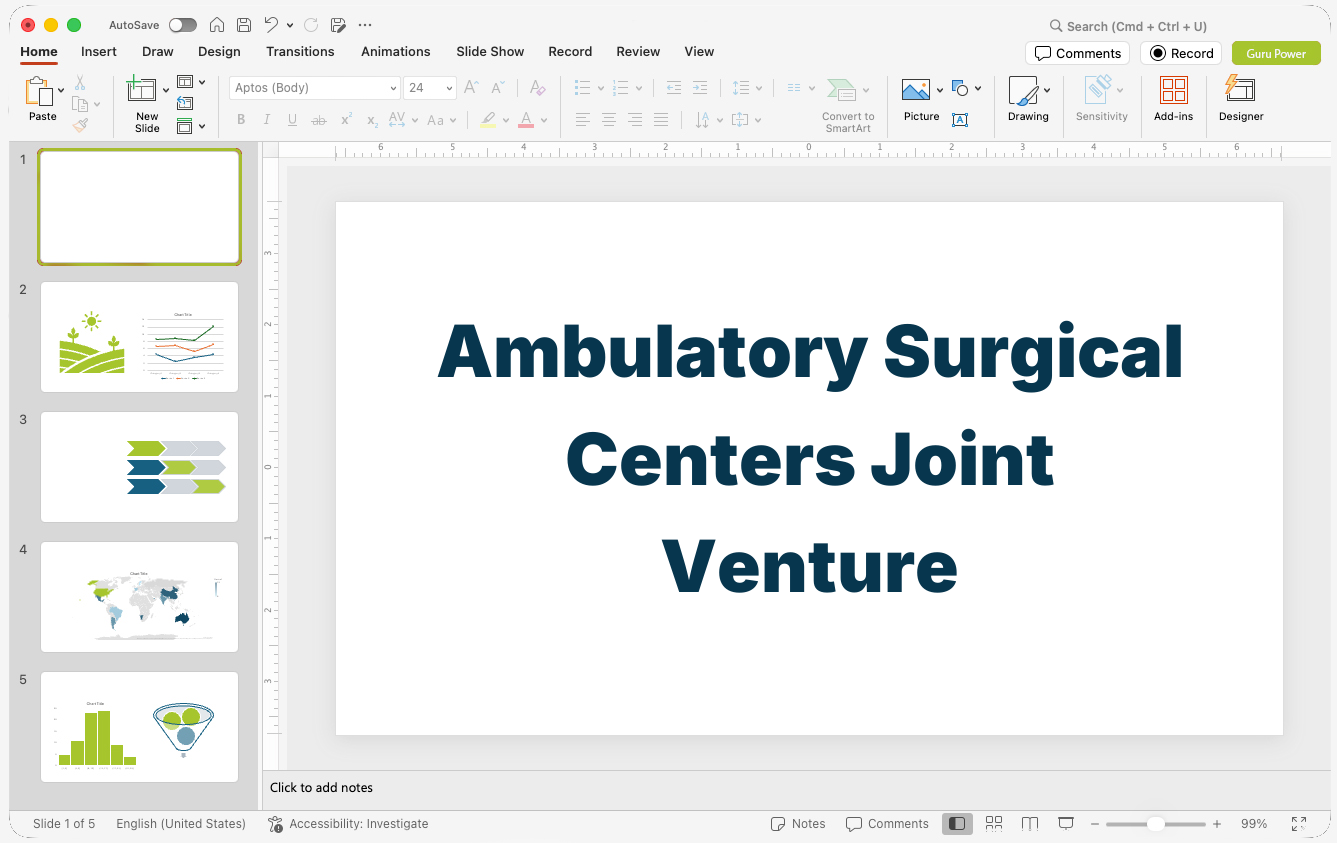
Ambulatory Surgical Centers Joint Venture Proposal Presentation
Primary Audience: Health system executives and hospital board members.
Purpose: Secure institutional approval and capital allocation for joint-venture outpatient facilities.
Description: This PowerPoint slide deck outlines the strategic partnership model between independent physician groups and health systems. The presentation details procedural volume shifts, shared equity breakdown, and projected EBITDA impact. Visual charts illustrate clinical governance models and Medicare reimbursement advantages. The final slides address risk mitigation and local market capacity.
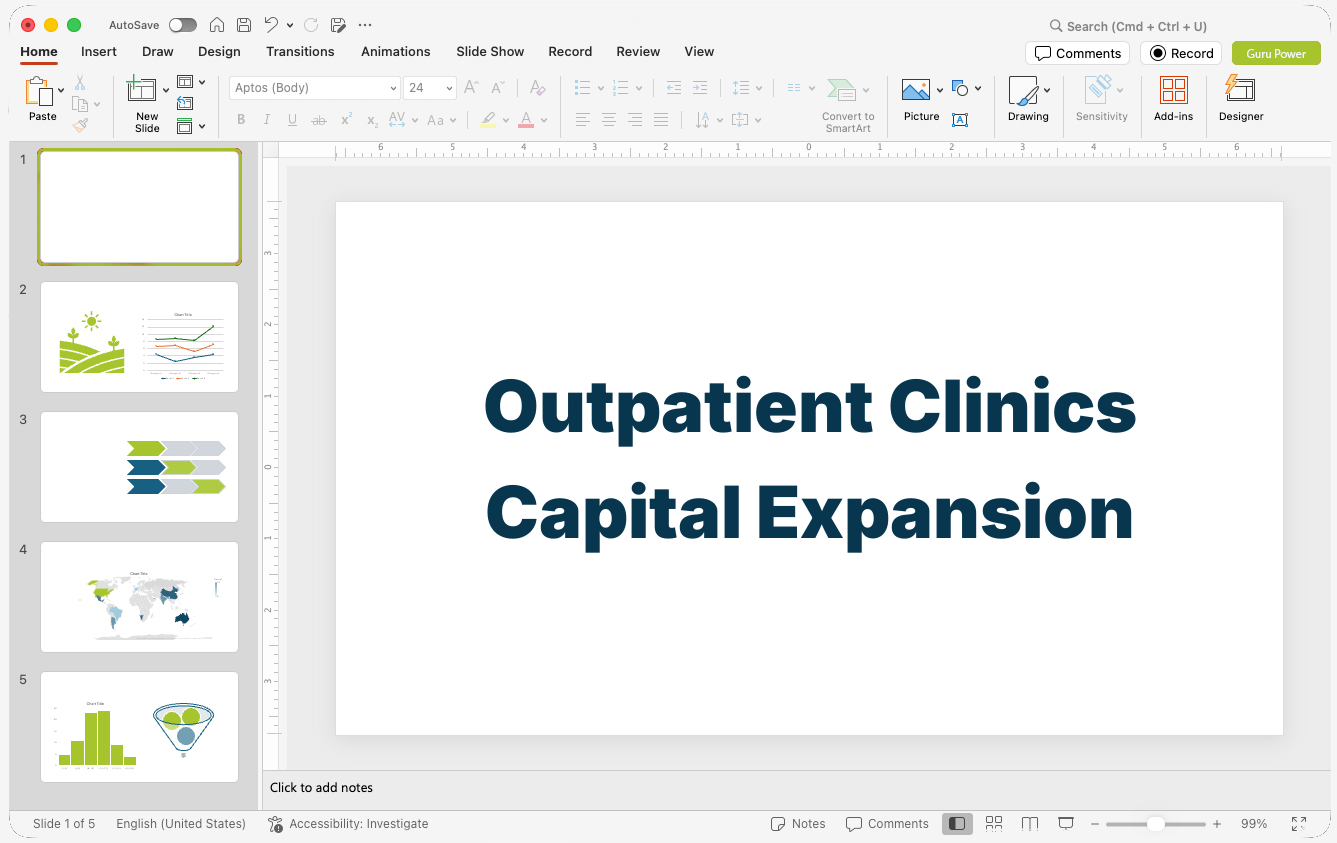
Outpatient Clinics Capital Expansion Pitch-Deck
Primary Audience: Healthcare private equity investors and commercial lenders.
Purpose: Obtain debt financing or equity funding for new outpatient facility construction.
Description: This presentation deck details the financial model for multi-site facility expansion. It features demographic patient analysis, service-line margin breakdowns, and capital expenditure timelines. Detailed Slides demonstrate projected return on invested capital across core specialties including orthopedics and gastroenterology. Clear visual layouts present payer mix projections and debt coverage ratios.
Same-Day Surgery Centers Physician Recruitment Slide-Deck
Primary Audience: Surgical specialists and medical group practice partners.
Purpose: Attract high-volume surgeons to buy equity or bring block time to the facility.
Description: This presentation highlights operational efficiency, block time scheduling, and surgical suite equipment capabilities. Visual layouts detail physician equity ownership structures, historical case turnaround times, and distribution histories. The slide-deck contrasts outpatient facility workflows against traditional inpatient hospital delays. Clinical quality metrics and nursing staff ratios are featured prominently.
Ambulatory Care Facilities Board Operations Review Presentation
Primary Audience: Board of directors and executive leadership teams.
Purpose: Align leadership on quarterly operational outcomes and clinical performance metrics.
Description: This presentation summarizes quarterly financial yield, patient volume by specialty, and operational cost containment initiatives. Standardized PowerPoint slides evaluate capacity utilization, staffing costs, and supply chain expenses. Visual dashboards track key performance indicators against annual budget targets. Operational bottlenecks and regulatory compliance updates are highlighted for board review.
Outpatient Medical Centers Certificate of Need Presentation
Primary Audience: State health planning boards and regulatory committees.
Purpose: Gain regulatory authorization to build or expand outpatient care capacity.
Description: This factual presentation proves community medical necessity and regional healthcare access gaps. The slide-deck maps patient travel times, local population demographics, and utilization trends of existing facilities. Visual charts demonstrate compliance with state health planning standards and charity care commitments. Data structures demonstrate minimal adverse economic impact on safety-net institutions.
Urgent Care Clinics Payer Contracting Presentation
Primary Audience: Commercial health insurance medical directors and network managers.
Purpose: Negotiate favorable fee schedules and inclusion in preferred provider networks.
Description: This slide presentation demonstrates clinical quality benchmarks, cost-of-care savings, and emergency department diversion statistics. Graphs show average patient wait times, door-to-provider metrics, and patient satisfaction scores. The presentation highlights accredited clinical protocols and multi-specialty triage capabilities. Clear data tables demonstrate overall cost reductions for covered patient populations.
Day Surgery Units Accreditation Compliance Presentation
Primary Audience: Surveyors from AAAHC, The Joint Commission, or CMS.
Purpose: Demonstrate complete adherence to clinical safety and facility operational standards.
Description: This presentation details quality management protocols, infection control statistics, and life safety compliance logs. Systematic visual slides outline governance documentation, credentialing verification, and peer review structures. Process flowcharts illustrate patient safety event reporting and emergency transfer protocols. The material provides audit-ready visual evidence for regulatory accreditation renewal.
Ambulatory Surgical Centers Revenue Cycle Strategy Presentation
Primary Audience: Revenue cycle managers and clinical operations directors.
Purpose: Standardize billing, prior authorization, and collection workflows across clinical sites.
Description: This operational slide-deck analyzes accounts receivable days, denial trends by payer, and prior authorization bottlenecks. Visual process diagrams outline point-of-service collection protocols and coding accuracy audit results. Slides establish standardized performance targets for billing departments across all facility locations. The presentation includes clear action plans for improving commercial claim clean rates.
Outpatient Clinics Service Line Expansion Deck
Primary Audience: Internal clinical steering committees and medical directors.
Purpose: Approve the addition of new surgical or diagnostic specialties to the clinic.
Description: This PowerPoint presentation evaluates the market demand and equipment requirements for adding new procedural capabilities. Financial modeling slides present payback periods, specialized staffing costs, and facility modification requirements. Competitive analysis diagrams detail local market saturation and referral network opportunities. Strategic recommendation slides provide clear phased launch schedules.
Same-Day Surgery Centers Patient Experience Review Presentation
Primary Audience: Facility administrators, nursing directors, and patient access leads.
Purpose: Implement operational changes to increase patient satisfaction and intake efficiency.
Description: This slide-deck tracks post-procedure survey results, online reputation scores, and intake wait times. Graphical layouts break down feedback across pre-op registration, nursing care, and discharge instructions. Operational transition slides outline digital check-in software deployment and patient communication protocols. Key targets demonstrate measurable improvements in patient retention and physician referrals.
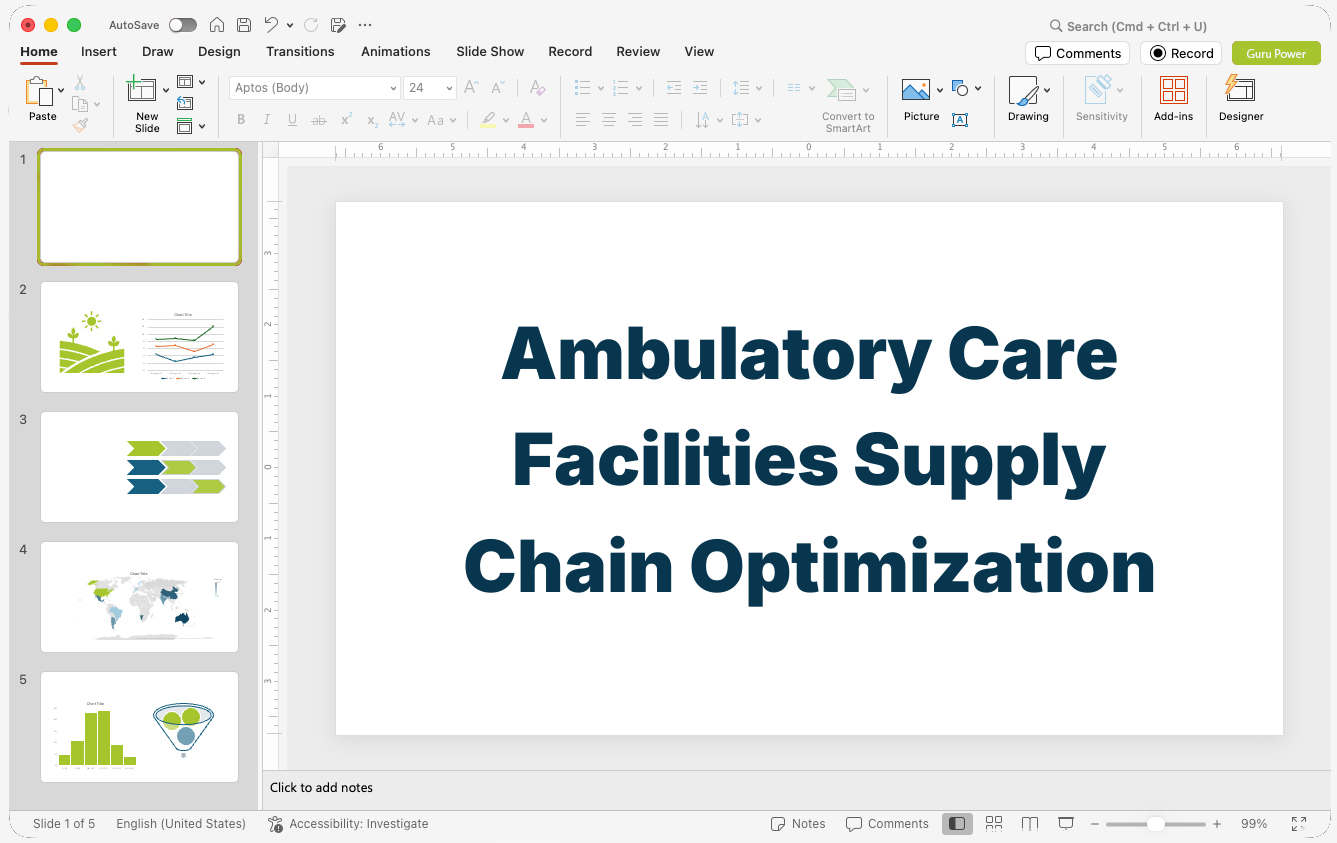
Ambulatory Care Facilities Supply Chain Optimization Deck
Primary Audience: Procurement committee members and materials management teams.
Purpose: Reduce surgical preference card costs and standardize implant pricing.
Description: This data-driven presentation outlines vendor consolidation opportunities, implant pricing variances, and inventory turnover ratios. Visual matrix slides compare physician preference card costs across identical surgical procedures. Financial charts highlight annual savings from bulk purchasing contracts and Group Purchasing Organization (GPO) utilization. The presentation sets target metrics for inventory management reduction.
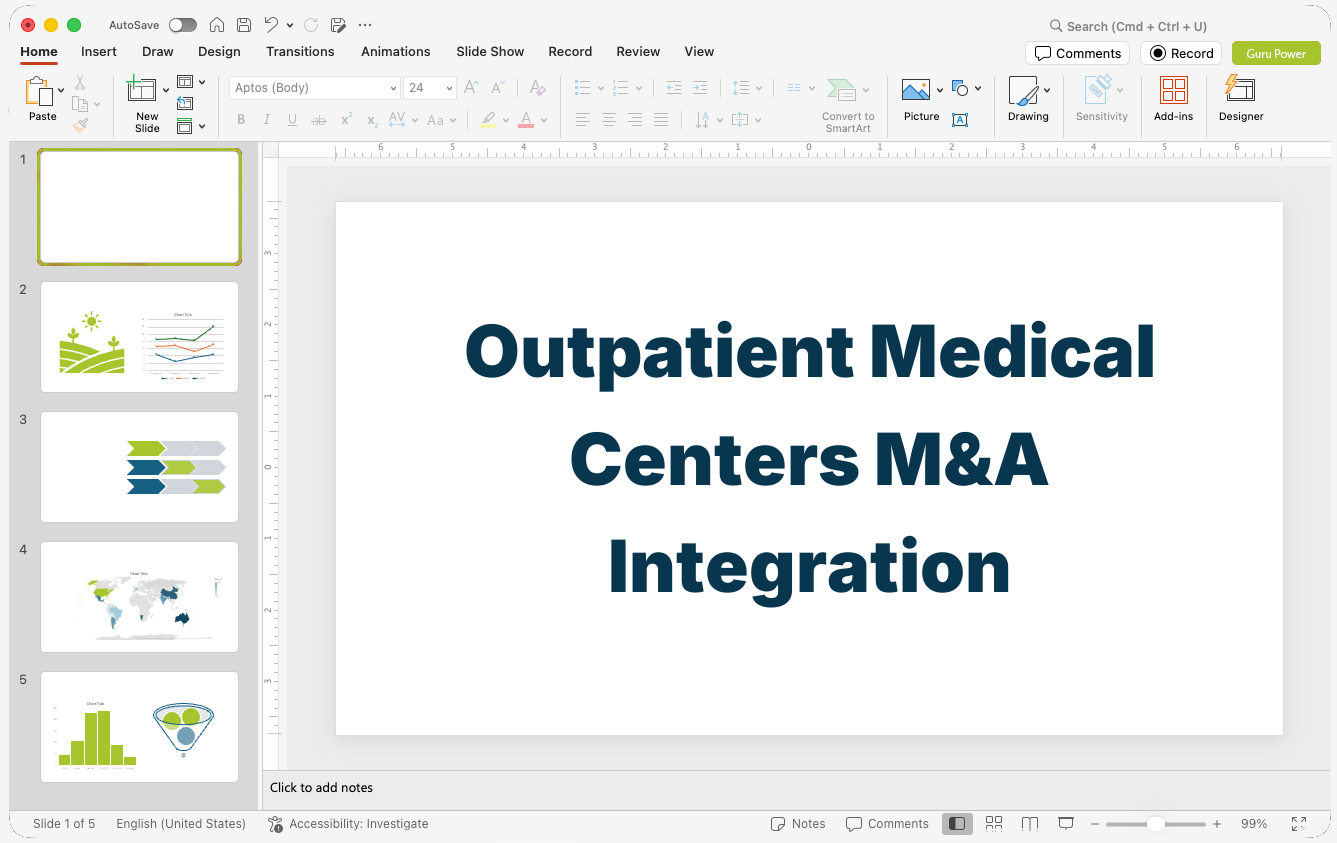
Outpatient Medical Centers M&A Integration Pitch-Deck
Primary Audience: Acquired clinical practice leaders and incoming administrative staff.
Purpose: Streamline corporate integration following an outpatient practice acquisition.
Description: This strategic presentation details the post-acquisition integration roadmap, corporate alignment, and operational changes. Visual timelines outline electronic health record (EHR) migration, payroll transition, and clinical workflow standardization. Slides introduce combined executive leadership and shared administrative support structures. The presentation reinforces organizational mission and performance goals.
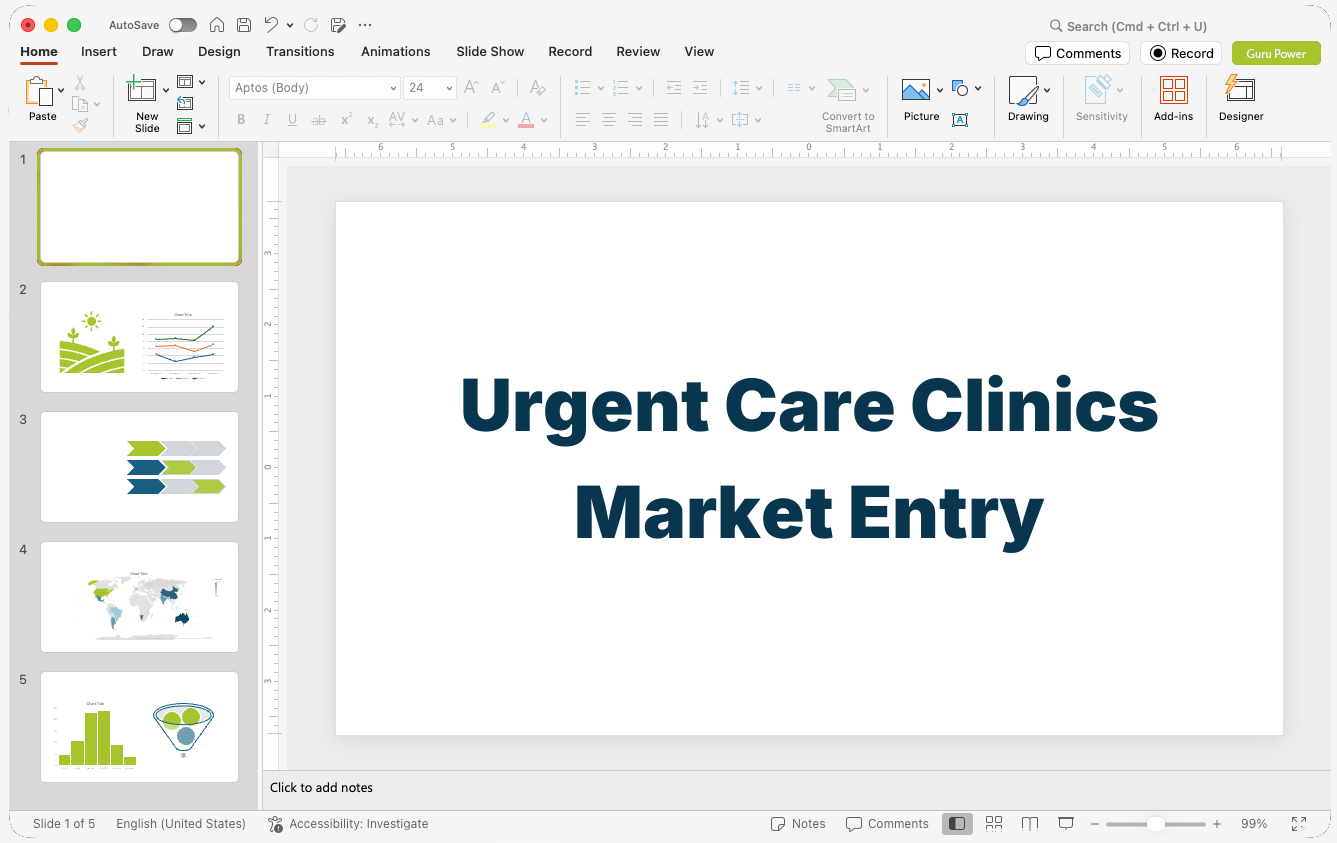
Urgent Care Clinics Market Entry Pitch-Deck
Primary Audience: Real estate developers, municipal zoning boards, and local health partners.
Purpose: Secure retail site location approvals and establish local healthcare referral networks.
Description: This presentation analyzes local retail footprint traffic, consumer demographics, and primary care shortages in target zip codes. Visual mapping slides showcase proximity to residential developments and urgent care access points. Architectural concept slides showcase facility footprint and patient access flow. The deck establishes community value through accessible urgent healthcare delivery.
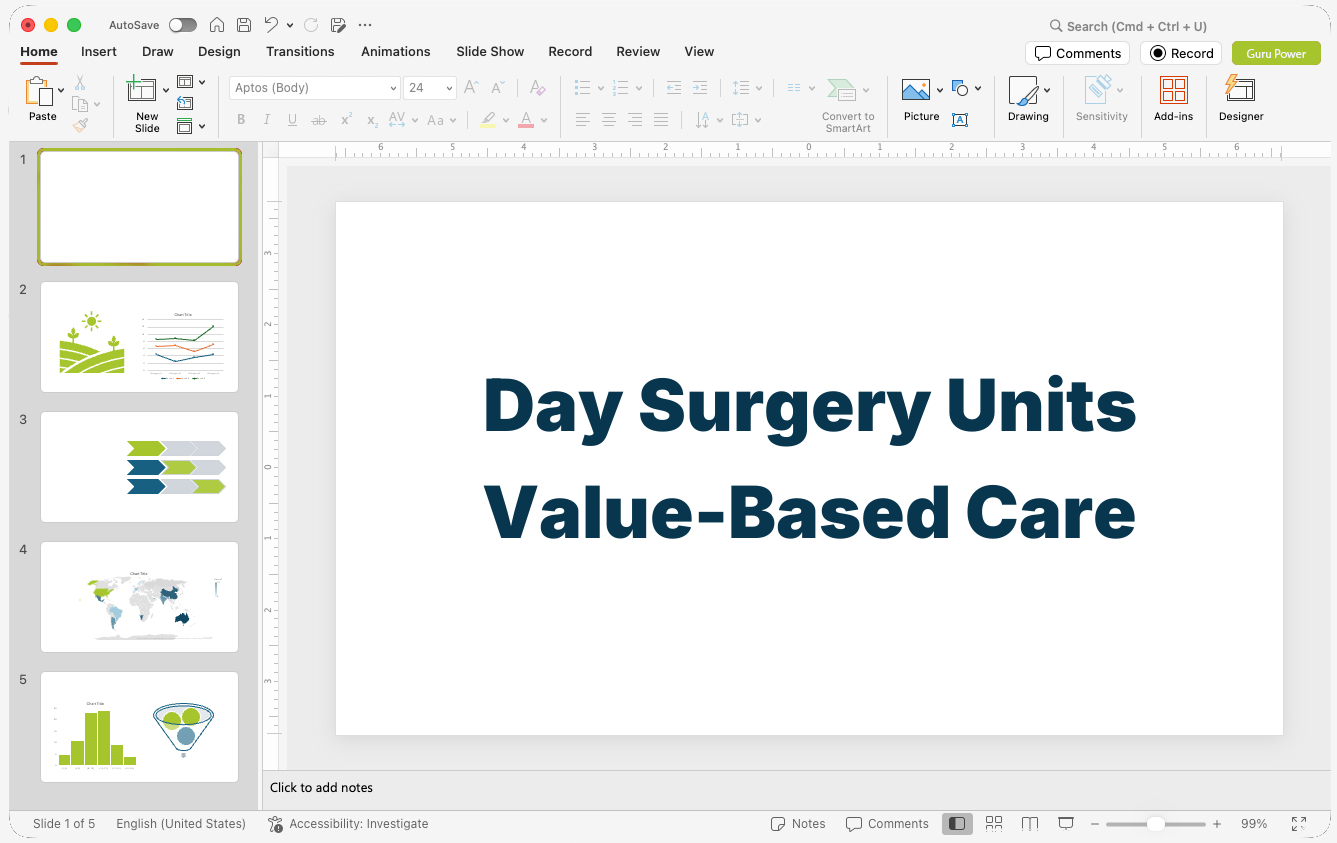
Day Surgery Units Value-Based Care Proposal Presentation
Primary Audience: Accountable Care Organization (ACO) directors and risk-bearing health systems.
Purpose: Form bundled payment arrangements for high-volume outpatient surgical procedures.
Description: This analytical slide-deck details historical readmission rates, total episode-of-care costs, and clinical outcomes for bundled surgical procedures. Comparative visual charts contrast facility costs against regional inpatient hospital benchmarks. Proposed gain-sharing metrics and quality performance tiers are modeled across dedicated slides. The presentation establishes shared financial incentives for cost containment.
Your PowerPoint, Google Slide and KeyNote Strategy, Story and Design Professionals
Presentation Gurus delivers end-to-end design, narrative structuring, and visual data organization for healthcare operators. We transform complicated Medicare reimbursement charts, procedural volume trends, and accreditation workflows into polished visual layouts. Every presentation maintains strict corporate branding, typography standards, and information hierarchy to establish immediate credibility with institutional investors and health system boards. Our team handles the visual execution so your leadership team can focus on clinical strategy and deal execution. Partner with Presentation Gurus to transform your complex healthcare operational data into persuasive PowerPoint decks. Contact us today to start your presentation project.
Ready ToGet Started?
Questions & Answers
Outpatient & Ambulatory Care Centers Presentations FAQs
Does our industry need a Presentation or a Pitch Deck?
The terms are frequently used interchangeably, but they serve different strategic purposes. A pitch deck is a highly visual, persuasive tool designed to secure a strategic commitment or investment. A standard presentation is an informative, detailed document structured to align stakeholders and share data.
Will our team receive the fully editable source file?
Yes. Unlike graphic designers who deliver flat PDFs or JPEGs, Presentation Gurus delivers the native, fully editable presentation file (.pptx, .key, etc.) so your team can make last-minute text edits on the fly, or update the presentation later as details change.
How quickly can your agency redesign a capital expenditure pitch-deck for an ambulatory facility expansion?
Standard presentation design projects are typically delivered within two to three weeks, depending on total slide volume and data complexity. We also accommodate expedited timelines for upcoming board meetings or Certificate of Need filings. Our process includes initial narrative alignment, visual structure staging, and iterative design reviews.
We have sensitive business information. Can you work under an NDA?
Virtually all of our client work is done under an NDA. We have a basic NDA included with our presentation work order, plus an enhanced, expanded non-disclosure agreement available whenever a project calls for it.
What visual format works best for presenting ASC joint venture proposals to hospital boards?
Hospital boards require structured, low-friction financial layouts that contrast inpatient capital costs against outpatient margin potential. Presentations should lead with regulatory clearance, ownership governance models, and procedural volume migration forecasts. Visual diagrams illustrating governance balance, clinical quality safeguards, and Medicare reimbursement impact build institutional confidence faster than text-dense paragraphs.
How does the collaboration process work?
Everything happens online. Every meeting is a Microsoft Teams call or similar virtual environment where we can share desktops and information in real time. Revision meetings and discovery calls are always scheduled in the morning, so by noon we can begin work on tasks for the next revision meeting.
How long does it take to get a presentation designed?
If your team needs a complete presentation by 9:00 AM the next day, we can meet that deadline. Most projects take 10 – 15 days, providing we have all the information. Pricing is also based on slide complexity and speed — a basic slide deck with a 15-day delivery costs much less than a premium slide deck delivered the next morning.
What does Outpatient & Ambulatory Care Centers Presentations presentation design cost?
Pricing is simple and clear. A basic slide design or redesign begins at $49 per slide. Premium presentation design, which includes copywriting and basic storytelling, starts at $79 per slide. Custom presentations involving strategy, copywriting and custom graphics are quoted based on your specifications. See complete pricing details here.
Can you design custom slide layouts that reflect specialized clinical quality metrics?
Yes. We regularly design custom data tables, dashboard layouts, and visual infographics for metrics like Ambulatory Surgical Center Quality Reporting (ASCQR) scores, infection rates, patient throughput times, and transfer-to-hospital rates. We convert raw clinical metrics into standardized visual indicators that board members and physician partners can evaluate immediately.
How do you handle HIPAA and sensitive clinical data in slide presentations?
We enforce strict data privacy standards by working exclusively with fully anonymized, aggregated operational data or synthetic proxy figures provided by your team. No Protected Health Information (PHI) is ever ingested, displayed, or stored. Visual charts showcase overall volume trends, case mix indices, and financial yield without compromising patient privacy or regulatory compliance guidelines.
Presentation Gurus' research identifies 15 locations with active Outpatient & Ambulatory Care Centers operations, including Houston, TX, Nashville, TN, and Dallas, TX.
Care delivery continues to shift toward outpatient environments across the country, driven by patient preferences and specialized clinical capabilities. In Texas, Houston, TX anchors massive outpatient surgical expansion around the Texas Medical Center, while Dallas, TX serves as a corporate hub for management companies like United Surgical Partners International. Similar corporate leadership sits in Nashville, TN, where major operators including HCA Healthcare and SCA Health partners guide national ambulatory surgery center networks. These operators work closely with partners across Hospital Systems & Healthcare Networks to coordinate community care transitions.
Metropolitan health systems are actively expanding their physical footprints into surrounding neighborhoods. In Atlanta, GA and Charlotte, NC, regional population growth fuels competitive construction of suburban outpatient facilities. Academic medical systems in Philadelphia, PA are also extending ambulatory networks outside traditional hospital campuses. In Chicago, IL, outpatient networks sit alongside healthcare private equity sponsors investing in specialized clinical programs. These expansions rely heavily on connected digital records supported by Healthcare IT & Electronic Health Records (EHR) systems to share data across distributed clinical teams.
Demographic trends create distinct local care requirements in the South and Southwest. High population inflows in Phoenix, AZ drive steady growth in same-day surgical centers and urgent care sites, while investments in Orlando, FL focus on comprehensive ambulatory access. On the Gulf Coast, Tampa, FL supports high surgical volumes in outpatient orthopedics and ophthalmology tailored to an older demographic. Recovering patients frequently transition from these centers directly into specialized programs managed by Physical Therapy & Rehabilitation Networks and comprehensive Mental Healthcare & Behavioral Health Services.
Physician-led models and complex operating environments define several major western and northeastern markets. Independent physician-owned facilities thrive across Los Angeles, CA and San Diego, CA, particularly in multispecialty and orthopedic surgery. Joint ventures between physicians and health systems are equally active in Denver, CO. Meanwhile, providers in New York, NY navigate state certificate-of-need requirements to develop ambulatory surgical centers and multi-specialty practices. In Boston, MA, clinical research drives adoption of novel day-surgery technologies. These facilities work with partners in Biotechnology Research, source advanced tools from Medical Device & Diagnostics Manufacturing, and collaborate with teams in Clinical Research Organizations (CROs) and Contract Development & Manufacturing (CDMO) to bring therapies into outpatient settings. Our presentation design team helps healthcare organizations present their network strategies, operational metrics, and growth plans to leadership teams and investors.
Outpatient & Ambulatory Care Centers Presentations By the Numbers
- Emergency and other outpatient care centers in the United States generated over 218 billion dollars in industry revenue. (Emergency & Other Outpatient Care Centers in the US Industry Analysis, 2026 – IBISWorld)