
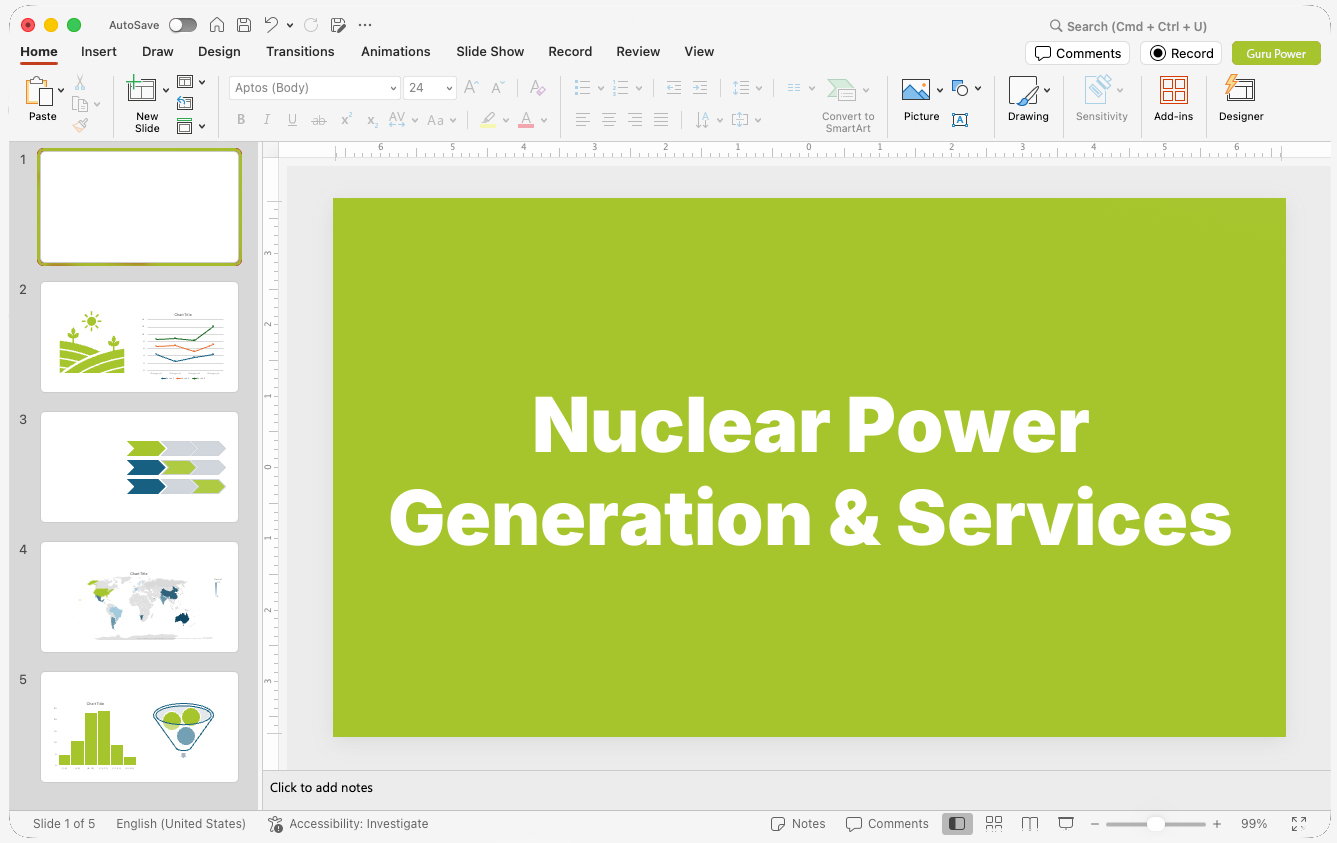
When Nuclear Industry Decision-Makers Need Strategic Presentations Addressing Business Outcomes
Nuclear Power Generation & Services Presentation Design is the strategic development of executive slide decks, technical visual representations, and regulatory communication frameworks specifically crafted for commercial nuclear utilities, reactor vendors, and field service contractors.
Presentation Gurus serves as the specialized presentation design partner for nuclear energy operators, equipment manufacturers, and service providers. Executives rely on precise communication during complex licensing cycles, capital raises, and board meetings. Our team builds executive-ready assets, including the Nuclear Energy Investment Pitch Deck, the Reactor Fleet Outage Execution Slide Deck, and the Nuclear Regulatory Commission Compliance Presentation. Readers looking to hire a dedicated presentation team receive structured narrative design, accurate data visualization, and rigorous content control. Every PowerPoint deck, strategic slide deck, and key presentation is developed to communicate complex nuclear engineering realities directly to institutional investors, public utility commissions, and internal oversight committees.
Why Nuclear Power Generation & Services Presentations Need Professional Presentation Design
The nuclear energy sector demands absolute clarity, yet standard decks obscure operational reality. Most executive decks rely on generic visuals that fail to capture capital intensity, regulatory nuances, or long-term risk management. This lack of strategic positioning delays project approvals, confuses capital partners, and compromises stakeholder trust. Strategy-led presentation structure aligns core technical metrics with clear financial and operational goals. Data visualizer frameworks convert complex engineering models into clear executive decisions. Safety case files and regulatory timelines become transparent roadmaps. Investors evaluate capital requirements accurately while regulators track compliance frameworks without friction. The measurable outcome is reduced approval cycles, clearer board alignment, and strengthened investor confidence.
How Working With Us Works
From First Conversation To Finished Deck
Company
Meet JR, our founder. Fortune 500s, SMBs, startups — he’s built presentations for all of them with his team for the past 30 years, and he’s ready to build yours.
Service
Find your fit. We match the right service and scope to your audience, your goals, and your deadline, from 24-hour service to a 15-day turnaround.
Cost
Know the number upfront. Transparent, flat pricing before we start — no surprises, no hidden hours. All from $49 per slide.
Get Started
Tell us about your presentation project. It will take two minutes and we’ll get back to you on our next business day.










12 Essential Presentation Types for Nuclear Power Generation & Services
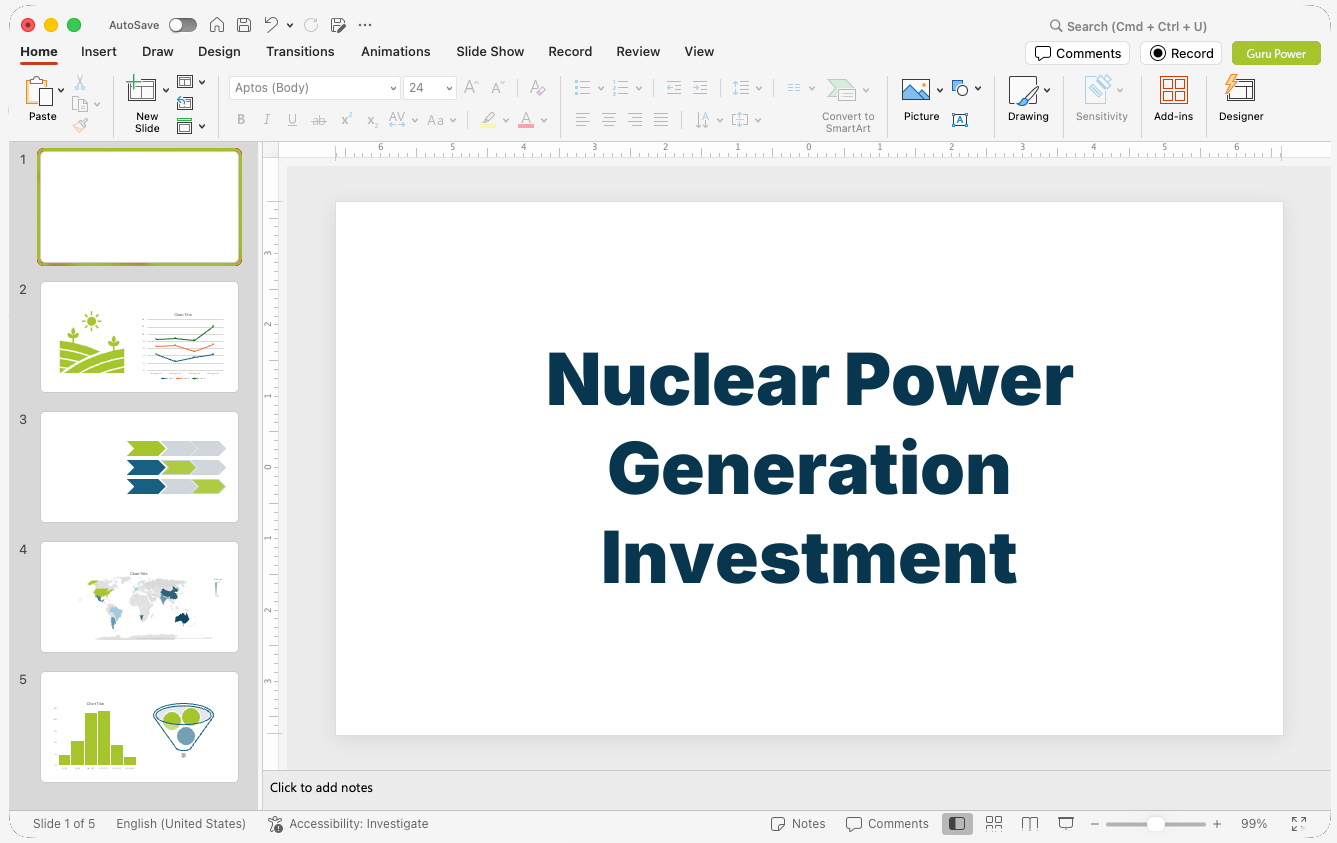
Nuclear Power Generation Investment Pitch-Deck
Primary Audience: Private equity firms, institutional investors, and infrastructure funds..
Purpose: Secure capital for plant acquisitions, uprates, or technology deployments..
Description: This Nuclear Power Generation Investment Pitch-Deck outlines plant operational economics, revenue stability, and long-term asset value. The presentation details capacity factors, power purchase agreements, and capital expenditure roadmaps. Investors evaluate cash flow projections and risk mitigation frameworks through precise visual charts. The presentation establishes clear business cases for large-scale energy infrastructure funding.
Nuclear Energy Regulatory Compliance Slide-Deck
Primary Audience: Nuclear Regulatory Commission officials and state utility commissioners..
Purpose: Demonstrate full adherence to safety codes and operational requirements..
Description: The Nuclear Energy Regulatory Compliance Slide-Deck delivers detailed updates on plant maintenance, safety system audits, and environmental impacts. Clear visual timelines track license renewal schedules and corrective action programs. Industry requirements mandate exact reporting of operational limits and safety margins. This slide presentation reduces oversight friction by organizing complex compliance data logically.
Atomic Power Station Outage Execution Presentation
Primary Audience: Plant management, maintenance contractors, and regional grid operators..
Purpose: Align operational teams on refuel and maintenance shutdown schedules..
Description: This Atomic Power Station Outage Execution Presentation details critical-path tasks for refueling and plant overhaul windows. Critical timelines, contractor work scopes, and safety check protocols are visually mapped to avoid schedule creep. Operational teams track milestone progress and resource allocations across all engineering disciplines. The deck minimizes costly plant downtime through precise task coordination.
Nuclear Utilities Board Capital Allocation Presentation
Primary Audience: Board of directors and executive leadership teams..
Purpose: Obtain budget approvals for long-term plant life extensions and equipment upgrades..
Description: The Nuclear Utilities Board Capital Allocation Presentation evaluates return on investment for major capital uprates and steam generator replacements. Strategic financial metrics are paired with technical degradation models to justify expenditure. Visual risk matrices outline consequences of deferred maintenance versus proactive investment. Directors gain clear context for multi-million dollar asset management decisions.
Reactor Services Technical Vendor Pitch-Deck
Primary Audience: Nuclear utility procurement officers and engineering directors..
Purpose: Win long-term maintenance, inspection, and component servicing contracts..
Description: This Reactor Services Technical Vendor Pitch-Deck showcases specialized field engineering, robotic inspection, and tooling capabilities. The deck highlights past outage performance metrics, safety records, and specialized personnel certifications. Case studies demonstrate past outage duration reductions and cost savings achieved for operating fleets. Procurement teams evaluate vendor reliability through structured service capability matrices.
Small Modular Reactor Deployment Slide-Deck
Primary Audience: Municipal power companies, industrial off-takers, and regional utilities..
Purpose: Promote commercial adoption and site selection for advanced reactor designs..
Description: The Small Modular Reactor Deployment Slide-Deck illustrates factory fabrication benefits, passive safety features, and modular construction schedules. Detailed graphics contrast capital requirements and construction timelines against traditional gigawatt-scale facilities. Off-takers analyze levelized cost of electricity and integration options for industrial heat or power. The deck accelerates commercial negotiation cycles for novel nuclear technologies.
Nuclear Fuel Cycle Management Presentation
Primary Audience: Fuel procurement managers and financial planning executives..
Purpose: Optimize enrichment, fabrication, and supply chain contracting strategies..
Description: This Nuclear Fuel Cycle Management Presentation provides market forecasts for uranium spot prices, conversion services, and fabrication availability. Visual supply chain maps highlight geopolitical risks and inventory hedging strategies. Procurement leaders evaluate long-term fuel burnup efficiencies and spent fuel storage requirements. The presentation supports strategic purchasing decisions in volatile commodity markets.
Atomic Power Decommissioning Strategy Slide-Deck
Primary Audience: State environmental agencies, local community leaders, and decommissioning trust fund trustees..
Purpose: Present safe dismantling protocols, environmental remediation, and fund allocation plans..
Description: The Atomic Power Decommissioning Strategy Slide-Deck maps the multi-year timeline for facility dismantling, spent fuel transfer, and site restoration. Financial charts detail decommissioning trust fund adequacy against projected radiological remediation costs. Stakeholders review safety protocols for dry cask storage and site release criteria. The presentation builds local consensus and regulatory trust during asset retirement.
Nuclear Operations Safety Culture Review Presentation
Primary Audience: Plant personnel, shift supervisors, and internal safety auditors..
Purpose: Reinforce human performance standards and corrective action reporting protocols..
Description: This Nuclear Operations Safety Culture Review Presentation analyzes operational incident trends, near-miss reporting, and procedure adherence metrics. Clear visual dashboards track human performance indicators and station operating experience lessons learned. Plant leadership uses the deck to drive accountability and continuous safety improvement across operational crews. The framework reinforces non-negotiable nuclear safety principles.
Nuclear Technology Advanced Research Slides
Primary Audience: Department of Energy reviewers, national laboratory partners, and academic grant committees..
Purpose: Secure research grants and commercialization funding for advanced nuclear fuels..
Description: The Nuclear Technology Advanced Research Slides illustrate experimental data, fuel cladding performance, and advanced neutronic simulations. Detailed charts highlight material resistance to extreme temperature and radiation environments. Review committees assess research methodology, technology readiness levels, and commercial viability. The presentation translates laboratory breakthroughs into fundable commercial energy programs.
Nuclear Utilities Power Purchase Agreement Pitch-Deck
Primary Audience: Hyperscale data center operators and energy-intensive industrial customers..
Purpose: Execute long-term clean baseload power off-take agreements..
Description: This Nuclear Utilities Power Purchase Agreement Pitch-Deck details 24/7 carbon-free power delivery models tailored for high-load commercial clients. Graphics highlight reliability metrics, grid interconnect availability, and price hedging structures. Customers evaluate environmental attribute credits alongside firm capacity guarantees. The pitch deck secures multi-year commercial revenue streams for nuclear generating assets.
Reactor Services Emergency Preparedness Presentation
Primary Audience: County emergency directors, first responders, and state hazard management teams..
Purpose: Coordinate emergency response plans and off-site protective actions..
Description: The Reactor Services Emergency Preparedness Presentation outlines evacuation zone planning, communications channels, and joint inter-agency response protocols. Visual maps delineate planning zones, radiation monitoring stations, and emergency facility locations. Public safety officials review training schedules and drill evaluation metrics. The deck ensures seamless coordination between utility teams and public safety authorities.
Your PowerPoint, Google Slide and KeyNote Strategy, Story and Design Professionals
Presentation Gurus converts technical engineering data into persuasive visual stories for nuclear power operators and service vendors. We establish strict visual hierarchies, accurate regulatory mapping, and clear financial modeling across every pitch deck and executive PowerPoint presentation. Operational workflows, outage management timelines, and waste management strategies are structured to eliminate ambiguity and reinforce market leadership. Our team maintains absolute brand consistency across every digital asset and print layout. Contact Presentation Gurus today to schedule a consultation and elevate your next strategic presentation.
Ready ToGet Started?
Questions & Answers
Nuclear Power Generation & Services Presentations FAQs
What does Nuclear Power Generation & Services Presentations presentation design cost?
Pricing is simple and clear. A basic slide design or redesign begins at $49 per slide. Premium presentation design, which includes copywriting and basic storytelling, starts at $79 per slide. Custom presentations involving strategy, copywriting and custom graphics are quoted based on your specifications. See complete pricing details here.
How does the collaboration process work?
Everything happens online. Every meeting is a Microsoft Teams call or similar virtual environment where we can share desktops and information in real time. Revision meetings and discovery calls are always scheduled in the morning, so by noon we can begin work on tasks for the next revision meeting.
How long does it take to get a presentation designed?
If your team needs a complete presentation by 9:00 AM the next day, we can meet that deadline. Most projects take 10 – 15 days, providing we have all the information. Pricing is also based on slide complexity and speed — a basic slide deck with a 15-day delivery costs much less than a premium slide deck delivered the next morning.
How do you maintain confidentiality for proprietary nuclear technology visuals?
Strict non-disclosure agreements are executed prior to data sharing. All working files are processed on secure networks, and proprietary system schematics can be stylized or abstracted to protect sensitive trade secrets while retaining business context.
How do you handle technical nuclear engineering data in an executive slide deck?
Technical data is converted into structured visual infographics, clear system diagrams, and simplified executive charts. Raw engineering metrics are presented alongside operational contexts, allowing non-technical board members and institutional investors to understand capital risks, safety margins, and performance output quickly.
Can your team assist with Nuclear Regulatory Commission (NRC) meeting presentations?
Yes, we structure regulatory decks to highlight safety compliance, risk mitigation, and license extension schedules clearly. Content is organized around regulatory requirements to minimize ambiguity, highlight quality assurance standards, and streamline interactions with oversight authorities.
Will our team receive the fully editable source file?
Yes. Unlike graphic designers who deliver flat PDFs or JPEGs, Presentation Gurus delivers the native, fully editable presentation file (.pptx, .key, etc.) so your team can make last-minute text edits on the fly, or update the presentation later as details change.
What is the typical turnaround time for a nuclear energy investor pitch deck?
A complete strategic deck typically requires two to three weeks, depending on data complexity and content readiness. Accelerated timelines are available for time-sensitive capital raises, regulatory deadlines, or emergency board reviews.
Does our industry need a Presentation or a Pitch Deck?
The terms are frequently used interchangeably, but they serve different strategic purposes. A pitch deck is a highly visual, persuasive tool designed to secure a strategic commitment or investment. A standard presentation is an informative, detailed document structured to align stakeholders and share data.
We have sensitive business information. Can you work under an NDA?
Virtually all of our client work is done under an NDA. We have a basic NDA included with our presentation work order, plus an enhanced, expanded non-disclosure agreement available whenever a project calls for it.
Presentation Gurus' research identifies 15 locations with active Nuclear Power Generation & Services operations, including Charlotte, NC, Atlanta, GA, and Pittsburgh, PA.
Power generation facilities and engineering suppliers form a tightly linked network across the country. In Charlotte, NC, Duke Energy maintains its corporate center alongside engineering offices for major service vendors. Further south, Atlanta, GA serves as home base for Southern Company and the Institute of Nuclear Power Operations. Regional generation oversight also runs through Birmingham, AL, where Southern Nuclear Operating Company directs multiple plant sites. Utilities in neighboring territories manage critical base-load infrastructure as well, including Dominion Energy in Richmond, VA, historical utility headquarters and nearby fuel facilities in Columbia, SC, and the Tennessee Valley Authority command in Chattanooga, TN.
Core plant design, precision component manufacturing, and primary research cluster around distinct technical hubs. In Pittsburgh, PA, Westinghouse Electric Company runs its global headquarters and main engineering operations. Specialized fabrication centers thrive in Lynchburg, VA with Framatome and BWX Technologies, while fuel fabrication and reactor services operate through GE Vernova Hitachi Nuclear Energy in Wilmington, NC. Advanced technical work and federal research tie deeply into local ecosystems, visible through suppliers around Oak Ridge National Laboratory in Knoxville, TN and federal reactor programs at Idaho National Laboratory near Idaho Falls, ID.
Fleet operators maintain massive footprints out west and in major metro centers. Constellation Energy directs the nation’s largest commercial fleet from Chicago, IL. In the Pacific Northwest, Energy Northwest runs the Columbia Generating Station alongside fuel manufacturing facilities in Richland, WA. Out southwest, Arizona Public Service operates the Palo Verde generating station from Phoenix, AZ. National policy, safety standards, and program oversight originate in Washington, DC through the Nuclear Regulatory Commission, the Department of Energy, and the Nuclear Energy Institute.
Complex commercial tenders and stakeholder communications often require structured documentation strategies, outlined in our guide on the High-Ticket Bespoke Package Proposal. These operational requirements frequently intersect with broader power networks, such as Renewable Energy Development (Solar, Wind, Hydro), Clean Tech & Carbon Capture Solutions, and Energy Pipeline & Storage (Midstream). In addition, plant construction and continuous maintenance rely heavily on Water & Wastewater Utilities, specialized Environmental & Waste Management Services, regional Warehousing & Distribution Centers, coordinated Third-Party Logistics (3PL) & Freight Forwarding, and heavy component transport by Maritime Freight & Ocean Shipping Lines.
Nuclear Power Generation & Services Presentations By the Numbers
- As of March 2026, the United States operated 96 commercial nuclear reactors across 57 nuclear power plants in 28 states. (U.S. nuclear industry – U.S. Energy Information Administration (EIA))