
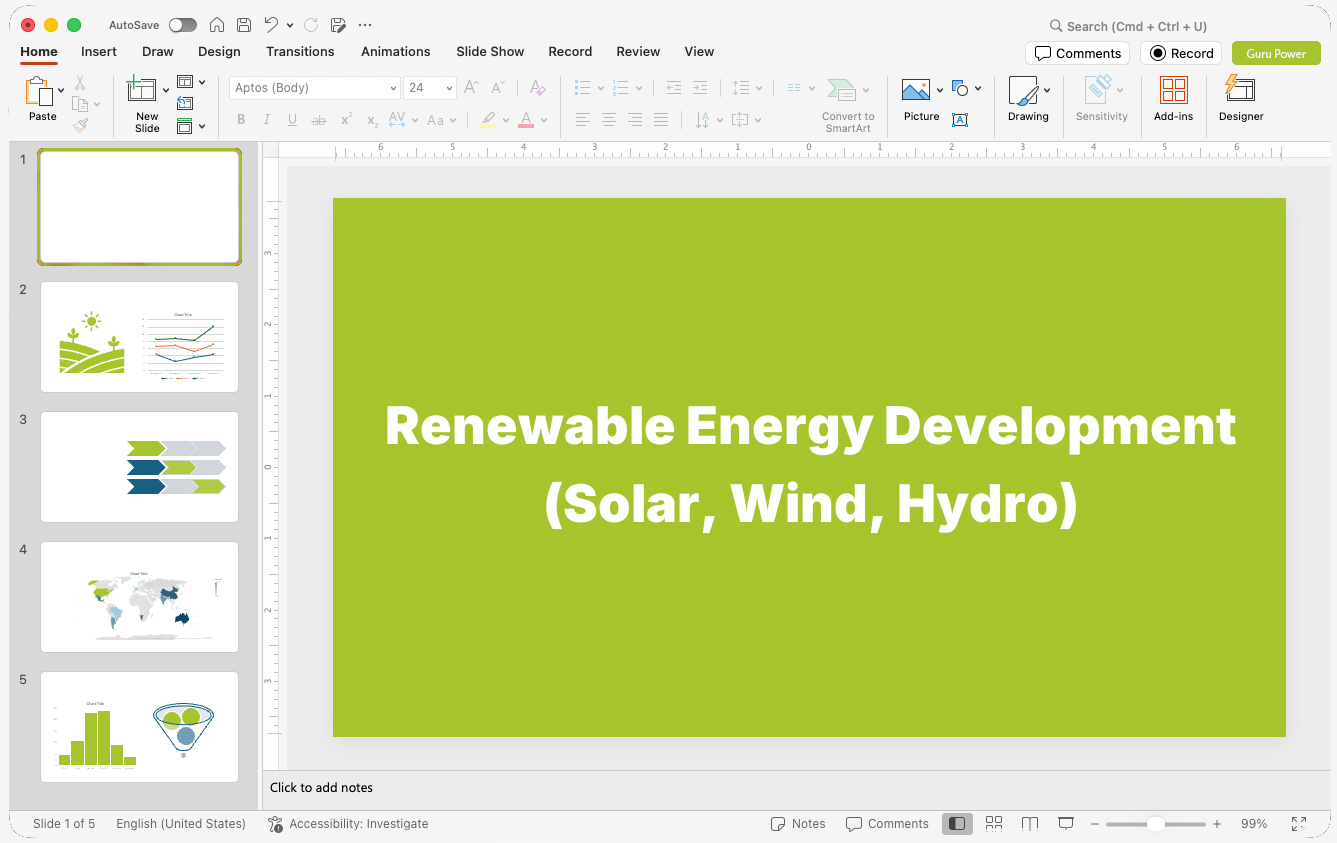
When Renewable Energy Developers Need Strategy-Driven Presentations Delivering Measurable Capital and Project Approvals
Renewable Energy Development (Solar, Wind, Hydro) Presentation Design is the strategic structuring and visual refining of technical, financial, and regulatory slide decks used by clean power developers to secure financing, land rights, power purchase agreements, and governmental permits.
Presentation Gurus serves as the specialized presentation design partner for leaders in Renewable Energy Development (Solar, Wind, Hydro). Developing utility-scale power projects requires specialized collateral for capital raising, municipal approvals, and corporate power purchase agreements. We build tailored assets such as a Clean Energy Infrastructure Capital Pitch Deck to secure equity and debt financing from institutional energy funds. For public hearings and zoning reviews, we construct a Hydroelectric Development Community & Regulatory Approval Presentation to address environmental impact and grid integration questions. Additionally, we craft a Solar Energy Development Power Purchase Agreement Pitch Deck tailored for corporate off-takers seeking long-term clean power contracts. Whether preparing an executive PowerPoint presentation for an investment committee or delivering a comprehensive slide deck to municipal planners, our strategic approach ensures complex technical data drives commercial outcomes.
Why Renewable Energy Development (Solar, Wind, Hydro) Presentations Need Professional Presentation Design
The problem is that standard pitch decks fail to articulate the intricate risk mitigation strategies inherent in utility-scale solar, onshore wind, and hydroelectric projects. Engineering diagrams and financial models often obscure the core investment hypothesis, leaving institutional lenders and off-takers uncertain about interconnection timelines, land acquisition rights, and capacity factors. Competitors present dense, unstructured slides that force investment committees to search for critical metrics. This addresses that gap through a strategy-led methodology. We restructure project fundamentals into logical capital narratives, clear risk allocation frameworks, and rigorous financial projections. Highlighting key metrics like levelized cost of energy, power purchase agreement terms, and environmental impact assessments builds stakeholder alignment. Investors expect clear, transparent disclosures, and off-takers demand operational certainty. The market requires presentation architecture that directly addresses underwriting requirements and community impact concerns. The data shows that project sponsors who present clear commercial terms secure faster approvals and capital commitments.
How Working With Us Works
From First Conversation To Finished Deck
Company
Meet JR, our founder. Fortune 500s, SMBs, startups — he’s built presentations for all of them with his team for the past 30 years, and he’s ready to build yours.
Service
Find your fit. We match the right service and scope to your audience, your goals, and your deadline, from 24-hour service to a 15-day turnaround.
Cost
Know the number upfront. Transparent, flat pricing before we start — no surprises, no hidden hours. All from $49 per slide.
Call 480-386-6000
Call us now. We’re open and we answer the phone. Or complete our quote request form that takes less than two minutes.












12 Essential Presentation Types for Renewable Energy Development (Solar, Wind, Hydro)
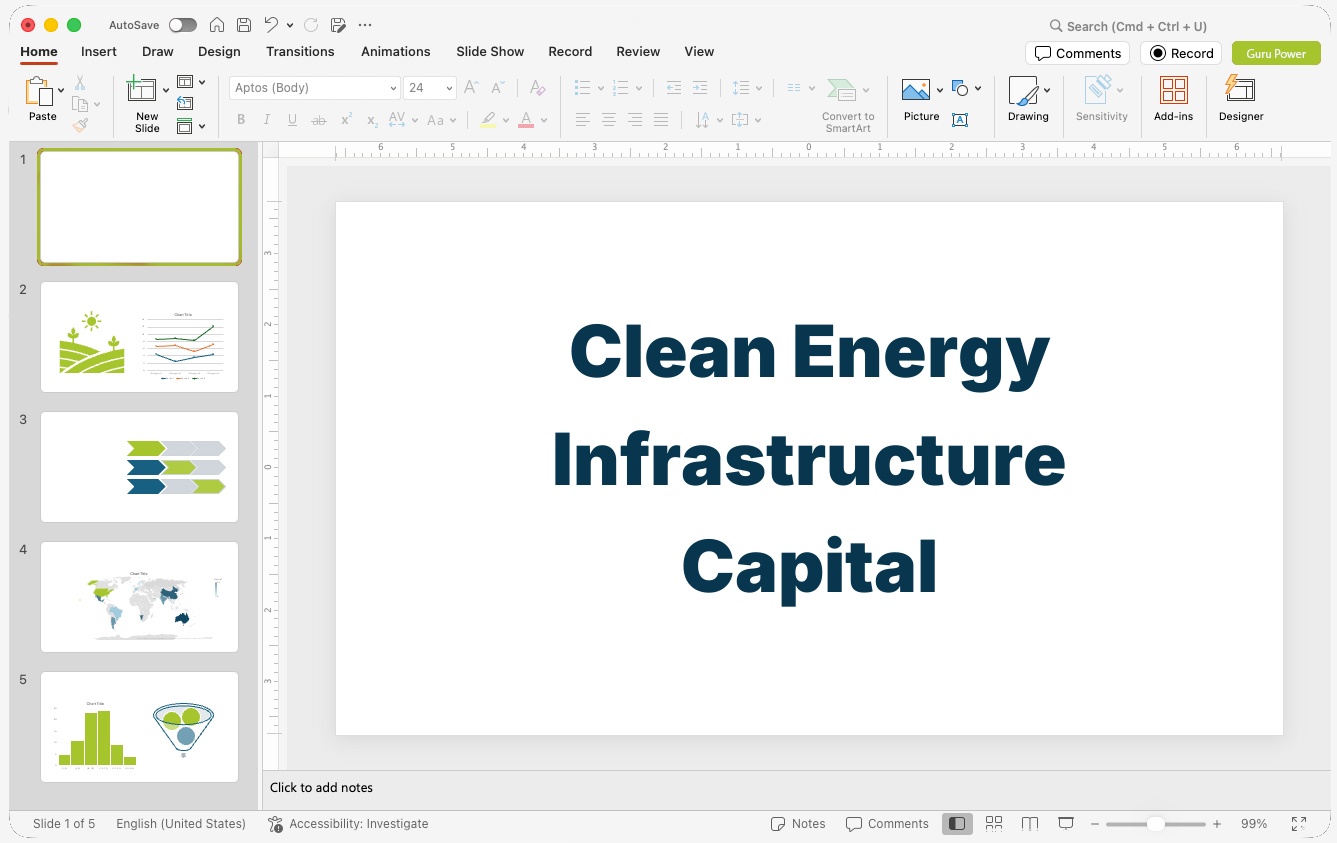
Clean Energy Infrastructure Capital Pitch Deck
Primary Audience: Infrastructure fund managers and private equity investment committees.
Purpose: Secure construction debt and tax equity financing for utility-scale assets.
Description: This Clean Energy Infrastructure Capital Pitch Deck presents project cash flows, credit ratings, and return metrics. It outlines project timeline milestones, land control agreements, and power purchase agreements. The PowerPoint presentation details risk allocation, EPC contract terms, and long-term yield projections to satisfy institutional underwriting requirements.
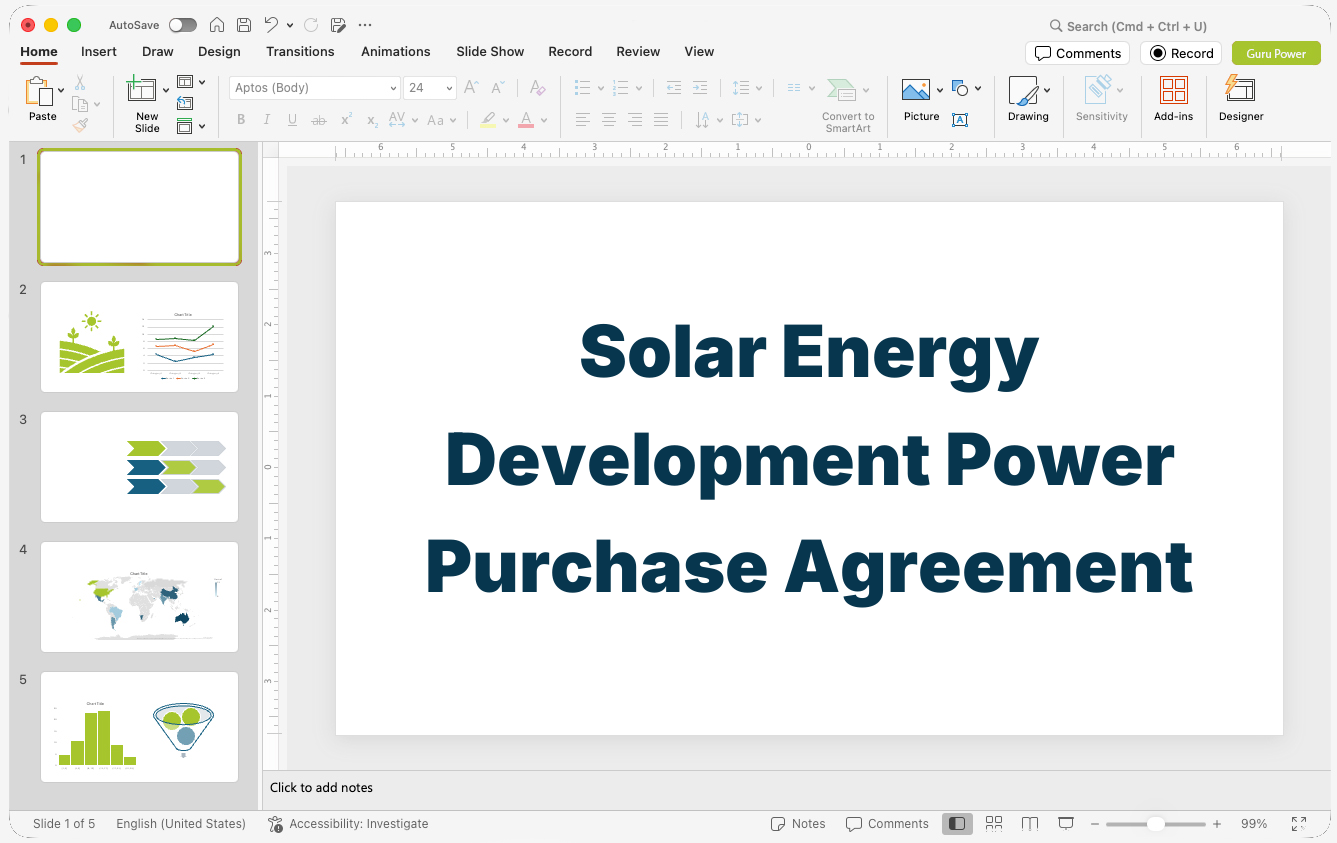
Solar Energy Development Power Purchase Agreement Pitch Deck
Primary Audience: Corporate sustainability officers and utility procurement managers.
Purpose: Execute long-term energy off-take contracts.
Description: This Solar Energy Development Power Purchase Agreement Pitch Deck outlines fixed-rate energy pricing, delivery schedules, and environmental attribute transfers. The presentation details site location, generation profiles, and grid connection points. Developers use these Slides to demonstrate project viability, creditworthiness, and carbon reduction value for corporate buyers.
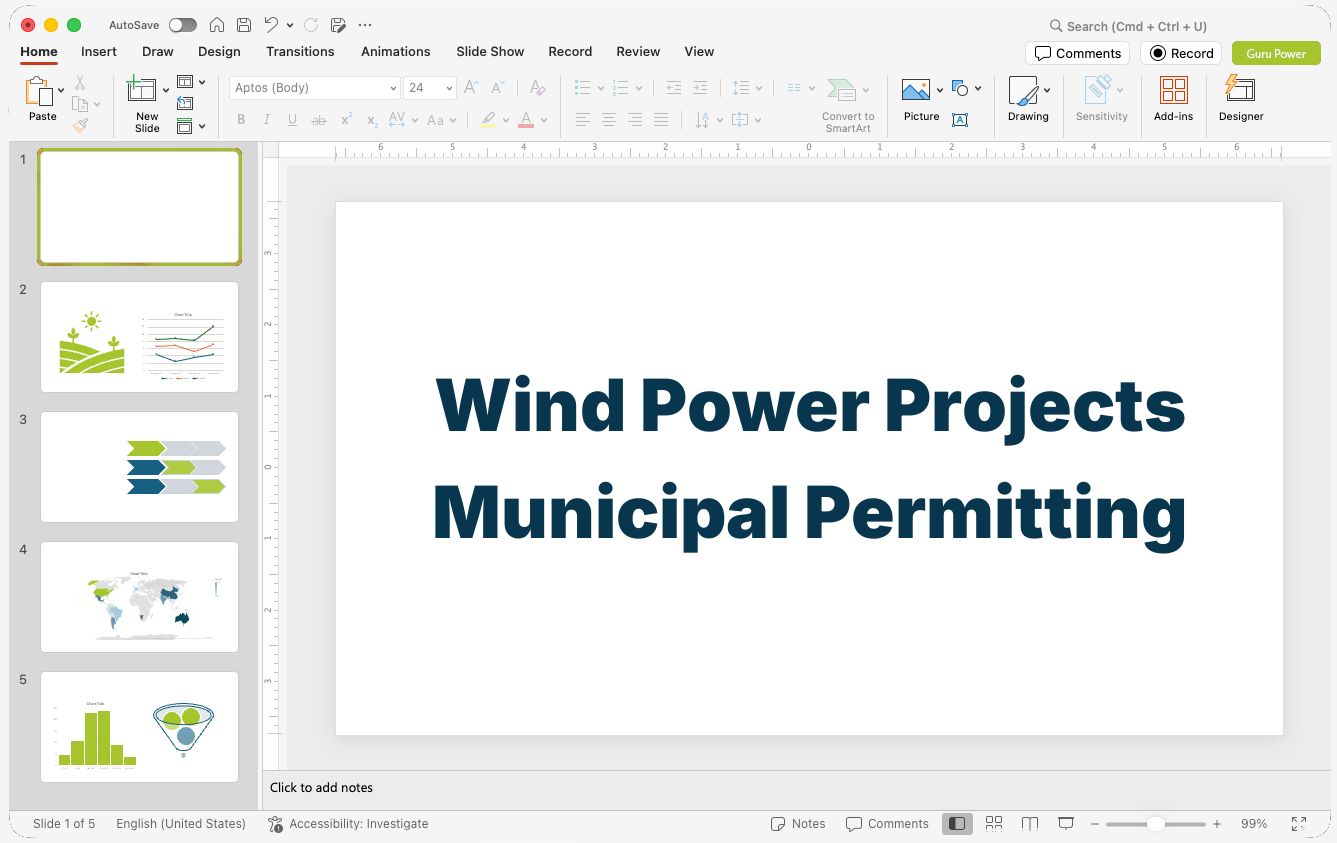
Wind Power Projects Municipal Permitting Presentation
Primary Audience: County planning commissions and local zoning boards.
Purpose: Obtain conditional use permits and local zoning approvals.
Description: This Wind Power Projects Municipal Permitting Presentation addresses land usage, setback distances, shadow flicker, and noise impact studies. The visual Slide-Deck outlines local tax revenue contributions, construction job creation, and road maintenance agreements. Clear maps and environmental mitigation plans help municipal leaders evaluate community safety and economic benefits.
Hydroelectric Development Regulatory Compliance Presentation
Primary Audience: Federal and state environmental protection regulators.
Purpose: Secure operating licenses and environmental clearances.
Description: This Hydroelectric Development Regulatory Compliance Presentation details fish passage mechanisms, water flow management, and ecosystem preservation measures. The detailed PowerPoint presentation integrates hydraulic modeling, historical flow data, and dam safety protocols. Developers present structured evidence demonstrating compliance with environmental statutes and water management mandates.
Renewable Power Generation Joint Venture Pitch Deck
Primary Audience: Co-developers and strategic utility partners.
Purpose: Form co-development partnerships and shared equity structures.
Description: This Renewable Power Generation Joint Venture Pitch Deck outlines development responsibilities, capital calls, and profit-sharing mechanisms. The structured Pitch-Deck covers portfolio composition, regional queue placement, and land acquisition footprints. It presents a clear strategic rationale for combining regional operational expertise with balance sheet strength.
Utility-Scale Energy Projects EPC Selection Presentation
Primary Audience: Engineering, procurement, and construction contractors.
Purpose: Award project construction contracts and finalize scope terms.
Description: This Utility-Scale Energy Projects EPC Selection Presentation establishes site specifications, delivery timelines, and performance guarantee expectations. The technical Slide-Deck details soil conditions, inverter specifications, and grid interconnection constraints. Clear visual timelines and liability terms ensure competitive bidding and transparent contractor evaluation.
Solar Energy Development Interconnection Review Presentation
Primary Audience: Regional transmission operators and utility engineers.
Purpose: Secure queue position and agree on grid upgrade cost allocations.
Description: This Solar Energy Development Interconnection Review Presentation details system capacity, substation impact, and thermal limit evaluations. The PowerPoint presentation maps out transformer specs, transmission line routes, and curtailment modeling. Clear data visualizations facilitate technical consensus regarding necessary grid reinforcement upgrades.
Wind Power Projects Landowner Lease Pitch Deck
Primary Audience: Rural property owners and agricultural landholders.
Purpose: Secure option contracts and long-term ground leases.
Description: This Wind Power Projects Landowner Lease Pitch Deck explains surface rights, turbine placements, compensation schedules, and farming disruption guarantees. The concise Pitch-Deck presents royalty structures, land restoration commitments, and liability protections. Simple visual diagrams help property owners understand physical land footprints and lease terms.
Hydroelectric Development Refurbishment Project Presentation
Primary Audience: Commercial banks and infrastructure debt funds.
Purpose: Secure modernization capital for existing dam facilities.
Description: This Hydroelectric Development Refurbishment Project Presentation highlights turbine efficiency upgrades, capacity expansion plans, and extended operational lifespans. The structured Slides detail historical power generation, maintenance records, and projected revenue gains. It demonstrates how capital expenditure investments optimize existing asset yields with minimal environmental impact.
Clean Energy Infrastructure Portfolio Acquisition Pitch Deck
Primary Audience: Institutional buyers and energy transition funds.
Purpose: Sell operating utility-scale assets or late-stage pipelines.
Description: This Clean Energy Infrastructure Portfolio Acquisition Pitch Deck summarizes operating capacity, revenue stability, and long-term maintenance contracts. The executive Pitch-Deck breaks down geographic diversity, technology mix, and remaining PPA contract duration. Buyers receive clear data on asset performance metrics and cash yield forecasts.
Renewable Power Generation Battery Storage Hybrid Presentation
Primary Audience: Utility grid planners and wholesale market operators.
Purpose: Approve solar-plus-storage grid dispatch agreements.
Description: This Renewable Power Generation Battery Storage Hybrid Presentation demonstrates how co-located battery capacity mitigates renewable intermittency and captures peak pricing. The technical PowerPoint presentation outlines charge-discharge schedules, round-trip efficiency, and ancillary service offerings. Grid operators review clear modeling of system reliability and dispatch capability.
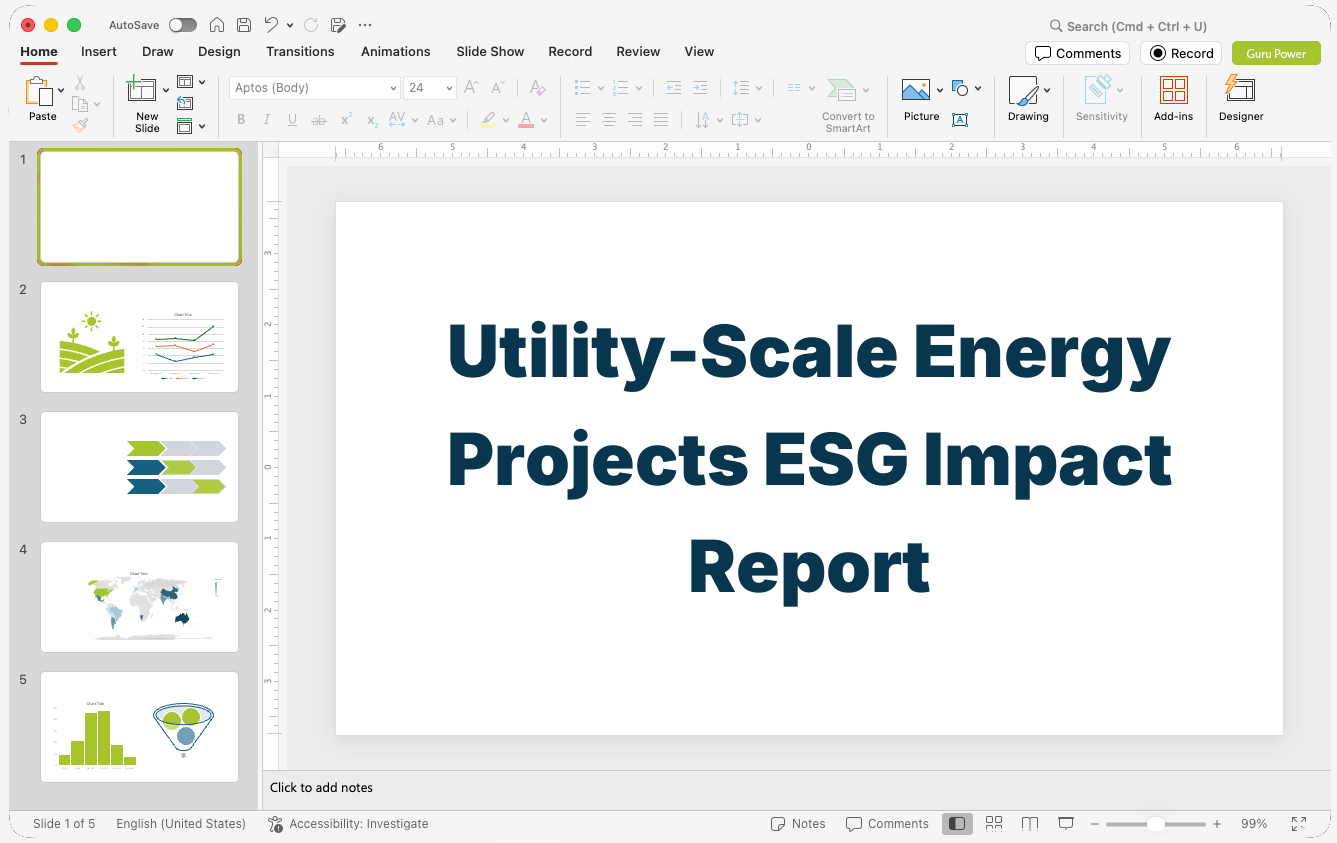
Utility-Scale Energy Projects ESG Impact Report Presentation
Primary Audience: Institutional investors and corporate ESG committees.
Purpose: Verify sustainability compliance and community impact standards.
Description: This Utility-Scale Energy Projects ESG Impact Report Presentation quantifies lifetime carbon offsets, habitat preservation measures, and local economic development metrics. The visual Slide-Deck presents third-party environmental audit results, supply chain transparency data, and labor standard compliance. Investors gain verifiable metrics supporting corporate sustainability disclosures.
Your PowerPoint, Google Slide and KeyNote Strategy, Story and Design Professionals
Presentation Gurus transforms dense technical data into clear, persuasive visual assets tailored for the clean energy sector. Our team structures site plans, financial models, interconnection studies, and regulatory filings into logical visual narratives. We maintain strict brand consistency across every presentation, pitch deck, and slide deck to build credibility with institutional partners. This disciplined approach eliminates clarity gaps, aligns executive stakeholders, and speeds up deal velocity. Contact Presentation Gurus today to review your project requirements and schedule a design consultation.
Ready ToGet Started?
Presentation Gurus is open.
Give us a call.
We actually answer the phone.
Questions & Answers
Renewable Energy Development (Solar, Wind, Hydro) Presentations FAQs
We have sensitive business information. Can you work under an NDA?
Virtually all of our client work is done under an NDA. We have a basic NDA included with our presentation work order, plus an enhanced, expanded non-disclosure agreement available whenever a project calls for it.
What information must be included in a wind energy project pitch deck for institutional investors?
Investors expect clear data on site control, wind resource assessments, interconnection status, power purchase agreement pricing, equipment procurement, tax credit eligibility, and debt-to-equity capital structures. The presentation must address yield projections and regulatory risk mitigation directly.
How long does it take to design a utility-scale renewable energy slide deck?
Standard development timelines range from two to four weeks depending on slide count, graphic complexity, and content readiness. Expedited workflows are available for tight investor meetings or regulatory filing deadlines.
How do you handle dense engineering and grid interconnection data in a solar energy presentation?
We translate complex single-line diagrams, interconnection queues, and capacity factor data into standardized executive summaries. High-level takeaway slides summarize critical constraints for non-technical investors, while detailed schematics remain preserved in structured appendix sections for technical due diligence.
What does Renewable Energy Development (Solar, Wind, Hydro) Presentations presentation design cost?
Pricing is simple and clear. A basic slide design or redesign begins at $49 per slide. Premium presentation design, which includes copywriting and basic storytelling, starts at $79 per slide. Custom presentations involving strategy, copywriting and custom graphics are quoted based on your specifications. See complete pricing details here.
How does the collaboration process work?
Everything happens online. Every meeting is a Microsoft Teams call or similar virtual environment where we can share desktops and information in real time. Revision meetings and discovery calls are always scheduled in the morning, so by noon we can begin work on tasks for the next revision meeting.
How long does it take to get a presentation designed?
If your team needs a complete presentation by 9:00 AM the next day, we can meet that deadline. Most projects take 10 – 15 days, providing we have all the information. Pricing is also based on slide complexity and speed — a basic slide deck with a 15-day delivery costs much less than a premium slide deck delivered the next morning.
Does our industry need a Presentation or a Pitch Deck?
The terms are frequently used interchangeably, but they serve different strategic purposes. A pitch deck is a highly visual, persuasive tool designed to secure a strategic commitment or investment. A standard presentation is an informative, detailed document structured to align stakeholders and share data.
Can custom presentation design assist with public municipal hearings for hydro or solar projects?
Yes. Public hearings require clear visual explanations regarding land use, environmental mitigation, local economic benefits, and grid stability. Clear, accessible slides build community trust and help municipal boards understand compliance with local zoning mandates.
Will our team receive the fully editable source file?
Yes. Unlike graphic designers who deliver flat PDFs or JPEGs, Presentation Gurus delivers the native, fully editable presentation file (.pptx, .key, etc.) so your team can make last-minute text edits on the fly, or update the presentation later as details change.
Presentation Gurus' research identifies 15 locations with active Renewable Energy Development (Solar, Wind, Hydro) operations, including Houston, TX, Austin, TX, and San Francisco, CA.
Across the United States, utility-scale renewable energy projects demand collaboration among project developers, capital providers, and technical engineers. In Texas, power producers navigate unique grid dynamics. Houston, TX serves as a massive corporate center for developer headquarters, utility-scale power operations, and energy transition private equity. Further west, Austin, TX hosts major solar and battery storage developers taking advantage of rapid ERCOT grid market activity. This focus on wind and solar power generation extends north through the central plains, where state economic development initiatives in Kansas highlight wind energy development as a core industrial priority. In the upper Midwest, Des Moines, IA functions as a primary operational center for utility-scale wind power generation and rural land acquisition, while Chicago, IL serves as a Midwest headquarters for regional transmission planning organizations and utility-scale development teams.
Western markets balance high solar adoption with grid modernization. Project developers in Phoenix, AZ expand utility-scale solar and battery storage installations across the desert Southwest. In Salt Lake City, UT, firms build regional footprints around utility-scale solar, geothermal assets, and interstate transmission line projects. Along the West Coast, San Diego, CA supports a dense concentration of commercial solar providers, storage specialists, and grid integration teams. Project capital and corporate strategy frequently flow out of San Francisco, CA, which brings together clean energy venture capital funds, project finance firms, and solar utility executives. Further north, Portland, OR anchors Pacific Northwest wind operations and specialized hydroelectric engineering, while Denver, CO acts as a regional nexus for federal energy research facilities, engineering firms, and wind developers.
Eastern commercial corridors provide essential project debt, institutional underwriting, and regulatory oversight. Deal teams in New York, NY structure infrastructure debt, coordinate tax equity investments, and arrange capital stacks for offshore wind assets. In Boston, MA, offshore wind development offices work alongside power engineering teams and clean tech venture funds. Regulatory strategy converges in Washington, DC, where developers interface with national trade associations, federal clean energy loan programs, and energy regulatory commissions. Across the Southeast, Charlotte, NC hosts major regional utility headquarters alongside corporate solar offices, and Atlanta, GA serves as a regional center for solar procurement firms, engineering contractors, and corporate renewable power purchasers.
Structuring these massive capital assets often requires partnering across corporate boundaries. Teams preparing partner proposals can consult our guide on structuring a Joint Venture Commercial Proposal. Renewable infrastructure also works in close proximity to adjacent utility and infrastructure operations. Project developers routinely interface with Nuclear Power Generation & Services, modern Water & Wastewater Utilities, and transitional assets in Energy Pipeline & Storage (Midstream). Industrial decarbonization initiatives connect wind and solar plants to Clean Tech & Carbon Capture Solutions and Environmental & Waste Management Services. Equipment movement for these sites relies on global freight networks, including Maritime Freight & Ocean Shipping Lines, regional providers in Third-Party Logistics (3PL) & Freight Forwarding, and staging facilities managed by Warehousing & Distribution Centers.
Renewable Energy Development (Solar, Wind, Hydro) Presentations By the Numbers
- Solar power accounts for 51% of the planned 86 gigawatts of new utility-scale electric generating capacity scheduled to be added to the United States power grid in 2026. (New U.S. electric generating capacity expected to reach a record high in 2026 – U.S. Energy Information Administration (EIA))