
When Policy Research Decision-Makers Need Strategic Presentations Translating Complex Methodology Into Action
Think Tanks & Policy Research Institutes Presentation Design is the specialized service of converting empirical research, econometric models, and policy proposals into clear, visually structured slide decks tailored for government officials, philanthropic donors, and institutional boards.
Presentation Gurus serves as the dedicated presentation design partner for Think Tanks & Policy Research Institutes seeking high-impact visual communication. We specialize in transforming complex academic and legislative analysis into structured visual tools. Whether your institution requires a policy proposal slide deck for legislative staffers, a board meeting presentation for institutional trustees, or a donor pitch deck for major philanthropic foundations, our team aligns design with your exact research methodology. We build every presentation, PowerPoint framework, and custom Google Slides deck to enforce institutional credibility and communicate empirical evidence effectively.
Why Think Tanks & Policy Research Institutes Presentations Need Professional Presentation Design
Policy research institutes frequently face a structural communication challenge. Subject matter experts write dense technical reports containing vital empirical data, but present those findings using text-heavy slides that confuse non-specialist stakeholders. Standard presentations obscure key policy implications under methodology notes and unformatted data tables. Decision-makers in government and philanthropy do not have the time to extract visual arguments from cluttered layouts. Strategy-led presentation design solves this by auditing raw research, establishing a logical narrative arc, and building precise visual hierarchies. Complex econometric models and statutory analyses become structured diagrams, interactive data visuals, and clear policy briefs. The market requires information architecture that preserves academic rigor while driving executive decision-making. This addresses the gap between technical scholarship and practical implementation. The measurable outcome is increased stakeholder engagement, faster legislative adoption, and sustained institutional funding.
How Working With Us Works
From First Conversation To Finished Deck
Company
Meet JR, our founder. Fortune 500s, SMBs, startups — he’s built presentations for all of them with his team for the past 30 years, and he’s ready to build yours.
Service
Find your fit. We match the right service and scope to your audience, your goals, and your deadline, from 24-hour service to a 15-day turnaround.
Cost
Know the number upfront. Transparent, flat pricing before we start — no surprises, no hidden hours. All from $49 per slide.
Get Started
Tell us about your presentation project. It will take two minutes and we’ll get back to you on our next business day.
















12 Essential Presentation Types for Think Tanks & Policy Research Institutes
Think Tanks & Policy Research Institutes Legislative Briefing Slides
Primary Audience: Congressional staffers, legislative directors, and elected officials..
Purpose: Translate statutory analysis and empirical data into actionable legislative recommendations..
Description: This Slide-Deck clarifies complex policy reform proposals for legislative decision-makers. The presentation organizes statutory reviews, fiscal impact models, and constituent outcomes into direct visual summaries. It eliminates academic jargon in favor of bold claims and verified statistics. Representatives use these decks during committee briefings and legislative work sessions.
Policy Institute Philanthropic Grant Pitch-Deck
Primary Audience: Foundation program officers and philanthropic grant committees..
Purpose: Secure multi-year operating grants and program-specific research funding..
Description: This Pitch-Deck details research goals, methodology, and societal impact metrics for prospective funding partners. The slides articulate the problem statement, theory of change, and budget allocations clearly. Custom graphics illustrate research milestones and reach across media and government channels. It serves as the core visual instrument during formal funding reviews.
Public Policy Center Board Meeting Presentation
Primary Audience: Board of trustees, executive directors, and financial committee members..
Purpose: Report institutional performance, research outputs, and financial health..
Description: This PowerPoint delivers an executive overview of institutional operations over the fiscal year. The slides cover endowment performance, publication reach, hiring milestones, and upcoming research initiatives. Structured charts standardize financial metrics and peer comparisons. Trustees rely on this deck to evaluate strategic positioning and approve operational budgets.
Research Foundation Economic Forecasting Presentation
Primary Audience: Corporate economists, financial analysts, and institutional investors..
Purpose: Present macro-economic models and market trend forecasts based on policy shifts..
Description: This Presentation breaks down complex macroeconomic indicators and econometric modeling. Custom data visualizations illustrate interest rate sensitivities, labor market shifts, and trade policy scenarios. The deck highlights primary data sources and statistical confidence intervals for institutional audiences. Financial analysts use these insights to assess regulatory exposure.
Nonpartisan Research Group Annual Research Agenda Slides
Primary Audience: Media, academic partners, policy analysts, and institutional stakeholders..
Purpose: Announce upcoming research programs and flagship publication schedules..
Description: This Slide-Deck outlines the strategic research priorities for the upcoming academic year. Each section focuses on a major policy vertical, introducing lead scholars, research questions, and target release dates. Visual timelines map publication schedules alongside key legislative sessions. The deck aligns internal research fellows around unified institutional priorities.
Policy Studies Institute Foreign Policy Strategy PowerPoint
Primary Audience: Diplomatic corps, national security advisors, and international relations scholars..
Purpose: Analyze geopolitical developments and propose international security frameworks..
Description: This PowerPoint analyzes international security, defense posture, and diplomatic strategies. Custom maps, actor-network diagrams, and threat matrix visuals simplify regional dynamic assessments. The presentation organizes multi-country data into clear, comparative layouts. Decision-makers use these slides to evaluate geopolitical risks and alliance commitments.
Economic Research Center Healthcare Policy Impact Slides
Primary Audience: Healthcare executives, state insurance commissioners, and public health officials..
Purpose: Demonstrate the fiscal and public health outcomes of proposed healthcare regulations..
Description: This Presentation details statutory changes in healthcare delivery, coverage expansions, and provider reimbursement rates. The slides feature comparative charts detailing premium impacts, budget projections, and health outcome indicators. Complex epidemiological models appear as clean visual graphics. Public health directors use the deck to frame state policy implementations.
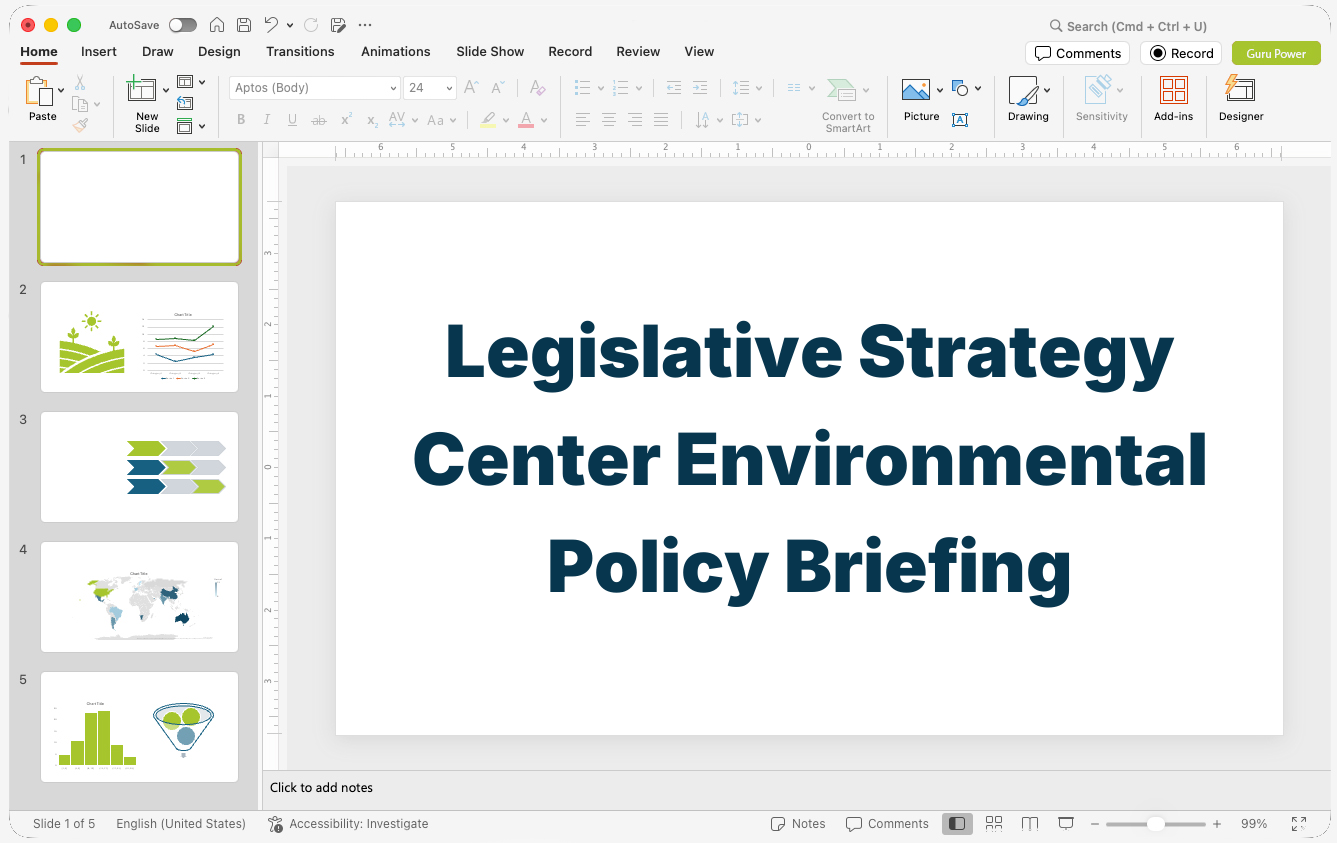
Legislative Strategy Center Environmental Policy Briefing Pitch-Deck
Primary Audience: Environmental agency officials, corporate sustainability officers, and legislative committees..
Purpose: Present carbon reduction models and regulatory compliance strategies..
Description: This Pitch-Deck presents empirical environmental data, emission trajectories, and economic cost-benefit analyses. The presentation uses visual infographics to explain technical regulatory standards and technological adoption curves. Data visualizations isolate regional environmental impacts clearly. Agencies rely on these slides to guide regulatory rulemaking.
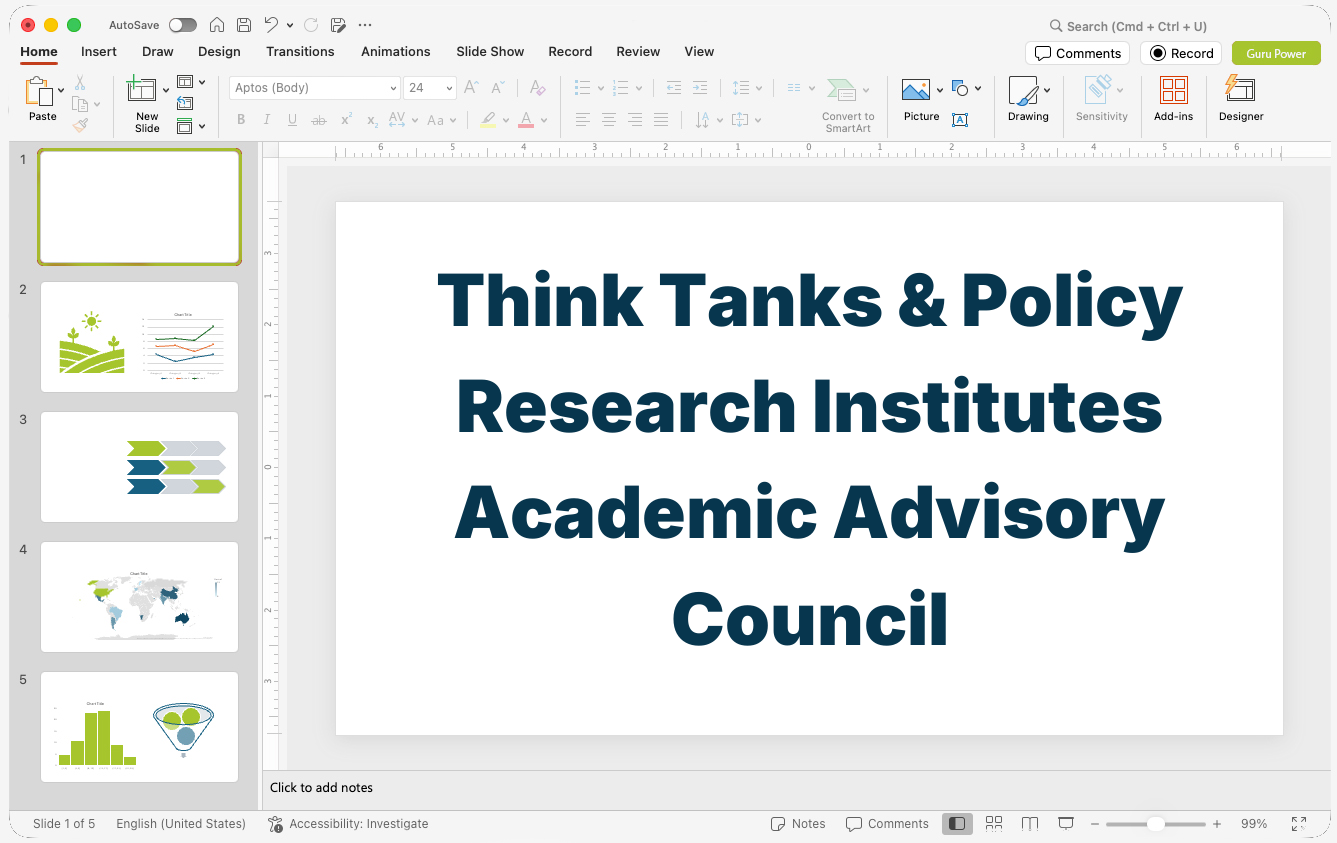
Think Tanks & Policy Research Institutes Academic Advisory Council Deck
Primary Audience: Senior university scholars, peer researchers, and journal editors..
Purpose: Validate research methodology and peer-review working papers prior to publication..
Description: This Slide-Deck presents preliminary research methodologies, dataset constructions, and econometric regressions for expert critique. The slides dedicate space to formula structures, variable definitions, and sensitivity analyses. Clear visual layouts keep technical discussion focused on statistical validity. Senior fellows use this deck to refine working papers before public release.
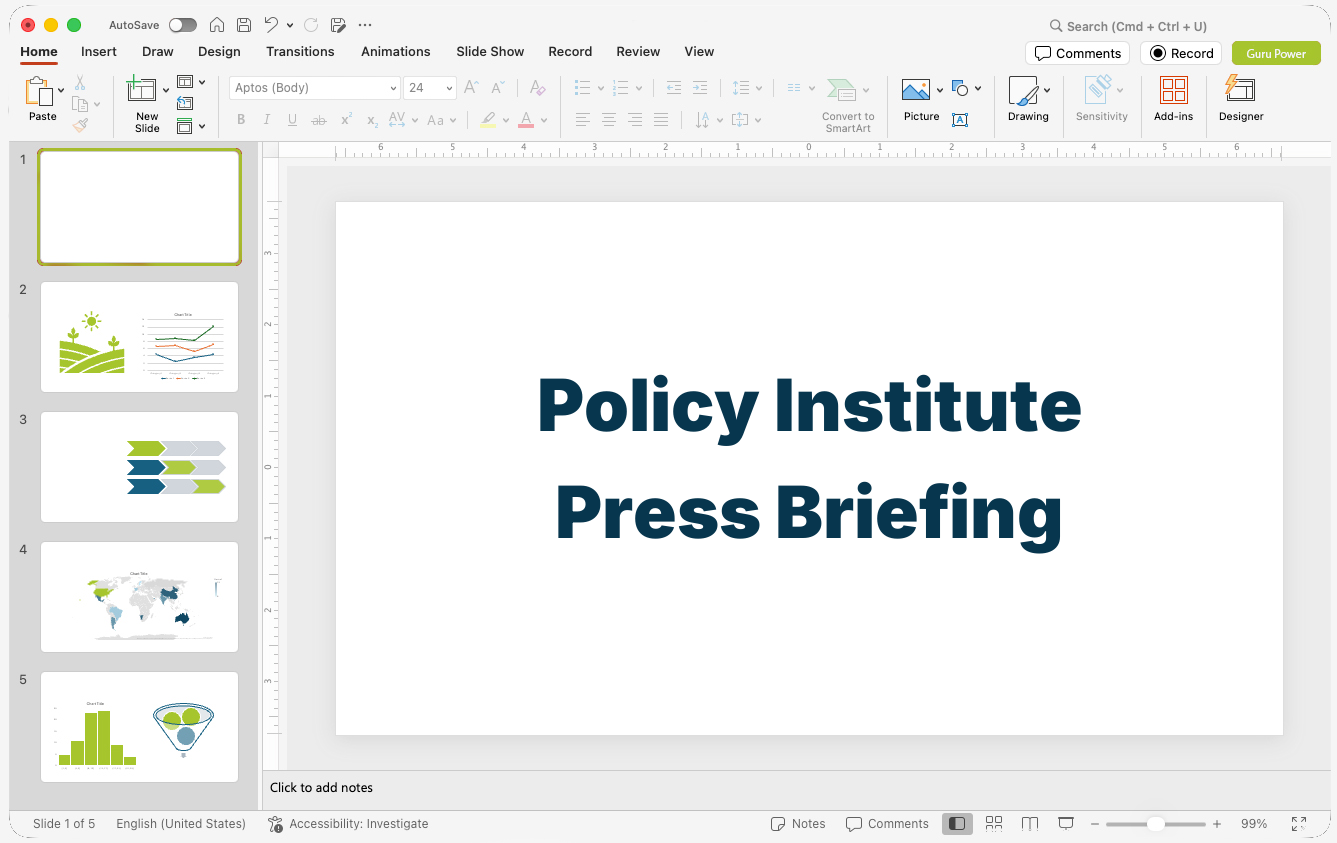
Policy Institute Press Briefing Presentation
Primary Audience: Journalists, media editors, policy commentators, and digital publishers..
Purpose: Communicate key findings of major study releases to national media outlets..
Description: This PowerPoint distills multi-chapter research publications into scannable key takeaways for press coverage. The slides highlight standalone charts, quote callouts, and executive summaries designed for news amplification. Visual hierarchy ensures journalists absorb main findings within minutes. Communications teams deploy this deck during virtual press briefings.
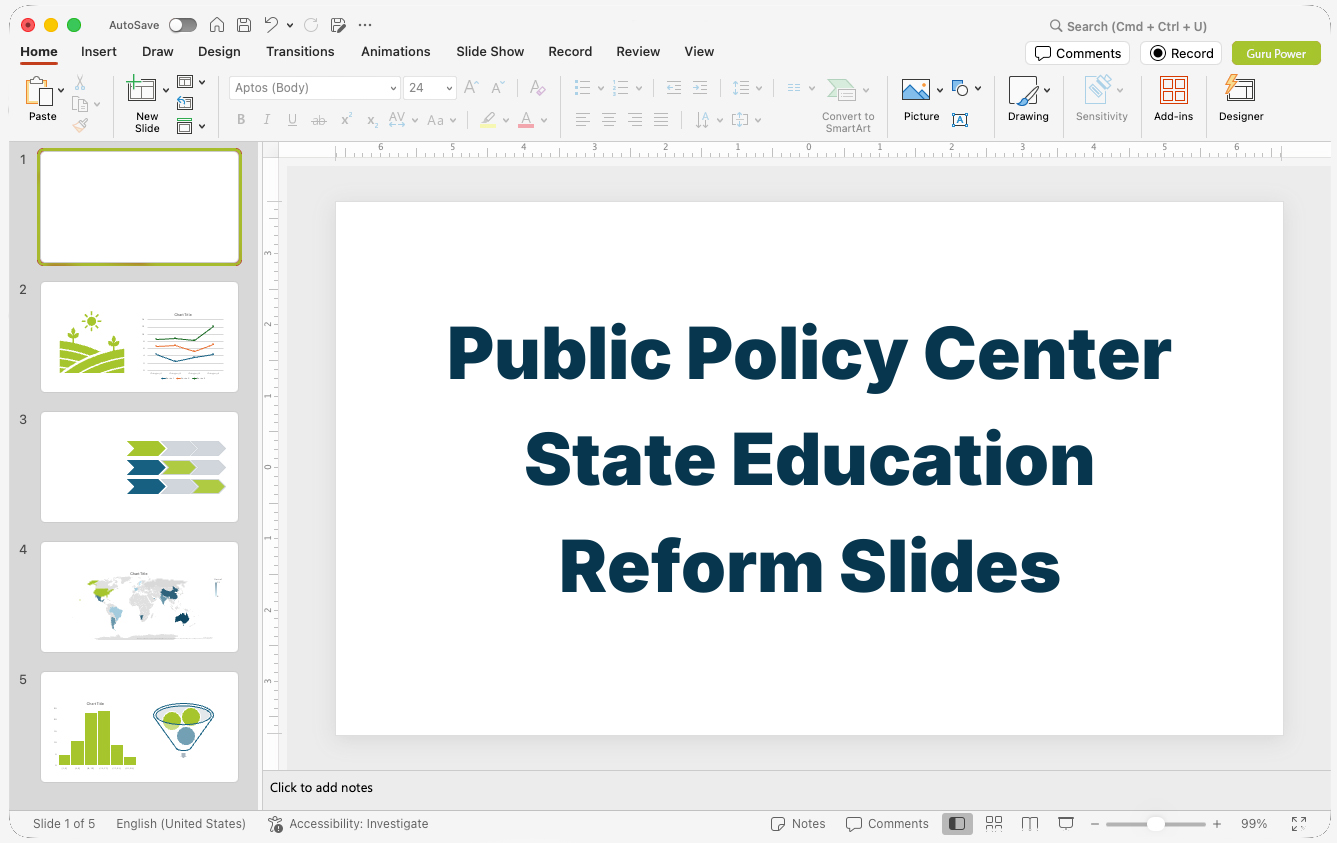
Public Policy Center State Education Reform Slides
Primary Audience: State school boards, education department directors, and legislative education committees..
Purpose: Promote evidence-based education policy reforms and funding allocations..
Description: This Slide-Deck evaluates school district performance data, funding allocation models, and student testing outcomes. The presentation converts complex longitudinal tracking data into straightforward trend lines and heat maps. Clear visual breakdowns demonstrate the return on investment for proposed curriculum reforms. Education policy makers use these slides to support legislative testimony.
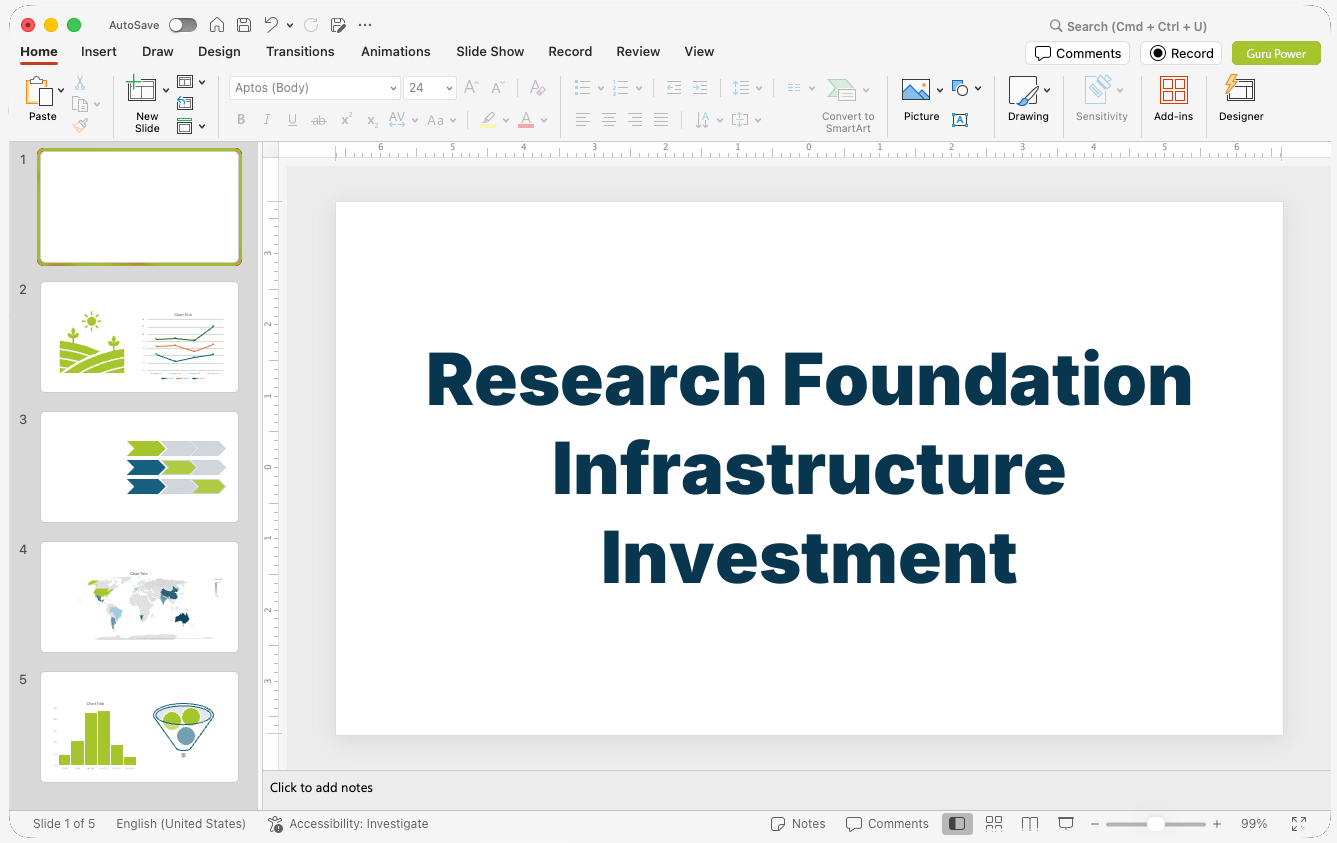
Research Foundation Infrastructure Investment Pitch-Deck
Primary Audience: Department of Transportation officials, municipal planners, and private infrastructure funds..
Purpose: Demonstrate public-private infrastructure investment models and economic benefits..
Description: This Pitch-Deck details regional infrastructure bottlenecks, capital allocation models, and long-term economic returns. Visual project maps, financial flow diagrams, and risk allocation matrices clearly present project feasibility. The slides address statutory hurdles and regulatory timeline projections directly. Municipal officials utilize this deck during capital planning summits.
Your PowerPoint, Google Slide and KeyNote Strategy, Story and Design Professionals
Presentation Gurus delivers end-to-end design, narrative structuring, and brand standardization for Think Tanks & Policy Research Institutes. We transform raw datasets and white papers into visual arguments that uphold peer-reviewed standards. Our team establishes strict typography, custom data visualization templates, and cohesive layouts to maintain brand consistency across all public-facing assets. Every slide deck we produce aligns technical accuracy with strategic clarity. Contact Presentation Gurus today to schedule a portfolio review and elevate your institution's presentation assets.
Ready ToGet Started?
Questions & Answers
Think Tanks & Policy Research Institutes Presentations FAQs
How does the collaboration process work?
Everything happens online. Every meeting is a Microsoft Teams call or similar virtual environment where we can share desktops and information in real time. Revision meetings and discovery calls are always scheduled in the morning, so by noon we can begin work on tasks for the next revision meeting.
Can your team design presentation templates that our internal research fellows can edit?
Yes, we build standardized, custom PowerPoint and Google Slides templates containing master layouts, pre-formatted charts, iconography, and typography guidelines. This allows internal policy experts to build consistent slides independently.
How long does it take to get a presentation designed?
If your team needs a complete presentation by 9:00 AM the next day, we can meet that deadline. Most projects take 10 – 15 days, providing we have all the information. Pricing is also based on slide complexity and speed — a basic slide deck with a 15-day delivery costs much less than a premium slide deck delivered the next morning.
How do you maintain academic rigor when simplifying dense policy research into slides?
We review white papers and technical data directly with your principal investigators. The team extracts core statistical findings and statutory frameworks, reformatting them into clean data visualizations and structured diagrams without truncating methodology or context.
What is the typical timeline for designing a high-stakes board or donor presentation?
Standard project turnarounds range from two to three weeks, depending on slide count and content complexity. Expedited design schedules are available for emergency legislative hearings, press briefings, or rapid-response research releases.
We have sensitive business information. Can you work under an NDA?
Virtually all of our client work is done under an NDA. We have a basic NDA included with our presentation work order, plus an enhanced, expanded non-disclosure agreement available whenever a project calls for it.
How do you handle confidential policy briefs and proprietary economic datasets?
We enforce strict confidentiality protocols, including bilateral non-disclosure agreements and secure data storage systems. All research assets, draft slides, and datasets remain fully protected throughout the presentation design process.
What does Think Tanks & Policy Research Institutes Presentations presentation design cost?
Pricing is simple and clear. A basic slide design or redesign begins at $49 per slide. Premium presentation design, which includes copywriting and basic storytelling, starts at $79 per slide. Custom presentations involving strategy, copywriting and custom graphics are quoted based on your specifications. See complete pricing details here.
Will our team receive the fully editable source file?
Yes. Unlike graphic designers who deliver flat PDFs or JPEGs, Presentation Gurus delivers the native, fully editable presentation file (.pptx, .key, etc.) so your team can make last-minute text edits on the fly, or update the presentation later as details change.
Does our industry need a Presentation or a Pitch Deck?
The terms are frequently used interchangeably, but they serve different strategic purposes. A pitch deck is a highly visual, persuasive tool designed to secure a strategic commitment or investment. A standard presentation is an informative, detailed document structured to align stakeholders and share data.
Presentation Gurus' research identifies 14 locations with active Think Tanks & Policy Research Institutes operations, including Washington, DC, Cambridge, MA, and Santa Monica, CA.
Public policy institutes translate complex data into actionable recommendations for civic leaders, governments, and the public. A significant portion of this research clusters naturally around federal decision-makers. In the District of Columbia, analysts at major organizations like the Brookings Institution shape national legislative debates. Right across Washington, DC, specialists at CSIS, the Heritage Foundation, and the Cato Institute build data-heavy briefings on foreign policy, economics, and governance. These teams frequently collaborate with peers in Defense & Military Organizations and partner with Trade Associations & Industry Coalitions to ensure national security assessments and regulatory proposals reach congressional committees clearly.
Beyond the capital, academic communities drive economic and international research. Up north, Cambridge, MA houses the National Bureau of Economic Research alongside prominent university policy centers. In New York, NY, the Council on Foreign Relations, the Manhattan Institute, and major philanthropic foundations guide strategic discussions on global diplomacy and domestic infrastructure. Further south along the eastern corridor, analysts in Philadelphia, PA lead programs at the Foreign Policy Research Institute and the University of Pennsylvania. In Durham, NC, Duke University policy centers and Research Triangle groups focus on technology, healthcare, and education reform. These initiatives often overlap directly with research conducted by Higher Education Institutions (Universities & Colleges) and Scientific Research Institutes & National Labs.
Regional challenges also demand dedicated state and municipal policy analysis. Midwestern priorities take center stage in Chicago, IL, where the Chicago Council on Global Affairs and local academic centers study urban development and trade. In Minneapolis, MN, regional economists track Upper Midwest labor markets and community growth, while teams in Pittsburgh, PA examine urban redevelopment alongside research teams at secondary RAND offices. These localized studies regularly support Non-Profit Organizations (NPOs) & NGOs and guide curriculum standards tracked by K-12 School Districts & Private Schools.
Across the Sunbelt and Western regions, specialized institutes tackle resources, workforce growth, and technology. Researchers in Atlanta, GA evaluate human rights and southern economic health at The Carter Center. In Austin, TX, state policy centers, energy institutes, and the LBJ School of Public Affairs focus on grid reliability and state infrastructure. Further west, teams in Denver, CO publish findings on public lands and natural resources. On the Pacific coast, analysts in Seattle, WA direct studies on global health systems and digital equity, while Palo Alto, CA hosts the Hoover Institution and Stanford policy groups evaluating innovation policy. Down the coast, Santa Monica, CA serves as the headquarters for the RAND Corporation, delivering defense and public welfare research that touches both Corporate Training & Executive Education programs and practical pathways at Vocational & Technical Training Centers.
Think Tanks & Policy Research Institutes Presentations By the Numbers
- According to Statista, the United States is home to 1,872 think tanks, representing the largest concentration of policy research organizations globally. (Chart: The U.S. Has The Most Think Tanks By Far | Statista)