
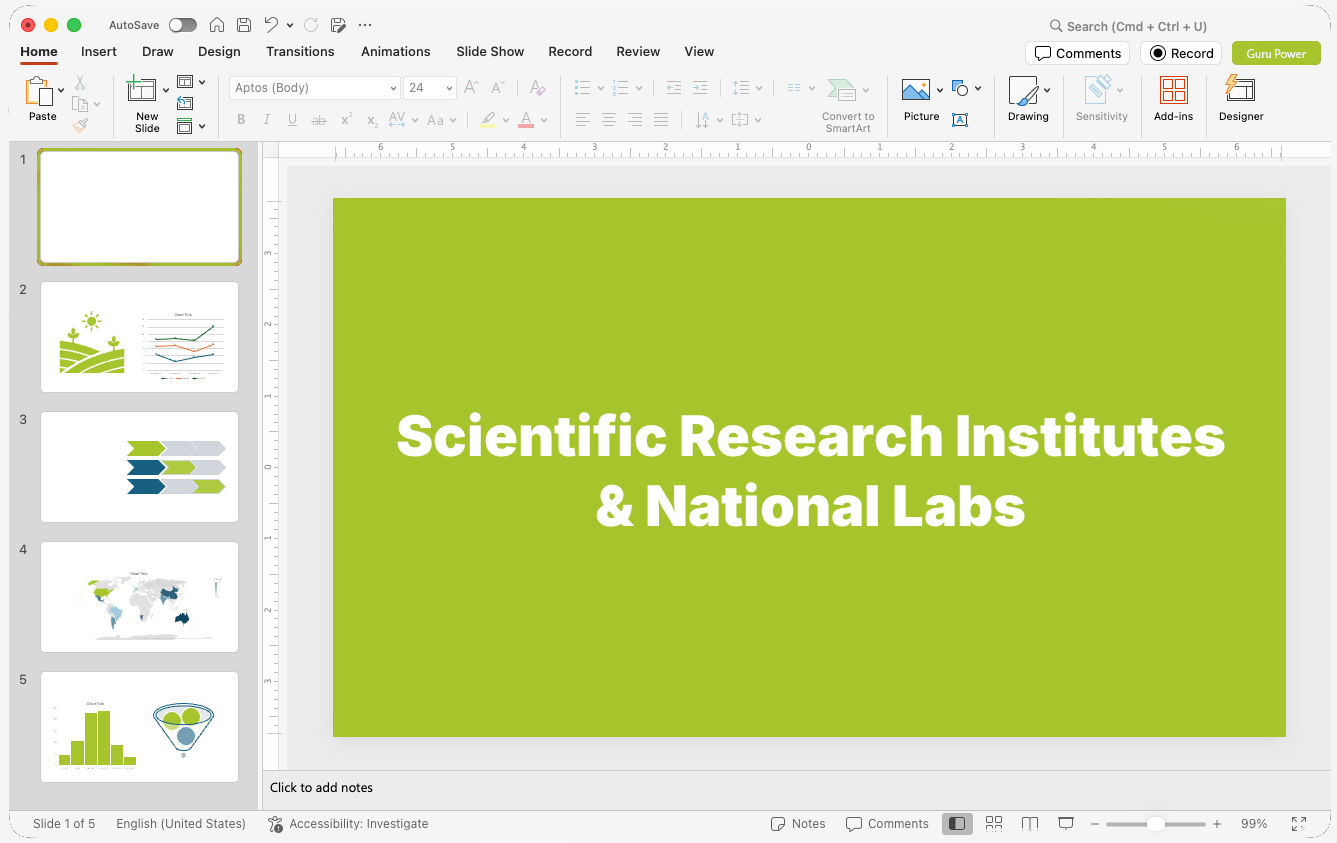
When National Lab Leadership Needs Strategic Presentations Addressing Complex Federal Research Outcomes
Scientific Research Institutes & National Labs Presentation Design is the strategic structuring and visual refining of technical decks, grant proposals, and executive briefings for public research facilities and government laboratory stakeholders.
Presentation Gurus provides specialized design support for scientific research institutes and federal laboratories. Our team translates complex scientific datasets, capital equipment requests, and programmatic roadmaps into high-impact visual narrative tools. We work directly with laboratory directors, department heads, and principal investigators to build structured pitch decks and executive slide decks tailored for institutional oversight. Whether you need a PowerPoint presentation for an upcoming DOE program review or an interactive presentation for commercial technology transfer partners, we structure every slide to emphasize critical milestones and performance metrics. By combining rigorous content organization with polished brand standards, we assist federal research facilities and independent scientific facilities in securing stakeholder alignment.
Why Scientific Research Institutes & National Labs Presentations Need Professional Presentation Design
Scientific research institutes and national labs operate under severe operational and communication constraints. Executive directors and principal investigators frequently present highly technical multi-million dollar initiatives using dense, text-heavy slides. These unstructured decks fail to articulate strategic value, resulting in delayed approvals, lengthened procurement cycles, and missed public-private partnership opportunities. Strategy-led presentation design solves this issue by translating technical jargon and complex datasets into clear, decision-focused narratives. By structuring content specifically for congressional committees, federal agency directors, and institutional review boards, strategy-led visual communication ensures key outcomes are instantly understandable. The data shows that structured visual communication directly impacts executive alignment and funding decisions. When research leaders utilize clear hierarchy, accurate data visualizations, and strategic storytelling, oversight bodies evaluate proposals faster and with greater confidence. This systematic approach reduces slide review iterations and aligns multi-disciplinary research teams behind unified operational goals.
How Working With Us Works
From First Conversation To Finished Deck
Company
Meet JR, our founder. Fortune 500s, SMBs, startups — he’s built presentations for all of them with his team for the past 30 years, and he’s ready to build yours.
Service
Find your fit. We match the right service and scope to your audience, your goals, and your deadline, from 24-hour service to a 15-day turnaround.
Cost
Know the number upfront. Transparent, flat pricing before we start — no surprises, no hidden hours. All from $49 per slide.
Get Started
Tell us about your presentation project. It will take two minutes and we’ll get back to you on our next business day.













12 Essential Presentation Types for Scientific Research Institutes & National Labs
National Laboratories Annual Budget Defense Presentation
Primary Audience: Congressional Appropriations Subcommittees and Agency Directors.
Purpose: Secure annual federal funding allocations for ongoing research operations.
Description: This PowerPoint slide deck outlines fiscal performance, major scientific achievements, and multi-year research milestones for federal oversight bodies. Clear financial breakdowns and program success metrics ensure committee members rapidly grasp ROI. Visual roadmaps illustrate how capital allocations support national strategic priorities.
Scientific Research Institutes Technology Transfer Slide-Deck
Primary Audience: Corporate R&D Executives and Venture Capital Investors.
Purpose: License lab-developed intellectual property and establish commercial partnerships.
Description: Designed to translate complex patents into commercial opportunities, this Pitch-Deck highlights market applications and readiness levels. Industry partners evaluate technical advantages, scale-up feasibility, and licensing frameworks clearly. Concise graphics bridge the gap between academic theory and commercial deployment.
Federal Research Facilities Capital Infrastructure Presentation
Primary Audience: Department of Energy and Department of Defense Program Managers.
Purpose: Obtain capital improvement grants for lab modernizations and supercomputers.
Description: This Slides proposal articulates the operational necessity of facility upgrades, supercomputing clusters, and specialized scientific equipment. The deck uses structural schematics and comparative capability benchmarks to prove asset degradation or technological obsolescence. Clear timelines establish construction milestones and operational readiness dates.
FFRDCs Multi-Year Strategic Research Slides
Primary Audience: Board of Governors and Institutional Advisory Committees.
Purpose: Align laboratory leadership on strategic scientific direction and hiring goals.
Description: Focusing on institutional goals across five-year horizons, this Presentation structures core research pillars including quantum computing, clean energy, and defense systems. Key milestones, inter-laboratory collaboration frameworks, and workforce recruitment targets are visually mapped. Executive summaries ensure advisory boards can approve overarching policy directives.
Government Research Centers Inter-Agency Collaboration Presentation
Primary Audience: NASA, NIH, NSF, and Department of Energy Program Leads.
Purpose: Form multi-agency research consortia and share infrastructure costs.
Description: This Slide-Deck details joint research capabilities, data-sharing protocols, and co-funding structures across separate federal entities. Clear diagrams highlight shared analytical instruments, supercomputer access allocations, and cross-disciplinary research teams. The presentation reduces operational friction by standardizing governance expectations.
Applied Research Labs Program Review Presentation
Primary Audience: Federal Sponsor Review Boards and External Scientific Peers.
Purpose: Pass annual peer evaluations and validate program continuation criteria.
Description: This technical PowerPoint slide layout delivers rigorous peer-review data, experiment validation metrics, and publication outputs. Visual chart templates help principal investigators present complicated experimental results without cluttering slides. Clear milestone gates establish project viability and future phase readiness.
National Laboratories LDRD Project Pitch-Deck
Primary Audience: Laboratory Directed Research and Development Selection Committees.
Purpose: Win internal competitive seed funding for high-risk, high-reward research.
Description: This concise Pitch-Deck presents early-stage scientific hypotheses, risk mitigation strategies, and preliminary proof-of-concept data. Principal investigators use structured slides to articulate how novel research aligns with core laboratory missions. Visual risk-reward charts aid internal selection committees during funding decisions.
Scientific Research Institutes Public Outreach Presentation
Primary Audience: Local Municipal Leaders, Educational Partners, and Community Stakeholders.
Purpose: Build community support and communicate environmental safety protocols.
Description: This accessible presentation translates complex nuclear, chemical, or biological research activities into easy-to-understand educational narratives. The Slides cover local economic impact, educational STEM initiatives, and rigorous environmental compliance measures. Clear infographics address public safety questions directly and objectively.
Federal Research Facilities User Facility Access Slides
Primary Audience: Visiting Academic Researchers and Industrial R&D Scientists.
Purpose: Maximize utilization rates for specialized beamlines and user facilities.
Description: Designed for potential facility users, this Presentation details proposal submission processes, available specialized instrumentation, and scheduling windows. Diagrams clarify beamline technical capabilities, sample preparation requirements, and data storage workflows. Clean layout structures lower barriers to entry for external academic partners.
FFRDCs Cybersecurity & Data Governance Presentation
Primary Audience: Federal Chief Information Officers and Inspector General Audit Teams.
Purpose: Demonstrate compliance with federal cyber mandates and data protection laws.
Description: This PowerPoint slide framework outlines classified network architecture, zero-trust implementation timelines, and sensitive data access protocols. Clear network diagrams and compliance matrices prove adherence to federal security controls. The presentation simplifies complex IT security audits for oversight officials.
Government Research Centers Industry Partnership Pitch-Deck
Primary Audience: Fortune 500 Technology Officers and Defense Prime Contractors.
Purpose: Execute Cooperative Research and Development Agreements (CRADAs).
Description: This Pitch-Deck presents collaborative research opportunities, IP ownership structures, and co-development funding mechanisms. Clean business slides detail lab talent access, specialized testing rigs, and shared research risk models. The layout accelerates legal and business development reviews between government and private entities.
Applied Research Labs Environmental Remediation Presentation
Primary Audience: State Environmental Agencies and EPA Oversight Officers.
Purpose: Secure approval for long-term site cleanup and waste management plans.
Description: Focusing on environmental stewardship, this Slides presentation maps ground contamination monitoring, waste processing technologies, and containment timelines. Quantitative risk models and hydrogeological diagrams provide transparent technical data. Visual milestone charts demonstrate ongoing compliance with federal cleanup mandates.
Your PowerPoint, Google Slide and KeyNote Strategy, Story and Design Professionals
Presentation Gurus delivers end-to-end design solutions tailored to scientific research institutes and national labs. We establish clear visual hierarchies, create custom data visualizations, and enforce strict brand compliance across every slide deck. Our process eliminates narrative clutter, ensuring complex physics, computing, and bioengineering concepts resonate with both technical experts and non-specialist decision-makers. We transform dense raw data into persuasive visual assets that support federal grant renewals, inter-agency briefings, and commercialization pitches. Partner with our team to upgrade your laboratory's presentation standards. Contact Presentation Gurus today to schedule a consultation for your next critical research presentation.
Ready ToGet Started?
Questions & Answers
Scientific Research Institutes & National Labs Presentations FAQs
How do you translate complex technical research into clear presentation slides?
We review raw research documentation, technical white papers, and dataset tables. Our team extracts key findings, establishes a logical narrative flow, and converts dense statistical tables into clear charts and diagrams that highlight operational impact.
What does Scientific Research Institutes & National Labs Presentations presentation design cost?
Pricing is simple and clear. A basic slide design or redesign begins at $49 per slide. Premium presentation design, which includes copywriting and basic storytelling, starts at $79 per slide. Custom presentations involving strategy, copywriting and custom graphics are quoted based on your specifications. See complete pricing details here.
How do you handle sensitive or proprietary scientific research content?
We operate under strict non-disclosure agreements and secure file handling protocols. Our team regularly handles pre-publication research, patent-pending technology disclosures, and restricted institutional program data.
How does the collaboration process work?
Everything happens online. Every meeting is a Microsoft Teams call or similar virtual environment where we can share desktops and information in real time. Revision meetings and discovery calls are always scheduled in the morning, so by noon we can begin work on tasks for the next revision meeting.
Will our team receive the fully editable source file?
Yes. Unlike graphic designers who deliver flat PDFs or JPEGs, Presentation Gurus delivers the native, fully editable presentation file (.pptx, .key, etc.) so your team can make last-minute text edits on the fly, or update the presentation later as details change.
Can you design presentations while adhering to strict government or lab branding guidelines?
Yes. We incorporate official laboratory style guides, departmental typography, required color palettes, and mandated federal compliance logos while improving visual clarity, slide hierarchy, and overall layout quality.
What is the typical turnaround time for a federal research lab deck?
Standard turnarounds range from two to three weeks depending on slide count and content complexity. Expedited schedules are available for urgent agency reviews, congressional briefings, and annual budget defense meetings.
How long does it take to get a presentation designed?
If your team needs a complete presentation by 9:00 AM the next day, we can meet that deadline. Most projects take 10 – 15 days, providing we have all the information. Pricing is also based on slide complexity and speed — a basic slide deck with a 15-day delivery costs much less than a premium slide deck delivered the next morning.
Does our industry need a Presentation or a Pitch Deck?
The terms are frequently used interchangeably, but they serve different strategic purposes. A pitch deck is a highly visual, persuasive tool designed to secure a strategic commitment or investment. A standard presentation is an informative, detailed document structured to align stakeholders and share data.
We have sensitive business information. Can you work under an NDA?
Virtually all of our client work is done under an NDA. We have a basic NDA included with our presentation work order, plus an enhanced, expanded non-disclosure agreement available whenever a project calls for it.
Presentation Gurus' research identifies 8 locations with active Scientific Research Institutes & National Labs operations, including Livermore, CA, Albuquerque, NM, and Richland, WA.
Scientific research institutions transform complex discoveries into actionable progress across the country. In Northern California, groundbreaking work takes place in Livermore, CA, home to Lawrence Livermore National Laboratory and the Sandia National Laboratories California campus. Just across the bay, Berkeley, CA hosts Lawrence Berkeley National Laboratory, which focuses on unclassified fundamental scientific research. Further south, space exploration advances in Pasadena, CA through the NASA Jet Propulsion Laboratory, managed by Caltech. These facilities often share findings and collaborative frameworks with Higher Education Institutions (Universities & Colleges) to prepare the next generation of researchers.
National security and energy innovation extend deep into the Mountain West. In New Mexico, the regional economy relies heavily on Albuquerque’s research cluster. Facilities in Albuquerque, NM, such as the headquarters of Sandia National Laboratories, lead major national security and energy initiatives alongside groups like the Santa Fe Institute. Meanwhile, across Idaho, nuclear energy research serves as a primary economic engine. In Idaho Falls, ID, Idaho National Laboratory operates as the country’s central facility for nuclear energy development. These programs coordinate closely with Defense & Military Organizations as well as Government Agencies (Federal, State, Local) to safeguard critical infrastructure.
Specialized physical and chemical sciences drive innovation in other key hubs nationwide. Teams in Richland, WA at Pacific Northwest National Laboratory concentrate on chemistry, environmental science, and national security. In the Midwest, researchers in Ames, IA at Ames National Laboratory pioneer materials design and chemical discoveries. On the East Coast, the Thomas Jefferson National Accelerator Facility in Newport News, VA leads specialized nuclear physics research. These technical breakthroughs frequently inform programs managed by Vocational & Technical Training Centers and K-12 School Districts & Private Schools building modern STEM curricula.
Non-profit and institutional networks also form a major part of this research ecosystem. Across North Carolina, Research Triangle Park serves as headquarters for RTI International, a non-profit research organization operating on a global scale. These groups routinely connect with Non-Profit Organizations (NPOs) & NGOs to tackle public health and environmental challenges. To translate laboratory science into industry adoption, research teams partner with Trade Associations & Industry Coalitions and deploy structured programs through Corporate Training & Executive Education. Communicating these technical milestones requires a dedicated presentation design agency that understands the value of clarity, accuracy, and strong visual storytelling.
Scientific Research Institutes & National Labs Presentations By the Numbers
- Total research and development expenditures at federally funded research and development centers reached $31.7 billion in fiscal year 2024. (R&D Spending at Federally Funded R&D Centers Surpassed $31 Billion in FY 2024 | NCSES | NSF)