
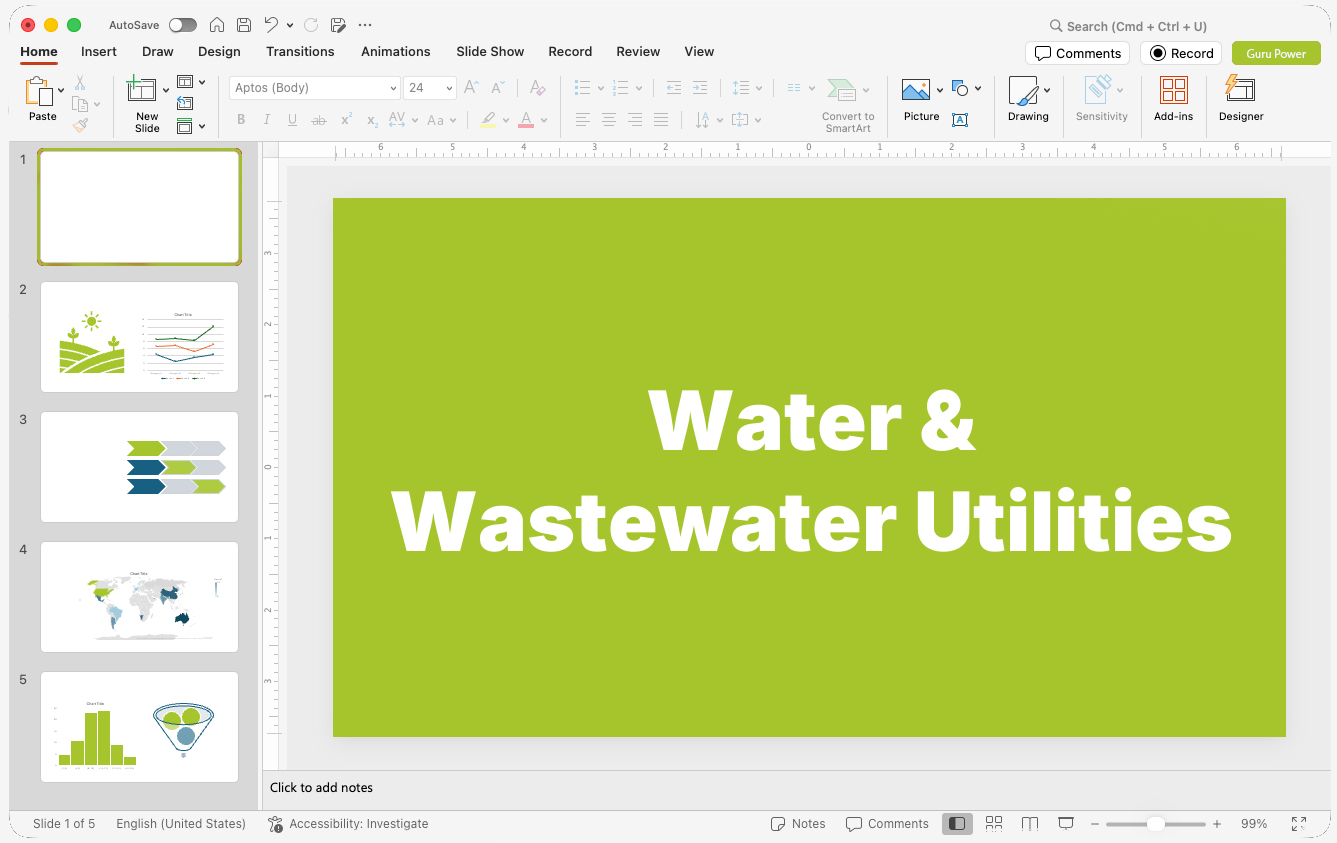
When Water & Wastewater Utilities Decision-Makers Need Strategic Presentations Addressing Business Outcomes
Water & Wastewater Utilities Presentation Design is the specialized discipline of structuring complex hydraulic, financial, and regulatory data into executive slide decks for municipal boards, regulatory commissions, and institutional investors.
Presentation Gurus serves as the presentation design partner for Water & Wastewater Utilities businesses facing critical stakeholder decisions. Utility executives rely on clear visual communication when requesting rate adjustments, presenting capital improvement programs, or defending regulatory compliance strategies. We transform complex utility data into high-impact presentation materials designed specifically for elected officials, regulatory bodies, and institutional investors. A typical utility project requires translating engineering schematics into a clear PowerPoint presentation or pitch deck for municipal bonding authorities. Whether delivering an executive briefing slide deck or a public hearing presentation, our team ensures complex utility metrics translate into clear strategic choices.
Why Water & Wastewater Utilities Presentations Need Professional Presentation Design
The problem is that standard technical presentations fail to bridge the gap between utility operations and financial governance. Engineering decks often present raw flow rates, asset conditions, and compliance metrics without establishing a compelling financial justification. The market requires presentations that connect capital improvement programs directly to rate structures, regulatory compliance, and risk mitigation. Strategy-led presentation design solves this problem by structuring technical data into structured executive narratives. Visual models clarify long-term asset renewal schedules, debt service requirements, and rate impacts for non-technical board members. The measurable outcome is reduced approval timelines for municipal bonds, rate adjustments, and environmental compliance programs.
How Working With Us Works
From First Conversation To Finished Deck
Company
Meet JR, our founder. Fortune 500s, SMBs, startups — he’s built presentations for all of them with his team for the past 30 years, and he’s ready to build yours.
Service
Find your fit. We match the right service and scope to your audience, your goals, and your deadline, from 24-hour service to a 15-day turnaround.
Cost
Know the number upfront. Transparent, flat pricing before we start — no surprises, no hidden hours. All from $49 per slide.
Get Started
Tell us about your presentation project. It will take two minutes and we’ll get back to you on our next business day.












14 Essential Presentation Types for Water & Wastewater Utilities
Water Utility Capital Improvement Program Pitch-Deck
Primary Audience: City Councils and Municipal Finance Committees.
Purpose: Secure multi-year capital allocation for asset renewal.
Description: This Water Utility capital planning Pitch-Deck breaks down multi-year infrastructure investments into prioritized funding phases. The presentation outlines asset degradation risks, projected capacity constraints, and required construction timelines. Technical asset management data is converted into clear visual spending roadmaps. Financial slides demonstrate project ROI and long-term debt service coverage.
Wastewater Utility Rate Case Request Presentation
Primary Audience: Public Utility Commissions and Municipal Boards.
Purpose: Obtain approval for adjusted wastewater service tariffs.
Description: This Wastewater Utility tariff Presentation justifies necessary rate adjustments to cover rising operational expenses and regulatory compliance costs. The narrative contrasts projected revenue shortfalls against required system maintenance investments. Visual charts compare average household bill impacts across neighboring service regions. Industry requirements mandate clear public disclosures on capital reinvestment strategy.
Clean Water Utility EPA Regulatory Compliance Deck
Primary Audience: State and Federal Environmental Regulatory Agencies.
Purpose: Demonstrate compliance milestones and corrective action plans.
Description: This Clean Water Utility regulatory updates Slide-Deck documents compliance progress for consent decrees and discharge permits. The presentation highlights water quality sampling results, treatment plant performance metrics, and corrective engineering controls. Process flow diagrams outline primary, secondary, and advanced treatment upgrades. The narrative establishes transparent timelines for meeting statutory environmental standards.
Water Infrastructure Municipal Bond Investor Slides
Primary Audience: Institutional Bond Buyers and Credit Rating Agencies.
Purpose: Achieve favorable credit ratings and issue debt securities.
Description: This Water Infrastructure financial Slides deck highlights revenue stability, coverage ratios, and local economic resilience for bond investors. Industry data demonstrates strong historical collection rates and prudent reserve fund balances. Visual dashboards outline debt service schedules alongside long-term capital improvement plans. The deck provides institutional investors with clear risk mitigation frameworks.
Water Reclamation Utility Industrial Reuse Presentation
Primary Audience: Industrial Customers and Commercial Facility Managers.
Purpose: Execute commercial off-take agreements for recycled water.
Description: This Water Reclamation Utility commercial Presentation details the economic and environmental benefits of industrial recycled water programs. The narrative compares potable water costs against offset recycled water rates for manufacturing operations. Visual diagrams illustrate dual-pipe distribution networks and specialized water quality specifications. Investors expect clear contract structures and reliable supply volume guarantees.
Sewer Utility System Capacity Expansion Pitch-Deck
Primary Audience: Regional Planning Commissions and Land Developers.
Purpose: Align sewer main extension projects with regional growth plans.
Description: This Sewer Utility capacity Pitch-Deck presents conveyance system expansion plans to support industrial and residential growth. GIS mapping slides detail wet-weather flow capacities, pump station lift limits, and proposed interceptor routes. The problem is framed around capacity bottlenecks that threaten local economic development. The solution establishes cost-sharing models between public utilities and private developers.
Water Utility PFAS Mitigation Strategy Slides
Primary Audience: Utility Board Directors and Public Health Officials.
Purpose: Approve capital spending for advanced water filtration assets.
Description: This Water Utility treatment strategy Slides deck details technical approaches for removing emerging contaminants like PFAS and microplastics. Flow schematics illustrate granular activated carbon and reverse osmosis process integration. Financial tables outline estimated capital expenditure versus ongoing operational media replacement costs. The presentation equips executives to address public health concerns directly.
Wastewater Utility SCADA Modernization Presentation
Primary Audience: Chief Executive Officers and Technology Committees.
Purpose: Authorize budget for automated treatment monitoring systems.
Description: This Wastewater Utility technology Presentation lays out the business case for upgrading legacy supervisory control and data acquisition systems. The slides compare existing operational risks against automated operational efficiencies and remote monitoring benefits. Cybersecurity frameworks demonstrate risk mitigation protocols for critical municipal infrastructure assets. The presentation justifies technology investments through reduced downtime and lower labor overhead.
Clean Water Utility Regional Consolidation Pitch-Deck
Primary Audience: Adjacent Township Boards and Small Water Districts.
Purpose: Consolidate fragmented water systems to achieve scale.
Description: This Clean Water Utility consolidation Pitch-Deck outlines the operational and financial benefits of merging small municipal water systems. The narrative addresses economies of scale in chemical procurement, regulatory reporting, and emergency response capabilities. Comparative financial slides illustrate long-term rate stabilization for combined customer bases. The deck provides a clear legal and operational transition roadmap.
Water Infrastructure Stormwater Management Slide-Deck
Primary Audience: County Commissioners and Environmental Groups.
Purpose: Fund green and grey infrastructure flood control projects.
Description: This Water Infrastructure flood resilience Slide-Deck showcases integrated watershed management and stormwater conveyance plans. Visual slides contrast traditional concrete retention systems with green infrastructure performance metrics. Flood modeling maps highlight community risk reduction and property damage prevention statistics. The presentation supports grant applications and local tax allocation proposals.
Sewer Utility Asset Management Master Plan Slides
Primary Audience: City Managers and Public Works Directors.
Purpose: Adopt comprehensive asset renewal and inspection schedules.
Description: This Sewer Utility asset evaluation Slides deck presents condition assessment findings from closed-circuit television pipe inspections. Heat maps categorize underground pipe networks by critical risk, age, and structural integrity scores. Financial projections contrast proactive pipe rehabilitation against costly emergency repair scenarios. The deck establishes a defensible, data-backed 10-year asset replacement plan.
Water Reclamation Utility Biosolids Strategy Presentation
Primary Audience: Agricultural Stakeholders and Waste Regulators.
Purpose: Secure land application permits and beneficial reuse contracts.
Description: This Water Reclamation Utility residuals Presentation outlines sustainable options for biosolids processing, drying, and land application. Chemical analysis slides demonstrate compliance with agricultural safety and soil amendment regulations. Logistics models compare incineration costs against land application distribution economics. The presentation aligns utility waste management with regional agricultural operations.
Water Utility Customer Bill Impact Presentation
Primary Audience: Community Ratepayers and Public Advocacy Groups.
Purpose: Build public understanding for necessary rate structure changes.
Description: This Water Utility public outreach Presentation explains customer billing changes required to fund aging pipe replacement projects. Simple graphic breakdowns illustrate how typical monthly bills are allocated across treatment, distribution, and debt service. Interactive charts demonstrate assistance programs available for low-income households. The narrative builds community trust through clear, transparent financial disclosures.
Wastewater Utility Emergency Response Slide-Deck
Primary Audience: Emergency Management Directors and Utility Operators.
Purpose: Establish standard operating protocols for severe weather events.
Description: This Wastewater Utility contingency Slide-Deck details operational protocols for severe weather events and treatment plant bypass risks. Actionable organizational charts map command structures, auxiliary power deployment, and emergency mutual aid response plans. Regulatory notification workflows ensure compliance during operational disruptions. The presentation serves as a clear training and alignment deck for operational leadership.
Your PowerPoint, Google Slide and KeyNote Strategy, Story and Design Professionals
Presentation Gurus combines industry domain knowledge with structured visual storytelling to elevate utility decks. We build custom visual frameworks, clear financial tables, and brand-consistent slide templates tailored for municipal and private utility operations. Every project aligns complex engineering requirements with executive decision-making criteria. Our team turns fragmented technical slides into a cohesive PowerPoint slide deck that drives board alignment and public buy-in. Contact Presentation Gurus today to schedule a consultation and transform your next utility presentation into a decisive strategic asset.
Ready ToGet Started?
Questions & Answers
Water & Wastewater Utilities Presentations FAQs
What presentation formats do you support for municipal water utility meetings?
We build fully editable decks in PowerPoint, Google Slides, and Keynote. Decks include printable executive summaries, public hearing presentation layouts, and custom chart templates configured for easy internal updates by utility staff.
Will our team receive the fully editable source file?
Yes. Unlike graphic designers who deliver flat PDFs or JPEGs, Presentation Gurus delivers the native, fully editable presentation file (.pptx, .key, etc.) so your team can make last-minute text edits on the fly, or update the presentation later as details change.
Does our industry need a Presentation or a Pitch Deck?
The terms are frequently used interchangeably, but they serve different strategic purposes. A pitch deck is a highly visual, persuasive tool designed to secure a strategic commitment or investment. A standard presentation is an informative, detailed document structured to align stakeholders and share data.
We have sensitive business information. Can you work under an NDA?
Virtually all of our client work is done under an NDA. We have a basic NDA included with our presentation work order, plus an enhanced, expanded non-disclosure agreement available whenever a project calls for it.
How do you present complex utility rate case data to non-technical city council members?
We translate complex financial models and hydraulic rate studies into visual charts, clear comparison tables, and plain-language impact summaries. The data shows that decision-makers approve rate cases faster when ratepayer impacts are connected directly to service reliability and compliance risks.
How do you ensure brand consistency across regional utility departments?
We build standardized master slide templates with enforced brand guidelines, structured typography, custom icon libraries, and locked color palettes. This allows engineering, finance, and executive teams to build compliant slides independently.
How long does it take to get a presentation designed?
If your team needs a complete presentation by 9:00 AM the next day, we can meet that deadline. Most projects take 10 – 15 days, providing we have all the information. Pricing is also based on slide complexity and speed — a basic slide deck with a 15-day delivery costs much less than a premium slide deck delivered the next morning.
Can you adapt engineering schematics and GIS data for utility slide decks?
Yes. We convert dense engineering schematics, GIS mapping layers, and complex process flow diagrams into simplified visual graphics. This addresses board level confusion while preserving technical accuracy for public record and regulatory review.
How does the collaboration process work?
Everything happens online. Every meeting is a Microsoft Teams call or similar virtual environment where we can share desktops and information in real time. Revision meetings and discovery calls are always scheduled in the morning, so by noon we can begin work on tasks for the next revision meeting.
What does Water & Wastewater Utilities Presentations presentation design cost?
Pricing is simple and clear. A basic slide design or redesign begins at $49 per slide. Premium presentation design, which includes copywriting and basic storytelling, starts at $79 per slide. Custom presentations involving strategy, copywriting and custom graphics are quoted based on your specifications. See complete pricing details here.
Presentation Gurus' research identifies 15 locations with active Water & Wastewater Utilities operations, including Denver, CO, Chicago, IL, and Los Angeles, CA.
Municipal utilities and regional authorities manage vital water infrastructure across every corner of the country. In the Midwest, teams look to Chicago, IL, where the Metropolitan Water Reclamation District operates the world’s largest wastewater treatment facility. On the East Coast, the historic Blue Plains Advanced Wastewater Treatment Plant operates in Washington, DC, while teams in Philadelphia, PA direct major green stormwater infrastructure programs through the Philadelphia Water Department. Further south, the Department of Watershed Management in Atlanta, GA oversees combined sewer overflow and water treatment assets, and the Miami-Dade Water and Sewer Department handles expansive coastal utilities in Miami, FL.
Western and southwestern operators face distinct operational demands tied to climate resilience and reclamation. In Denver, CO, Denver Water runs extensive municipal water recycling and supply networks, while the Southern Nevada Water Authority manages critical recycling and intake infrastructure in Las Vegas, NV. Arizona teams in Phoenix, AZ drive regional drought resiliency programs and water reclamation projects. Along the Pacific coast, LADWP manages major water conveyance systems and advanced purification facilities in Los Angeles, CA, while San Diego, CA advances the Pure Water San Diego initiative, and Seattle Public Utilities stewards regional supply watersheds and innovative stormwater assets in Seattle, WA.
Texas stands out as another major center of utility operations and distribution planning. In Houston, TX, Houston Public Works runs extensive regional purification plants and wastewater collection networks. Meanwhile, Dallas Water Utilities oversees major reservoirs and treatment plants in Dallas, TX, Austin Water maintains municipal treatment plants and reclaimed distribution grids in Austin, TX, and the San Antonio Water System operates one of the country’s largest recycled water networks in San Antonio, TX.
These municipal networks regularly intersect with related utility, logistics, and resource sectors. Infrastructure planners frequently share operational insights with teams in Environmental & Waste Management Services and Clean Tech & Carbon Capture Solutions. Regional capital programs also connect with energy systems like Renewable Energy Development (Solar, Wind, Hydro), Nuclear Power Generation & Services, and Energy Pipeline & Storage (Midstream). In addition, water managers coordinate with industrial transport partners across Warehousing & Distribution Centers, Third-Party Logistics (3PL) & Freight Forwarding, and Maritime Freight & Ocean Shipping Lines to support ongoing capital investments and community service delivery.
Water & Wastewater Utilities Presentations By the Numbers
- The United States Environmental Protection Agency estimates national drinking water infrastructure needs will reach $625 billion over the next 20 years. (EPA's 7th Drinking Water Infrastructure Needs Survey and Assessment | US EPA)
- According to the Environmental Protection Agency Clean Watersheds Needs Survey, national clean water infrastructure needs total $630.1 billion. (Clean Watersheds Needs Survey | US EPA)
- The American Water Works Association reported that less than half of surveyed water utilities are fully able to cover operations costs through current rates. (AWWA State of the Water Industry Report underscores infrastructure, funding challenges)