
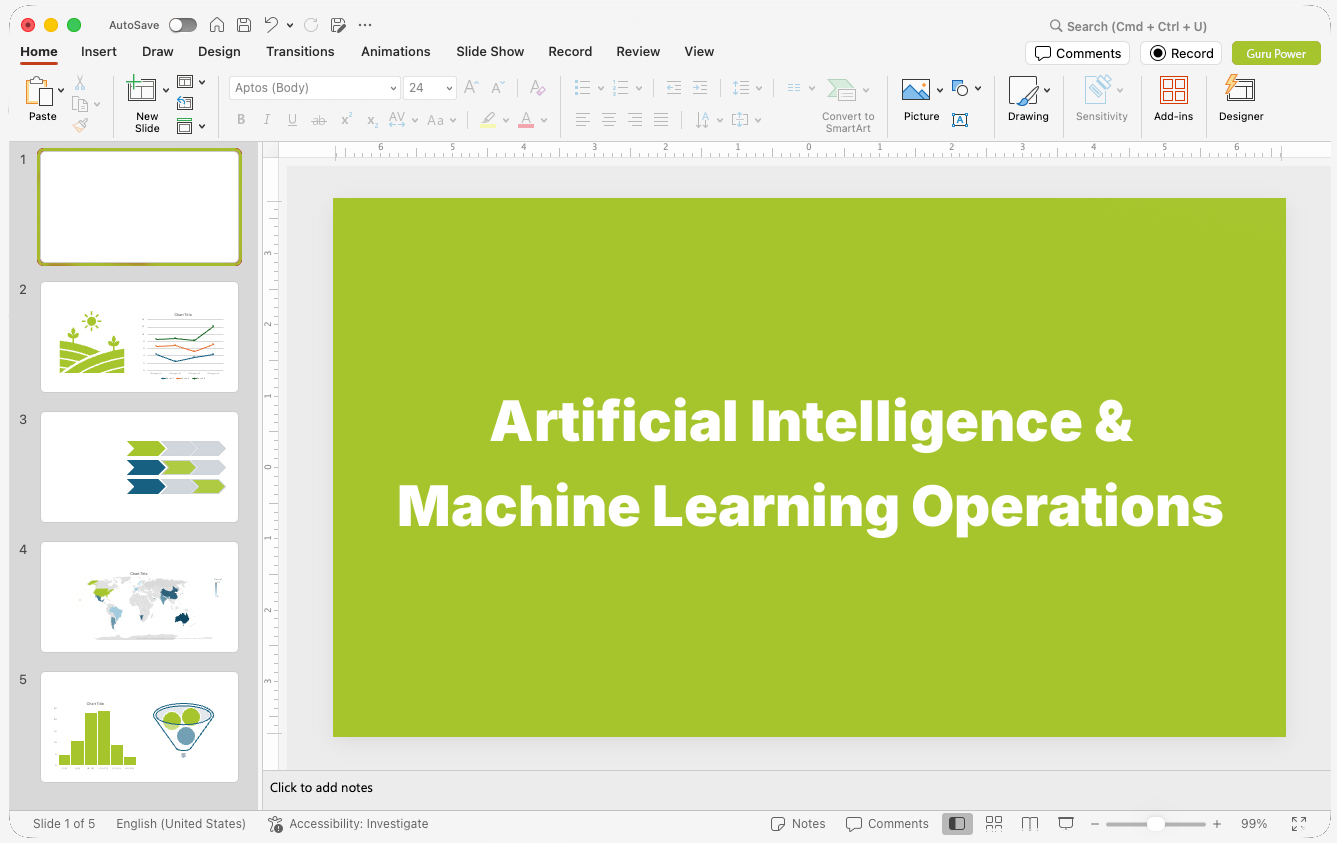
When Technical Leaders Need Clear Strategic Presentations That Align Engineers, Executives, and Investors
Artificial Intelligence & Machine Learning Operations Presentation Design is the specialized discipline of structuring complex machine learning infrastructure, data pipelines, model governance frameworks, and operational risks into clear, executive-ready visual presentations for enterprise decision-makers and investors.
Presentation Gurus builds dedicated communication assets for machine learning engineering teams and enterprise technology leaders. Engineering leaders face strict operational requirements when pitching infrastructure investments or reporting model performance. We design structured Machine Learning Operations Infrastructure Pitch Decks, AI Model Governance Presentation decks, and MLOps Pipeline Architecture Slides that clarify technical dependencies for non-technical buyers. Building an effective presentation requires bridging the gap between low-level system metrics and enterprise financial returns. Whether your team needs an executive PowerPoint deck for board meetings, an updated pitch deck for venture funding, or standardized Google Slides for internal engineering alignment, our strategic workflow translates your system logs into clear operational visual stories.
Why Artificial Intelligence & Machine Learning Operations Presentations Need Professional Presentation Design
Machine learning engineering teams struggle to communicate complex system architecture and operational overhead to executive stakeholders. Non-technical decision-makers often misinterpret operational model drift, latency overhead, and pipeline retraining expenses as simple software maintenance. Standard corporate decks rely on generic templates that fail to convey machine learning governance, data lineage, and infrastructure costs. Strategy-led presentation design solves this by structuring pipeline mechanics into clear business impact models. Engineering risk gets translated into financial risk, and infrastructure scaling gets mapped directly to revenue reliability. Strategic slide architecture uses functional system diagrams instead of vague conceptual icons. Executives gain an immediate understanding of model deployment bottlenecks, compliance exposure, and resource requirements. The market requires technical clarity to justify capital allocation for machine learning engineering. Teams using strategy-led presentations secure faster executive sign-offs, streamline technical auditing processes, and align engineering priorities with core corporate growth goals.
How Working With Us Works
From First Conversation To Finished Deck
Company
Meet JR, our founder. Fortune 500s, SMBs, startups — he’s built presentations for all of them with his team for the past 30 years, and he’s ready to build yours.
Service
Find your fit. We match the right service and scope to your audience, your goals, and your deadline, from 24-hour service to a 15-day turnaround.
Cost
Know the number upfront. Transparent, flat pricing before we start — no surprises, no hidden hours. All from $49 per slide.
Get Started
Tell us about your presentation project. It will take two minutes and we’ll get back to you on our next business day.













12 Essential Presentation Types for Artificial Intelligence & Machine Learning Operations
MLOps Pipeline Architecture Slides
Primary Audience: Enterprise Chief Technology Officers and Software Engineering Directors.
Purpose: Secure approval for automated deployment pipeline tooling and cloud infrastructure budgets.
Description: This presentation maps data ingestion, feature stores, continuous training loops, and model registry components. The data shows that unautomated deployment creates operational bottlenecks across enterprise IT teams. The deck details system throughput, latency thresholds, and automated rollback triggers. Industry requirements mandate clear structural isolation between staging and production environments.
Machine Learning Operations Infrastructure Pitch Deck
Primary Audience: Venture Capital Investors and Strategic Corporate Development Teams.
Purpose: Raise growth capital for specialized model deployment platforms.
Description: The pitch-deck breaks down cloud resource optimization, compute efficiency, and developer productivity gains. Market growth requires dedicated orchestration frameworks to handle scaling production workloads. The presentation outlines unit economics, customer deployment timelines, and competitive positioning against legacy cloud infrastructure. Investors expect clear burn rate figures alongside operational platform adoption metrics.
AI Operations Model Governance Presentation
Primary Audience: Chief Risk Officers, Compliance Committees, and Legal Counsel.
Purpose: Demonstrate regulatory compliance, data lineage tracking, and audit readiness.
Description: Regulatory mandates require strict audit trails for automated decisioning systems. This presentation details data provenance, bias testing protocols, and explainability frameworks across production workflows. Visual matrices highlight automated policy enforcement and model versioning logs. The structure proves compliance to internal governance boards and external regulatory authorities.
Machine Learning Engineering Continuous Training Deck
Primary Audience: Lead Data Scientists and Enterprise Software Architects.
Purpose: Align technical teams on automated retraining triggers and drift detection thresholds.
Description: Model drift degrades predictive accuracy over time if monitoring triggers fail. This technical slide deck outlines statistical drift monitoring methodologies, automated pipeline execution, and validation checks. System diagrams define data drift limits alongside baseline retraining workflows. The documentation establishes standardized operational procedures across distributed engineering units.
ModelOps Enterprise Integration PowerPoint
Primary Audience: Enterprise IT Integration Managers and Systems Engineers.
Purpose: Standardize cross-departmental model deployment pipelines and API orchestration.
Description: Enterprise software environments require standardized operational patterns for connecting machine learning endpoints to legacy applications. This PowerPoint presentation maps REST API contracts, containerization standards, and security authentication protocols. The slides define service-level agreements for system uptime and model inference latency. Engineering teams use this deck to enforce consistent operational standards across subsidiaries.
LLMOps Compute Budget Slide-Deck
Primary Audience: Chief Financial Officers and Vice Presidents of Engineering.
Purpose: Justify hardware, GPU allocation, and cloud compute expenditures for large model fine-tuning.
Description: Large language model operations demand significant capital allocation for GPU clusters and API tokens. This budget slide-deck outlines operational costs per inference, dynamic batching savings, and cloud vendor cost comparisons. The financial analysis proves ROI through reduced latency and automated pipeline optimization. Decision-makers receive exact cost-scaling projections tied to user concurrency.
AI Infrastructure Performance Monitoring Presentation
Primary Audience: Site Reliability Engineers and Infrastructure Operations Managers.
Purpose: Establish real-time observability protocols for production machine learning clusters.
Description: Production models require continuous uptime and anomaly detection to prevent revenue loss. This operational presentation outlines telemetry stack integration, log aggregation, and automated incident alert thresholds. Visual dashboards demonstrate target mean-time-to-detection and resolution metrics. The deck standardizes on-call operational response workflows for mission-critical deployments.
Machine Learning Pipelines Feature Store Pitch Deck
Primary Audience: Enterprise Data Platform Leads and Head of Data Engineering.
Purpose: Drive adoption of centralized feature registries across business unit teams.
Description: Redundant feature engineering wastes compute resources and introduces model inconsistency. This internal pitch deck outlines the cost reduction achieved by consolidating feature pipelines into a centralized registry. The slides highlight feature reusability metrics, offline-to-online data consistency, and access control governance. Engineering leaders use this asset to secure cross-team platform migration commitments.
MLOps Vendor Evaluation Presentation
Primary Audience: Enterprise Procurement Committees and Technology Procurement Officers.
Purpose: Guide vendor selection for third-party model monitoring and deployment tools.
Description: The market requires systematic evaluation criteria when selecting commercial machine learning tools. This slide presentation compares vendor capabilities across pipeline integration, security compliance, deployment flexibility, and pricing models. Weighted scoring matrices present clear vendor rankings based on operational fit. Procurement teams utilize this asset to negotiate enterprise software licensing terms.
AI Operations Edge Deployment Slides
Primary Audience: Embedded Systems Engineers and IoT Hardware Product Managers.
Purpose: Approve architectural frameworks for deploying models onto edge hardware devices.
Description: Edge deployment requires severe optimization due to memory, power, and bandwidth constraints. These technical slides detail model quantization, pruning techniques, and local inference execution frameworks. System diagrams display offline caching logic and delta synchronization protocols. Product teams use the deck to guide edge-hardware integration roadmaps.
ModelOps Incident Post-Mortem Slide-Deck
Primary Audience: Executive Leadership and Technical Advisory Boards.
Purpose: Document root-cause analysis and operational remediation following a model failure.
Description: Production model outages or unexpected output drift require transparent post-mortem analysis. This slide-deck outlines failure timelines, root causes, financial impact, and structural prevention steps. The problem is isolated to specific data ingestion pipeline failures or unmonitored upstream schema changes. The deck provides concrete operational commitments to prevent recurring deployment incidents.
Machine Learning Engineering Security PowerPoint
Primary Audience: Chief Information Security Officers and Cybersecurity Operations Teams.
Purpose: Approve security controls against adversarial attacks, model inversion, and data poisoning.
Description: Machine learning pipelines introduce novel threat vectors that traditional software security tools miss. This PowerPoint presentation details container scanning procedures, input sanitization workflows, and RBAC governance for model registries. Threat models illustrate defense mechanisms against training data manipulation. Security leaders use this document to validate platform hardiness before production release.
Your PowerPoint, Google Slide and KeyNote Strategy, Story and Design Professionals
Our team transforms complex engineering concepts into precise visual structures without losing technical accuracy. We eliminate generic graphics, replacing them with clear pipeline workflows, governance matrices, and cost-allocation charts tailored to machine learning infrastructure. Every slide deck, presentation, and custom pitch deck maintains strict visual hierarchy and enterprise brand standards. We deliver modular PowerPoint assets that allow engineering teams to update performance metrics and architecture nodes seamlessly. Contact Presentation Gurus today to review your current deck and schedule an intake session with our technical presentation strategists.
Ready ToGet Started?
Questions & Answers
Artificial Intelligence & Machine Learning Operations Presentations FAQs
Does our industry need a Presentation or a Pitch Deck?
The terms are frequently used interchangeably, but they serve different strategic purposes. A pitch deck is a highly visual, persuasive tool designed to secure a strategic commitment or investment. A standard presentation is an informative, detailed document structured to align stakeholders and share data.
What technical background is required from our team during the deck intake process?
Your team provides raw system diagrams, whitepapers, or existing internal documentation. Our presentation strategists extract key architecture nodes, operational bottlenecks, and financial metrics to construct the logical story without requiring engineering teams to draft copy.
Will our team receive the fully editable source file?
Yes. Unlike graphic designers who deliver flat PDFs or JPEGs, Presentation Gurus delivers the native, fully editable presentation file (.pptx, .key, etc.) so your team can make last-minute text edits on the fly, or update the presentation later as details change.
How do you handle technical updates to model performance statistics in the presentation?
We build presentations using modular components and native chart elements in PowerPoint or Google Slides. This infrastructure allows your internal team to edit underlying data tables, accuracy percentages, and cloud expenditure figures without breaking layout formatting.
What does Artificial Intelligence & Machine Learning Operations Presentations presentation design cost?
Pricing is simple and clear. A basic slide design or redesign begins at $49 per slide. Premium presentation design, which includes copywriting and basic storytelling, starts at $79 per slide. Custom presentations involving strategy, copywriting and custom graphics are quoted based on your specifications. See complete pricing details here.
How does the collaboration process work?
Everything happens online. Every meeting is a Microsoft Teams call or similar virtual environment where we can share desktops and information in real time. Revision meetings and discovery calls are always scheduled in the morning, so by noon we can begin work on tasks for the next revision meeting.
How do you translate complex MLOps pipeline architecture into an executive PowerPoint deck?
We replace abstract network diagrams with structured process flows that isolate inputs, deployment logic, and business impact. Engineering metrics like latency and throughput are mapped directly to operational cost, compliance safety, and enterprise customer experience.
We have sensitive business information. Can you work under an NDA?
Virtually all of our client work is done under an NDA. We have a basic NDA included with our presentation work order, plus an enhanced, expanded non-disclosure agreement available whenever a project calls for it.
Can your team design slides that comply with strict enterprise IT governance requirements?
Yes. We structure model monitoring, data lineage, and security compliance metrics into standardized tabular layouts and clear risk heatmaps. This format allows internal security auditors and enterprise buyers to evaluate system safety quickly.
How long does it take to get a presentation designed?
If your team needs a complete presentation by 9:00 AM the next day, we can meet that deadline. Most projects take 10 – 15 days, providing we have all the information. Pricing is also based on slide complexity and speed — a basic slide deck with a 15-day delivery costs much less than a premium slide deck delivered the next morning.
Presentation Gurus' research identifies 15 locations with active Artificial Intelligence & Machine Learning Operations operations, including San Francisco, CA, Seattle, WA, and New York, NY.
Operational teams working across machine learning pipelines rely on robust infrastructure to move complex models from development into production. In San Francisco, CA, headquarters for OpenAI, Databricks, and leading MLOps platform creators set the benchmark for modern deployment tooling. That focus extends southward to San Jose, CA, a primary hub for AI hardware optimization and compute acceleration research, while Los Angeles, CA applies these frameworks to media technology, recommendation engine operations, and defense technology systems. Down the coast, San Diego, CA maintains a specialized cluster dedicated to biotech and genomic machine learning pipeline engineering.
Cloud backbones are critical to keeping these distributed models running reliably. In Seattle, WA, teams support major cloud infrastructure hubs for AWS and Microsoft Azure machine learning operations. This links directly to broader enterprise movements within Cloud Computing Infrastructure (IaaS/PaaS) and specialized DevOps & Cloud Migration Services. Further inland, Denver, CO provides an expanding market for cloud infrastructure startups and remote engineering teams, while Salt Lake City, UT operates a growing enterprise SaaS cluster focused on data infrastructure tools.
High-throughput data demands also transform traditional corporate centers. In New York, NY, financial enterprise teams deploy high-frequency model pipeline infrastructure to handle market shifts in real time. Similarly, Chicago, IL hosts large enterprise logistical and financial firms scaling internal production model pipelines. These environments share deep operational ties with both Enterprise Software-as-a-Service (SaaS) platforms and Cybersecurity & Threat Intelligence systems that protect core pipelines from operational vulnerabilities.
Technical specialization continues across regional research corridors. Academic research clusters in Boston, MA consistently drive enterprise machine learning deployment spin-offs, frequently crossing into Healthtech & Digital Health Software. In Pittsburgh, PA, engineering efforts center on robotics, autonomous systems, and embedded machine learning frameworks. Government, defense, and public sector machine learning compliance and governance clusters anchor the work happening in Washington, DC, where operational oversight remains paramount.
Growth across the southern and central regions shows similar momentum. Austin, TX has become a major destination for enterprise software engineers and specialized AI hardware operations. In Atlanta, GA, a technological center thrives around enterprise data engineering, while the Research Triangle hub in Raleigh, NC focuses heavily on automated data science workflows. Beyond coastal markets, Missouri shows steady expansion, where Balto, an artificial intelligence SaaS company, is active and growing in the St. Louis technology ecosystem.
As organizations standardize their architectures, standard operating procedures help technical teams communicate model health and deployment milestones. The Step-by-Step SOP Overview outlines structured approaches for documenting these mission-critical practices clearly. Maintaining these standards is equally vital across related fields such as IT Managed Service Providers (MSPs), Telecommunications & Network Infrastructure, and modern Edtech Platform Development. When teams need to translate complex architectural diagrams, deployment stages, and data flows into clear slides, partnering with an experienced presentation design agency helps keep every stakeholder aligned.