
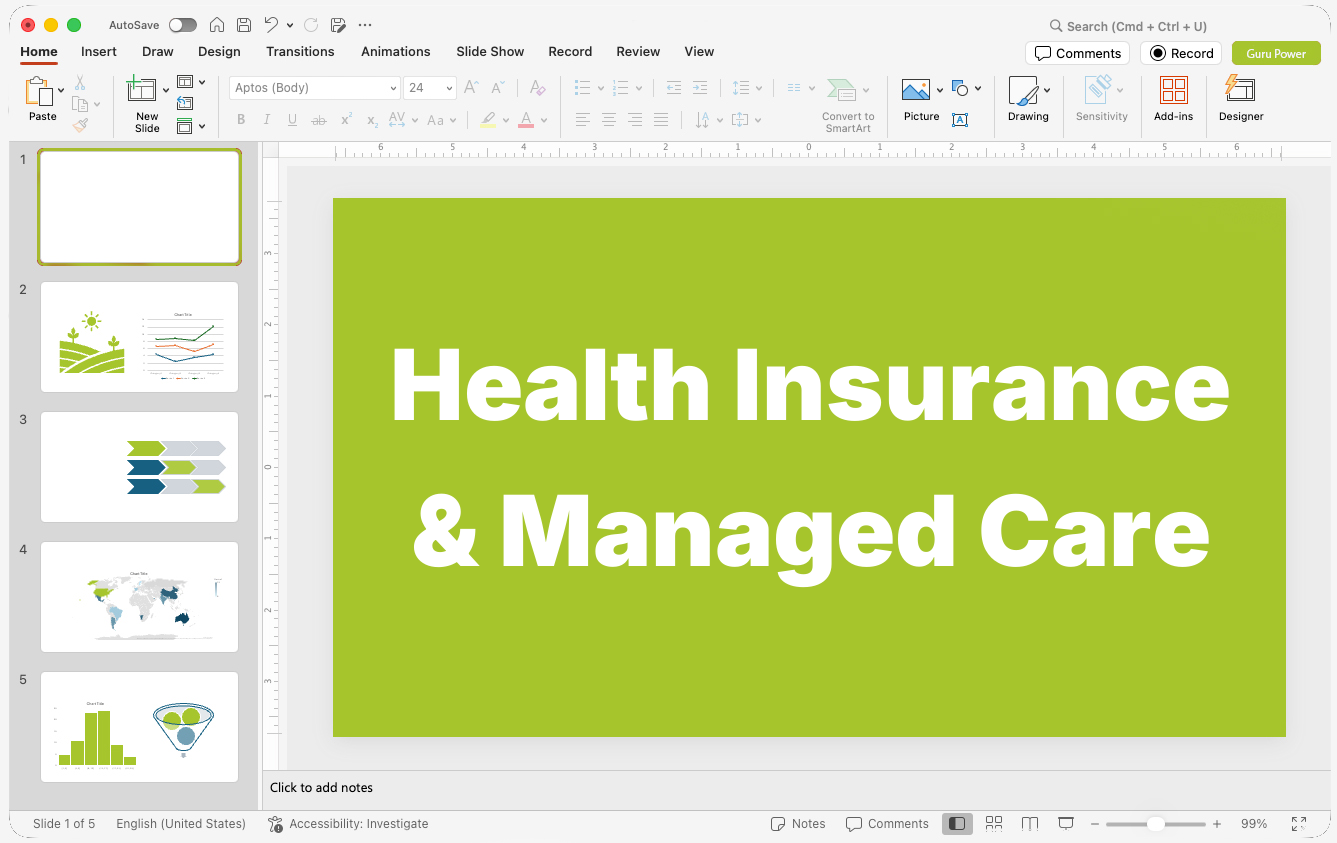
When Health Insurance & Managed Care Decision-Makers Need Strategic Presentations Addressing Business Outcomes
Health Insurance & Managed Care Presentation Design is a specialized business service that translates complex health plan financial metrics, payer-provider risk contracts, regulatory compliance reporting, and utilization management frameworks into clear, strategy-led visual decks for healthcare executives.
Presentation Gurus serves as the dedicated design partner for health insurance and managed care entities requiring visual structure for critical operational, clinical, and financial communications. Industry requirements mandate clear visual positioning when delivering a payer-provider network integration deck, a Medicare Advantage bid defense presentation, or a commercial health plan proposal pitch deck. Payers and health plans must present complex capitation structures, quality rating metrics, and utilization management workflows to non-technical stakeholders. Working directly with your corporate strategy, underwriting, and medical management teams, Presentation Gurus translates technical data sets into clean PowerPoint slides that drive executive alignment. Whether your team requires a refreshed slide deck for an upcoming board meeting or a structured presentation for state Medicaid procurement, the visual framework ensures key financial and operational claims are clear.
Why Health Insurance & Managed Care Presentations Need Professional Presentation Design
The data shows that health insurance and managed care organizations operate under strict margin constraints and changing regulatory requirements. Standard presentations rely on generic text blocks and cluttered spreadsheets that obscure critical financial performance metrics and network operational realities. Strategy-led design restructures these complex inputs into clear narrative architectures. The problem is that complex actuarial tables and medical management data lose impact without visual hierarchy. Competitors present dense, unformatted technical slides that confuse board members and procurement teams. Strategic presentation design addresses this gap by mapping provider network metrics, risk-adjustment formulas, and medical loss ratios into clear visual models. This methodology establishes clear links between operational performance, compliance standards, and revenue targets. The measurable outcome is improved executive comprehension, accelerated contract approval timelines, and effective alignment among corporate oversight committees.
How Working With Us Works
From First Conversation To Finished Deck
Company
Meet JR, our founder. Fortune 500s, SMBs, startups — he’s built presentations for all of them with his team for the past 30 years, and he’s ready to build yours.
Service
Find your fit. We match the right service and scope to your audience, your goals, and your deadline, from 24-hour service to a 15-day turnaround.
Cost
Know the number upfront. Transparent, flat pricing before we start — no surprises, no hidden hours. All from $49 per slide.
Get Started
Tell us about your presentation project. It will take two minutes and we’ll get back to you on our next business day.












13 Essential Presentation Types for Health Insurance & Managed Care
Payer-Provider Network Integration Deck
Primary Audience: Health system executives and physician network leads.
Purpose: Secure participation agreements for value-based care networks.
Description: This Health Insurance & Managed Care slide-deck outlines network expansion targets, reimbursement schedules, and clinical quality expectations. The presentation visualizes risk-sharing tiers, credentialing workflows, and administrative integration pathways. Key charts highlight projected patient volume shifts and shared-savings opportunities under modern care models.
Medicare Advantage Bid Defense Presentation
Primary Audience: CMS reviewers and corporate oversight committees.
Purpose: Validate plan pricing, benefit structures, and risk models.
Description: This Managed Care Organization presentation details benefit package design, regional pricing strategy, and Star Ratings performance metrics. The slides display historical claim data alongside projected utilization rates across targeted demographic zones. Executive summary layouts highlight medical loss ratio projections and supplemental benefit allocations.
Commercial Health Plan Employer Pitch-Deck
Primary Audience: Corporate HR directors and employee benefit brokers.
Purpose: Win group coverage contracts for employer groups.
Description: This Health Plan PowerPoint presents tier options, wellness incentives, and administrative fee structures to employer groups. The presentation visualizes plan architecture across preferred provider networks and high-deductible options. Clear visual comparisons illustrate cost-containment measures and digital member-engagement tools.
Medicaid Managed Care Procurement Presentation
Primary Audience: State healthcare procurement officers and evaluation committees.
Purpose: Secure state Medicaid managed care program contracts.
Description: This Managed Care Organization deck presents population health management capabilities, community outreach programs, and care coordination infrastructure. The presentation highlights compliance track records, social determinants of health initiatives, and provider access standards. Structured maps show network adequacy coverage across urban and rural counties.
Medical Loss Ratio Executive Board Presentation
Primary Audience: Corporate board of directors and chief financial officers.
Purpose: Evaluate quarterly financial performance and claims expense trends.
Description: This Health Payer slides presentation breaks down claims paid against earned premiums across commercial, Medicare, and Medicaid business lines. The PowerPoint deck isolates specialty drug spending, inpatient utilization, and administrative overhead costs. Visual charts highlight variance against budgeted loss ratio benchmarks and statutory reserves.
HEDIS Quality Performance Review Deck
Primary Audience: Clinical quality directors and medical management leadership.
Purpose: Drive operational improvements in clinical quality metrics.
Description: This Health Maintenance Organization presentation details measure compliance, preventive screening rates, and chronic disease management outcomes. The slide-deck maps year-over-year performance changes against national benchmark standards. Visual action plans outline targeted provider outreach and patient engagement protocols.
PPO Annual Rate Renewal Slide-Deck
Primary Audience: Enterprise client benefit committees and risk managers.
Purpose: Justify premium rate adjustments and plan design changes.
Description: This Preferred Provider Organization pitch-deck reviews claim utilization patterns, large-claim impacts, and inflation factors for large employer accounts. The presentation provides visual evidence supporting proposed rate adjustments and stop-loss threshold changes. Scenario slides illustrate the financial impact of plan design modifications.
Value-Based Care Shared Savings Presentation
Primary Audience: Accountable Care Organization (ACO) leaders and medical directors.
Purpose: Reconcile annual financial settlements and quality bonus payouts.
Description: This Health Care Financing deck summarizes annual spending against risk-adjusted benchmarks for attribution populations. The slides illustrate savings distribution calculations, quality score multipliers, and trend line adjustments. Clear visual models isolate actionable care gaps and high-cost utilization metrics.
Pharmacy Benefit Management Strategy Deck
Primary Audience: Payer formulary committees and executive leadership.
Purpose: Approve annual formulary designs and drug rebate strategies.
Description: This Medical Insurance PowerPoint examines specialty pharmaceutical spend trends, biosimilar adoption, and rebate performance. The presentation visually details formulary tier placements, prior authorization protocols, and member cost-sharing impacts. Graphs map net drug cost projections against historic spend curves.
Stop-Loss Reinsurance Underwriting Deck
Primary Audience: Reinsurance underwriters and capital allocation committees.
Purpose: Secure excess loss coverage for self-funded employer groups.
Description: This Commercial Payer slide-deck presents group risk profiles, catastrophic claim histories, and specific deductibles. The presentation utilizes structured tables to illustrate exposure levels across high-cost claimant categories. Visual risk models justify policy terms and aggregate stop-loss attachment points.
Population Health Management Program Pitch-Deck
Primary Audience: Employer group risk managers and health plan sponsors.
Purpose: Expand enrollment in targeted wellness and disease management plans.
Description: This Health Plan presentation maps chronic condition prevalence, intervention strategies, and projected return on investment. The slides highlight member stratification models, telephonic coaching outreach, and digital health monitoring integration. Case study layouts demonstrate clinical outcome improvements and cost avoidance.
Utilization Management Operational Review Slides
Primary Audience: Chief medical officers and operational department heads.
Purpose: Optimize authorization workflows and medical necessity review times.
Description: This Managed Care Organization PowerPoint details prior authorization volumes, approval rates, and appeal processing turnaround times. The deck isolates denial trends by clinical category and provider specialty group. Flowcharts map automated decision pathways alongside peer-to-peer review escalations.
Health Plan Market Expansion Pitch-Deck
Primary Audience: Venture investors and corporate strategy executives.
Purpose: Secure capital for entry into new geographic insurance markets.
Description: This Health Insurance & Managed Care slide-deck details target market demographics, competitor market shares, and regulatory licensing steps. The presentation outlines provider network construction milestones and distribution channel partnerships. Financial forecast slides project enrollment growth, premium revenues, and break-even timelines.
Your PowerPoint, Google Slide and KeyNote Strategy, Story and Design Professionals
Presentation Gurus builds structured, high-impact decks tailored to health insurance and managed care brands. Every layout enforces strict visual hierarchy, brand consistency, and accurate visual representation of complex medical economics. Our design process converts dense text, compliance disclosures, and operational flowcharts into intuitive visual assets. By pairing strategic content design with polished visual assets, your team can present market expansion plans, value-based care initiatives, and regulatory filings with precision. Contact Presentation Gurus today to schedule a consultation for your next pitch deck or executive presentation.
Ready ToGet Started?
Questions & Answers
Health Insurance & Managed Care Presentations FAQs
We have sensitive business information. Can you work under an NDA?
Virtually all of our client work is done under an NDA. We have a basic NDA included with our presentation work order, plus an enhanced, expanded non-disclosure agreement available whenever a project calls for it.
How does specialized presentation design help managed care organizations?
Managed care organizations rely on complex data involving capitation rates, HEDIS quality scores, and medical loss ratios. Specialized presentation design converts technical spreadsheets into structured visual models, enabling board members, regulators, and employer groups to rapidly evaluate financial health and clinical performance.
Can confidential health plan data and financial projections be protected?
Yes. Non-disclosure agreements protect all proprietary health plan data, employer client information, and financial projections. Visual formatting can utilize anonymized data sets or placeholder figures during initial draft stages if required by corporate compliance policies.
How do visual presentation decks improve provider network contracting?
Visual decks effectively summarize fee schedules, shared savings arrangements, and administrative requirements for provider groups. Clear visual representation of risk-sharing tiers and clinical performance benchmarks reduces negotiation friction and aligns payer-provider operational goals.
How does the collaboration process work?
Everything happens online. Every meeting is a Microsoft Teams call or similar virtual environment where we can share desktops and information in real time. Revision meetings and discovery calls are always scheduled in the morning, so by noon we can begin work on tasks for the next revision meeting.
What does Health Insurance & Managed Care Presentations presentation design cost?
Pricing is simple and clear. A basic slide design or redesign begins at $49 per slide. Premium presentation design, which includes copywriting and basic storytelling, starts at $79 per slide. Custom presentations involving strategy, copywriting and custom graphics are quoted based on your specifications. See complete pricing details here.
Will our team receive the fully editable source file?
Yes. Unlike graphic designers who deliver flat PDFs or JPEGs, Presentation Gurus delivers the native, fully editable presentation file (.pptx, .key, etc.) so your team can make last-minute text edits on the fly, or update the presentation later as details change.
How long does it take to get a presentation designed?
If your team needs a complete presentation by 9:00 AM the next day, we can meet that deadline. Most projects take 10 – 15 days, providing we have all the information. Pricing is also based on slide complexity and speed — a basic slide deck with a 15-day delivery costs much less than a premium slide deck delivered the next morning.
Does our industry need a Presentation or a Pitch Deck?
The terms are frequently used interchangeably, but they serve different strategic purposes. A pitch deck is a highly visual, persuasive tool designed to secure a strategic commitment or investment. A standard presentation is an informative, detailed document structured to align stakeholders and share data.
What information is needed to begin a health insurance deck design project?
Project initiation requires your raw content, draft text, data points, brand guidelines, and target audience profiles. The design process restructures existing materials into a clear visual narrative while ensuring compliance disclaimers and proprietary financial figures remain accurate.
Presentation Gurus' research identifies 13 locations with active Health Insurance & Managed Care operations, including Minnetonka, MN, Hartford, CT, and Indianapolis, IN.
Health plans and managed care organizations coordinate coverage, process claims, and manage care networks for millions of Americans every day. In Minnetonka, MN, UnitedHealth Group leads the country as the largest health insurance and managed care provider. Farther east, Hartford, CT functions as a historic insurance center, hosting key operations for Aetna and Cigna. The sector also holds a major footprint across New England, with CVS Health serving as one of the largest corporate employers based in Rhode Island. In New York, NY, organizations like EmblemHealth and Empire BlueCross BlueShield guide administration across the metropolitan area, while regional teams in Virginia Beach, VA handle high-volume claims processing and core operational workflows.
Across the Midwest, large carriers steer extensive regional and state networks. Elevance Health operates from its corporate base in Indianapolis, IN, ranking among the largest corporate employers in Indiana. Nearby in Louisville, KY, Humana guides nationwide Medicare Advantage programs, making it a prominent enterprise anchor in Kentucky. In neighboring Ohio, CareSource manages extensive non-profit managed care plans out of Dayton. Blue Cross Blue Shield operations run deep throughout the region as well, with Health Care Service Corporation managing plans across five states from Chicago, IL and Blue Cross Blue Shield of Michigan directing statewide networks from Detroit, MI.
Integrated delivery systems and carrier networks continue down the coast and into the South. In Pennsylvania, Independence Health Group maintains its corporate base in Philadelphia, PA, while Highmark Health combines financing and clinical care delivery out of Pittsburgh, PA. Down in Tampa, FL, administrative centers direct WellCare operations alongside national call centers for Medicare and Medicaid programs. Regional corporate leaders and preferred provider organizations coordinate extensive coverage from Dallas, TX, while Kaiser Permanente oversees integrated managed care on the West Coast from Oakland, CA.
Health insurance operations intersect closely with care delivery and clinical support. Payer networks connect directly with Hospital Systems & Healthcare Networks and Outpatient & Ambulatory Care Centers to establish patient options and reimbursement policies. Digital integration is sustained through platforms developed by Healthcare IT & Electronic Health Records (EHR) providers. Specialized coverage frameworks also guide clinical partnerships with Mental Healthcare & Behavioral Health Services and Physical Therapy & Rehabilitation Networks. Upstream, insurer formularies and medical policies evaluate discoveries emerging from Biotechnology Research, trial data gathered by Clinical Research Organizations (CROs), and therapeutic innovations produced by Medical Device & Diagnostics Manufacturing teams. Working with a dedicated presentation design agency helps healthcare and payer leaders translate these complex regulatory, clinical, and financial relationships into clear slide decks for executive boards and member communities.
Health Insurance & Managed Care Presentations By the Numbers
- Private health insurance spending grew 8.8% to $1,644.6 billion in 2024, accounting for 31 percent of total national health expenditures. (NHE Fact Sheet – CMS)
- The average annual premium for employer-sponsored family health coverage reached $25,572 in 2024. (2024 Employer Health Benefits Survey – KFF)