
When Medical Imaging & Radiology Services Decision-Makers Need Strategic Presentations Addressing Business Outcomes
Medical Imaging & Radiology Services Presentation Design is the strategic structuring and visual development of executive decks to communicate diagnostic capabilities, teleradiology workflows, software integrations, and capital equipment value propositions to healthcare decision-makers.
Presentation Gurus serves as the dedicated presentation design partner for health systems, diagnostic centers, and teleradiology providers. We build high-stakes decks tailored specifically to the operational realities of the radiology sector. Whether your team needs a specialized Teleradiology Service Expansion Pitch-Deck for health system administrators or an AI-Driven Radiology Software Presentation for hospital CIOs, we structure every slide around clinical and financial metrics. We regularly develop Outpatient Imaging Center Acquisition Pitch-Decks that align clinical directors and financial officers around capital expenditure ROI. A well-constructed slide deck clarifies technical capability while maintaining strict narrative control. Our team translates complex PACS/RIS architectures, throughput metrics, and clinical workflows into executive-ready visual presentations.
Why Medical Imaging & Radiology Services Presentations Need Professional Presentation Design
The data shows that hospital purchasing committees and healthcare investors evaluate medical imaging proposals on capital risk, operational efficiency, and clinical throughput. Standard presentations fail because they over-index on raw diagnostic specifications while ignoring patient workflow bottlenecks, reimbursement codes, and technology integration timelines. Strategy-led presentation design solves this gap by organizing complex radiology service capabilities around high-priority executive metrics. Complex imaging modalities are mapped directly to revenue cycles, referral retention rate, and staffing utilization figures. This structured approach simplifies decision-making for executive boards and clinical committees alike. The measurable outcome is shorter sales cycles, clearer investor buy-in, and higher approval rates for major imaging service contracts.
How Working With Us Works
From First Conversation To Finished Deck
Company
Meet JR, our founder. Fortune 500s, SMBs, startups — he’s built presentations for all of them with his team for the past 30 years, and he’s ready to build yours.
Service
Find your fit. We match the right service and scope to your audience, your goals, and your deadline, from 24-hour service to a 15-day turnaround.
Cost
Know the number upfront. Transparent, flat pricing before we start — no surprises, no hidden hours. All from $49 per slide.
Call 480-386-6000
Call us now. We’re open and we answer the phone. Or complete our quote request form that takes less than two minutes.
















12 Essential Presentation Types for Medical Imaging & Radiology Services
Teleradiology Service Expansion Pitch-Deck
Primary Audience: Hospital Chief Medical Officers and Health System Procurement Officers.
Purpose: Secure long-term outsourced coverage contracts for remote diagnostic reading.
Description: This Medical Imaging presentation outlines overnight and subspecialty remote reading capabilities. The Slide-Deck details subspecialty board certifications, guaranteed report turnaround times, and PACS integration protocols. The PowerPoint structure highlights risk mitigation, staffing coverage reliability, and cost containment for regional hospital networks.
AI-Driven Radiology Software Presentation
Primary Audience: Chief Information Officers and Chiefs of Diagnostic Imaging.
Purpose: Gain IT clearance and clinical approval for AI triage software deployment.
Description: This Diagnostic Imaging Slide-Deck demonstrates machine learning algorithm accuracy, clinical trial validation, and DICOM workflow automation. The PowerPoint slides illustrate diagnostic accuracy improvements and reading time reductions per scan. The deck addresses cloud data security, HIPAA compliance, and EHR integration architecture.
Outpatient Imaging Center Acquisition Pitch-Deck
Primary Audience: Healthcare Private Equity Firms and Strategic Buying Groups.
Purpose: Obtain capital funding for acquiring and consolidating regional diagnostic sites.
Description: This Radiology Services Pitch-Deck presents financial modeling, patient volume metrics, and payor mix data for target facilities. The PowerPoint outlines revenue synergy opportunities, equipment lifecycle costs, and referral network expansion. The presentation deck provides investors with clear EBITDA projections and risk mitigation strategies.
Advanced MRI & CT Modality Capital Purchase Presentation
Primary Audience: Hospital Capital Allocation Committees and Health System CFOs.
Purpose: Approve capital expenditure for next-generation scanner installation.
Description: This Medical Imaging Slide-Deck compares technical specifications, patient throughput limits, and energy efficiency metrics across scan equipment models. The PowerPoint deck models scan volume capacity against lease costs and reimbursement rates. The presentation proves net revenue growth potential and reduced maintenance downtime.
Radiological Care Quality & Safety Compliance Presentation
Primary Audience: Joint Commission Inspectors and Hospital Quality Committees.
Purpose: Verify compliance with radiation dose tracking and patient safety regulations.
Description: This Radiological Care PowerPoint documents radiation protocol tracking, equipment calibration logs, and safety audits. The Slide-Deck outlines technologist training programs and accreditation compliance across facilities. The presentation provides clear visual data proof of low error rates and adherence to clinical safety guidelines.
Mobile Diagnostic Imaging Fleet Proposal Slides
Primary Audience: Rural Hospital Administrators and Urgent Care Clinic Directors.
Purpose: Establish recurring service leases for mobile CT and MRI units.
Description: This Diagnostic Imaging presentation introduces mobile modality units equipped with certified technologists. The PowerPoint Slide-Deck models scheduling flexibility, site requirements, and shared service cost structures. The pitch proves how smaller healthcare facilities can offer advanced imaging without capital equipment expenditures.
Teleradiology Subspecialty Peer Review Deck
Primary Audience: Clinical Governance Boards and Radiologist Medical Executive Committees.
Purpose: Establish standardized peer review and diagnostic quality assurance metrics.
Description: This Teleradiology presentation establishes double-blind reading error tracking and concordance scoring systems. The PowerPoint slides detail discrepancy resolution protocols and radiologist performance benchmarks. The deck demonstrates institutional commitment to diagnostic accuracy and continuous medical education.
Comprehensive Mammography Screening Program Presentation
Primary Audience: Women's Health Directors and Health System Marketing Executives.
Purpose: Expand community screening initiatives and 3D tomosynthesis adoption.
Description: This Medical Imaging Slide-Deck presents clinical evidence for early detection rates using advanced 3D mammography. The PowerPoint presentation maps patient flow, callback management, and primary care referral integrations. The deck provides operational plans for scaling outpatient screening volume.
Imaging Centers Joint Venture Pitch-Deck
Primary Audience: Independent Physician Associations and Regional Health Systems.
Purpose: Form co-owned outpatient diagnostic imaging centers.
Description: This Imaging Centers Pitch-Deck maps equity distribution, governance structures, and facility management terms. The PowerPoint deck details patient leakage reduction and local market share capture goals. The presentation outlines operational expense sharing and capital contribution timelines.
Nuclear Medicine & PET-CT Oncology Service Deck
Primary Audience: Oncology Department Chairs and Tumor Boards.
Purpose: Integrate advanced nuclear imaging into routine clinical cancer staging.
Description: This Radiology Services presentation details radiopharmaceutical tracer availability, scan resolution, and diagnostic precision for cancer tracking. The PowerPoint Slide-Deck presents clinical case comparisons between standard CT and PET-CT staging. The deck establishes referral pathways and scheduling turnaround standards.
Radiological Care Enterprise PACS Migration Presentation
Primary Audience: Health System IT Steering Committees and Chief Medical Officers.
Purpose: Secure budget approval to migrate legacy PACS to cloud enterprise infrastructure.
Description: This Radiological Care Slide-Deck evaluates cloud storage scalability, data redundancy, and zero-footprint viewer access. The PowerPoint presentation outlines legacy DICOM data migration phases and network downtime risk controls. The presentation deck provides total cost of ownership savings projections over five years.
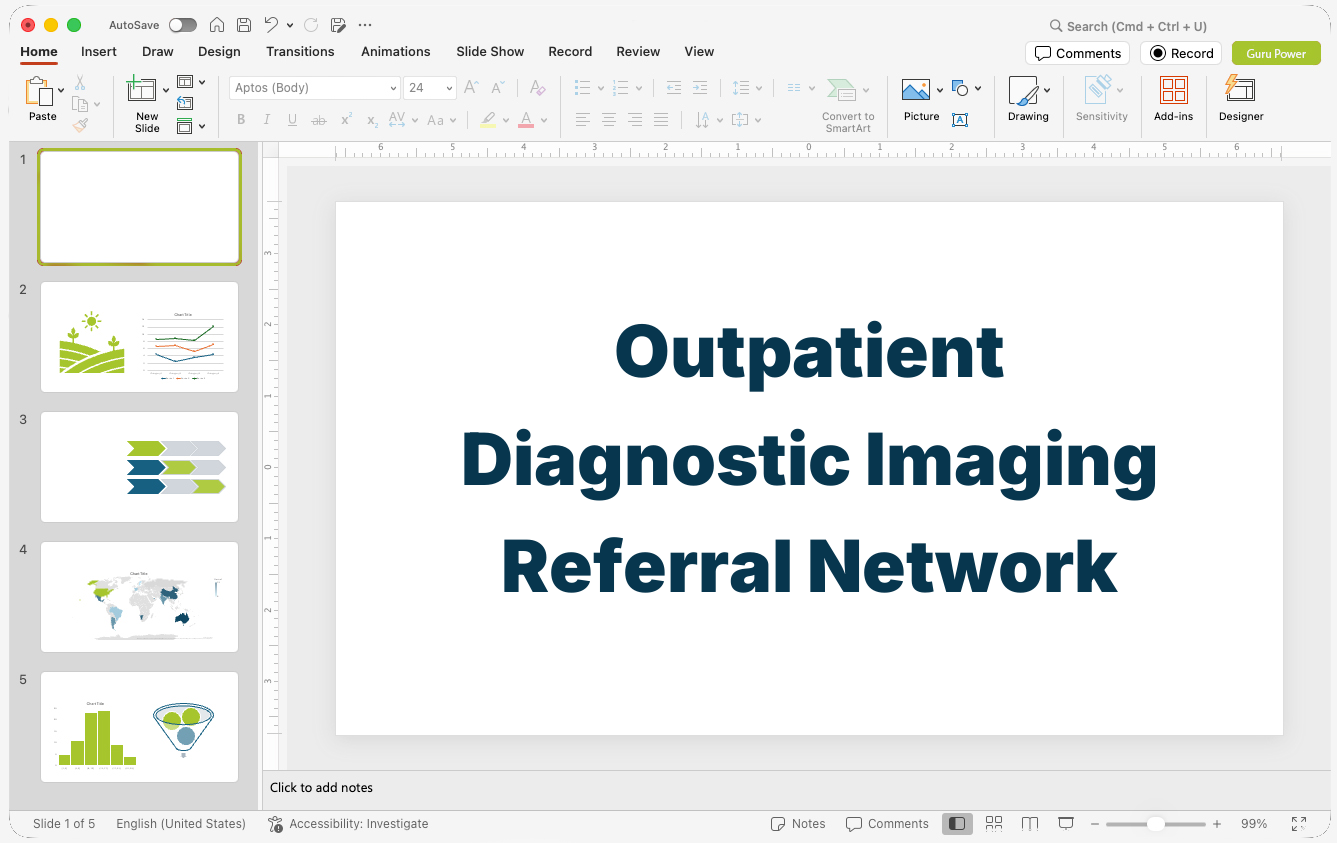
Outpatient Diagnostic Imaging Referral Network Deck
Primary Audience: Primary Care Physicians and Orthopedic Specialist Groups.
Purpose: Increase local physician order volume for diagnostic imaging facilities.
Description: This Diagnostic Imaging Slide-Deck outlines physician portal access, rapid scheduling turnarounds, and stat reading protocols. The PowerPoint presentation highlights patient convenience, insurance pre-authorization support, and online image viewing. The pitch demonstrates seamless integration with referring physician EMR systems.
Your PowerPoint, Google Slide and KeyNote Strategy, Story and Design Professionals
Presentation Gurus delivers end-to-end design, narrative structure, and brand alignment for diagnostic imaging organizations. We eliminate confusing text-heavy slides, replacing them with custom data visualizations, clear clinical workflow diagrams, and branded layouts. Every PowerPoint presentation we produce reflects your organization's technical authority while prioritizing reader comprehension. By combining precise visual storytelling with deep healthcare domain awareness, we ensure your pitch deck resonates with hospital executives, private equity buyers, and clinical leadership. Contact Presentation Gurus today to turn complex medical imaging data into structured, persuasive presentation decks that drive operational growth.
Ready ToGet Started?
Presentation Gurus is open.
Give us a call.
We actually answer the phone.
Questions & Answers
Medical Imaging & Radiology Services Presentations FAQs
Will our team receive the fully editable source file?
Yes. Unlike graphic designers who deliver flat PDFs or JPEGs, Presentation Gurus delivers the native, fully editable presentation file (.pptx, .key, etc.) so your team can make last-minute text edits on the fly, or update the presentation later as details change.
How do you handle HIPAA compliance and patient data visual privacy in radiology presentations?
We enforce strict data anonymization standards across all diagnostic visual assets. Sample DICOM images, patient charts, and case studies are systematically de-identified and replaced with fully compliant synthetic graphics or licensed clinical illustrations.
What slides are essential for a teleradiology group pitching to hospital systems?
A teleradiology presentation requires clear slides detailing subspecialty credentialing, turn-around-time SLAs, night-coverage workflows, and EHR integration timelines. It must also feature a financial model slide illustrating cost savings over full-time internal physician staffing.
How does the collaboration process work?
Everything happens online. Every meeting is a Microsoft Teams call or similar virtual environment where we can share desktops and information in real time. Revision meetings and discovery calls are always scheduled in the morning, so by noon we can begin work on tasks for the next revision meeting.
How do you explain complex PACS and DICOM software workflows in a PowerPoint slide deck?
We convert complex architectural schematics into simplified step-by-step diagnostic workflow diagrams. By isolating data flow, cloud integration points, and clinical user touchpoints across separate visual layers, non-technical hospital executives easily grasp software security, interoperability, and operational speed.
What does Medical Imaging & Radiology Services Presentations presentation design cost?
Pricing is simple and clear. A basic slide design or redesign begins at $49 per slide. Premium presentation design, which includes copywriting and basic storytelling, starts at $79 per slide. Custom presentations involving strategy, copywriting and custom graphics are quoted based on your specifications. See complete pricing details here.
How long does it take to get a presentation designed?
If your team needs a complete presentation by 9:00 AM the next day, we can meet that deadline. Most projects take 10 – 15 days, providing we have all the information. Pricing is also based on slide complexity and speed — a basic slide deck with a 15-day delivery costs much less than a premium slide deck delivered the next morning.
We have sensitive business information. Can you work under an NDA?
Virtually all of our client work is done under an NDA. We have a basic NDA included with our presentation work order, plus an enhanced, expanded non-disclosure agreement available whenever a project calls for it.
Can you design presentations for both clinical radiologists and hospital CFOs?
Yes. We design modular presentations featuring dual-track narratives. Core slides deliver financial metrics, volume forecasts, and reimbursement impact for CFOs, while optional deep-dive appendix slides showcase image resolution, diagnostic accuracy, and workflow software for clinical directors.
Does our industry need a Presentation or a Pitch Deck?
The terms are frequently used interchangeably, but they serve different strategic purposes. A pitch deck is a highly visual, persuasive tool designed to secure a strategic commitment or investment. A standard presentation is an informative, detailed document structured to align stakeholders and share data.
Presentation Gurus' research identifies 14 locations with active Medical Imaging & Radiology Services operations, including Rochester, MN, Boston, MA, and Cleveland, OH.
Clinical diagnostic teams and imaging researchers operate across major medical centers throughout the country. In Rochester, MN, Mayo Clinic maintains a massive diagnostic radiology department alongside dedicated research facilities. Similar research efforts anchor the Northeast, where Harvard-affiliated labs and Massachusetts General Hospital lead clinical studies in Boston, MA, while NYU Langone Radiology and Mount Sinai Health System run extensive networks throughout New York, NY. In Philadelphia, PA, Penn Medicine works alongside the Children’s Hospital of Philadelphia on specialized pediatric scans. These large hospital-anchored programs connect closely with broader initiatives in Hospital Systems & Healthcare Networks and drive continuous upgrades within Healthcare IT & Electronic Health Records (EHR).
Regional clinical networks also depend heavily on advanced imaging hubs to serve growing populations. Cleveland Clinic’s Imaging Institute coordinates regional centers out of Cleveland, OH, while the Texas Medical Center hosts programs at MD Anderson Cancer Center and Houston Methodist in Houston, TX. In Baltimore, MD, Johns Hopkins Medicine combines diagnostic radiology with active nuclear medicine units. Meanwhile, Northwestern Medicine facilities operate out of Chicago, IL, which also serves as the headquarters for the Radiological Society of North America. These clinical operations often intersect with external trials run by Clinical Research Organizations (CROs) and discoveries emerging from Biotechnology Research.
Outpatient facilities represent another major sector of diagnostic medicine. Operating companies based in Nashville, TN manage nationwide chains of ambulatory imaging sites, providing critical infrastructure for Outpatient & Ambulatory Care Centers. Similarly, RadNet coordinates large-scale outpatient imaging operations from its corporate base in Los Angeles, CA. The diagnostic scans produced across these centers frequently guide patient care plans in Physical Therapy & Rehabilitation Networks as well as targeted therapies in Mental Healthcare & Behavioral Health Services.
Hardware development and technological innovation support every layer of clinical practice. Industrial manufacturing and equipment leadership for GE HealthCare center in Milwaukee, WI, representing a key link to Medical Device & Diagnostics Manufacturing. Academic centers push technical boundaries as well. The Emory University Department of Radiology and Imaging Sciences in Atlanta, GA pairs high-volume clinical reading with artificial intelligence research. On the West Coast, the UCSF Department of Radiology and Biomedical Imaging develops new clinical tools in San Francisco, CA, while UW Medicine and Fred Hutchinson Cancer Center advance oncological imaging in Seattle, WA.