
When Pharmaceutical Manufacturing & R&D Decision-Makers Need Strategic Presentations Addressing Business Outcomes
Pharmaceutical Manufacturing & R&D Presentation Design is a specialized discipline that translates drug discovery data, clinical trial outcomes, regulatory compliance milestones, and cGMP manufacturing operations into structured visual executive decks for biopharmaceutical stakeholders.
Presentation Gurus acts as a specialized presentation design partner for Pharmaceutical Manufacturing & R&D leadership. The market requires presentation support that understands the nuances of drug development pipelines, cGMP compliance, and clinical trial outcomes. Whether your team needs a clean slide deck for an upcoming steering committee meeting, a high-stakes pitch deck for institutional biopharmaceutical investors, or an executive presentation for a regulatory milestone review, our agency builds data-driven visuals. We design clinical trial result presentations, pharmaceutical cGMP manufacturing facility pitch decks, and drug discovery pipeline pitch decks that align technical rigor with commercial goals. Working directly with biopharmaceutical research heads and operations leaders, we convert dense data into clear PowerPoint structures.
Why Pharmaceutical Manufacturing & R&D Presentations Need Professional Presentation Design
Pharmaceutical Manufacturing & R&D organizations operate in a capital-intensive environment governed by strict FDA compliance, clinical trial benchmarks, and complex drug development timelines. Standard corporate slide templates fail because they lack the structure required to translate complex clinical data, cGMP manufacturing metrics, and regulatory drug pipeline roadmaps into strategic executive narratives. The problem is that non-technical steering committees and investors struggle to evaluate technical biopharmaceutical risk when data is presented without clear hierarchy. Strategy-led presentation design addresses this gap by structuring drug development milestones, safety endpoints, and capital expenditure needs into logical, self-contained business cases. By applying strict visual hierarchy to clinical data and biopharmaceutical manufacturing workflows, technical presentations become readable and actionable decision-making tools. The data shows that structured narrative frameworks reduce review cycles with institutional investors and board members, accelerating approval timelines for clinical programs and facility expansions.
How Working With Us Works
From First Conversation To Finished Deck
Company
Meet JR, our founder. Fortune 500s, SMBs, startups — he’s built presentations for all of them with his team for the past 30 years, and he’s ready to build yours.
Service
Find your fit. We match the right service and scope to your audience, your goals, and your deadline, from 24-hour service to a 15-day turnaround.
Cost
Know the number upfront. Transparent, flat pricing before we start — no surprises, no hidden hours. All from $49 per slide.
Get Started
Tell us about your presentation project. It will take two minutes and we’ll get back to you on our next business day.











12 Essential Presentation Types for Pharmaceutical Manufacturing & R&D
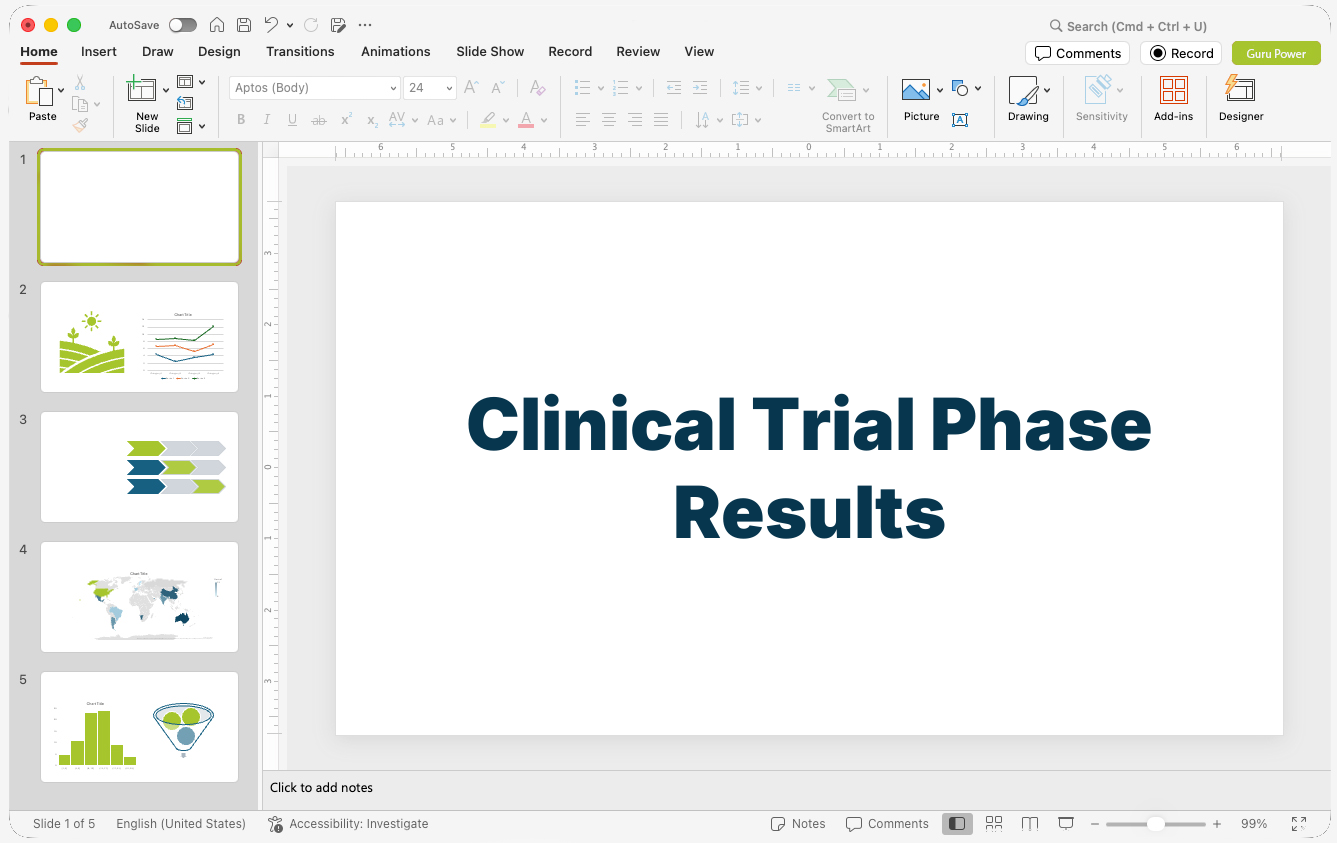
Clinical Trial Phase Results Presentation
Primary Audience: Clinical steering committees, investors, and regulatory reviewers.
Purpose: Demonstrate patient efficacy and safety endpoints to secure approval for subsequent phase trials..
Description: This presentation translates complex patient cohort outcomes, dosage responses, and primary endpoint data into precise visual charts. It provides clear data hierarchy for medical directors and scientific boards evaluating trial success. The deck structures drug discovery performance data to eliminate ambiguity around patient safety profiles.
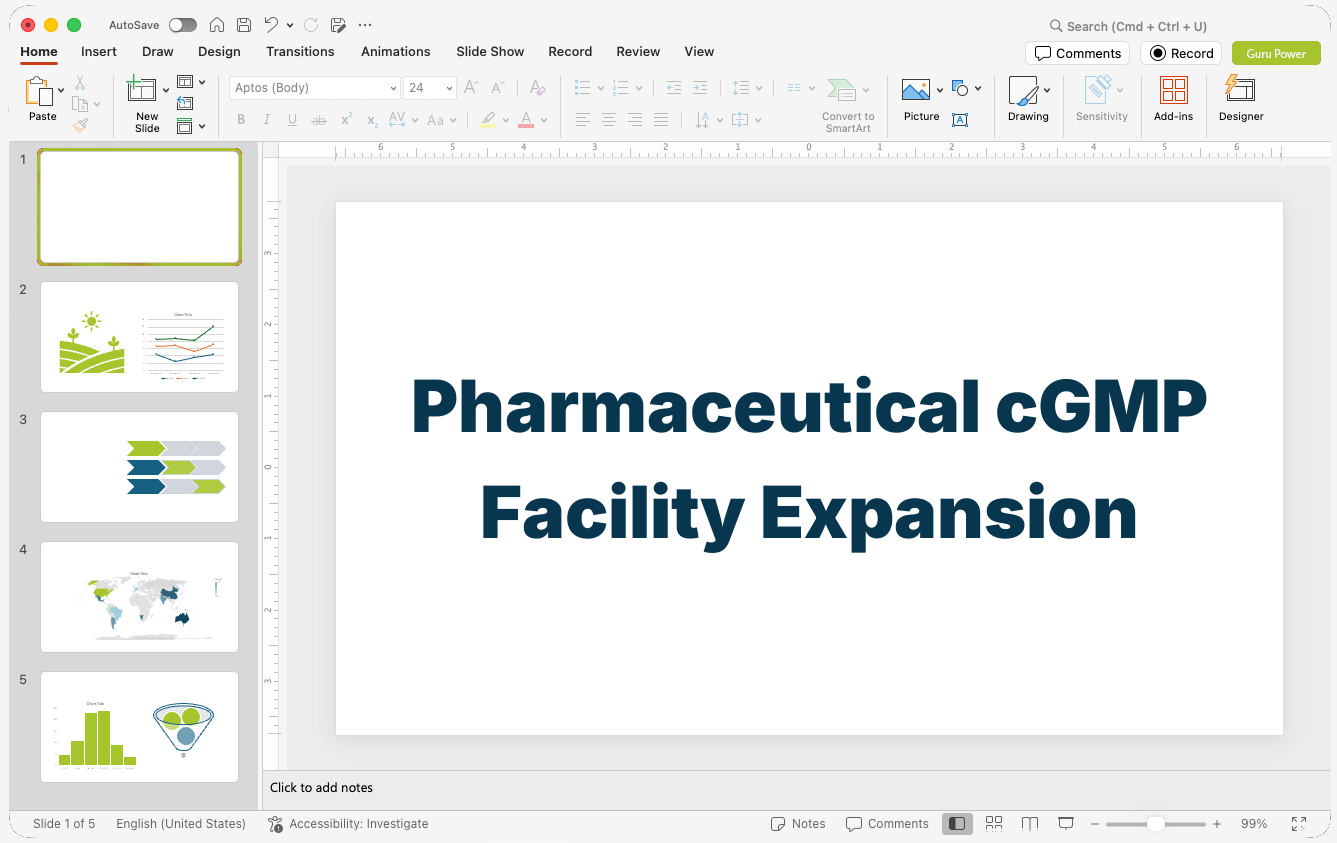
Pharmaceutical cGMP Facility Expansion Pitch-Deck
Primary Audience: Corporate board members, capital expenditure committees, and commercial lenders.
Purpose: Secure capital authorization for scale-up of pharmaceutical manufacturing cleanrooms and automated packaging lines..
Description: This pitch-deck establishes the financial and operational necessity of expanding commercial drug manufacturing capacity. It details cleanroom square footage, cGMP compliance features, unit economics, and output yield projections. The slide-deck incorporates operational timelines and cap-ex paybacks to justify facility investments.
Biopharmaceutical Drug Discovery Pipeline PowerPoint
Primary Audience: Institutional venture capital firms and pharmaceutical licensing partners.
Purpose: Present active pre-clinical and clinical drug candidates to secure strategic partnership funding..
Description: This PowerPoint presentation maps lead molecule candidates from target validation through Phase 3 clinical trials. It highlights therapeutic mechanism of action, target market size, patent exclusivity windows, and development risk mitigation strategies. The slides frame the research pipeline as a commercial asset portfolio.
FDA Regulatory Milestone Approval Slide-Deck
Primary Audience: Internal regulatory affairs teams and executive leadership.
Purpose: Align cross-functional stakeholders on submission timelines for Investigational New Drug or New Drug Applications..
Description: This slide-deck outlines the mandatory regulatory documentation, stability testing results, and agency meeting schedules required for market approval. It visually maps critical path tasks across clinical, quality control, and pharma production divisions. The presentation provides clarity on regulatory risk parameters.
Biologics Manufacturing Yield Optimization Slides
Primary Audience: Vice presidents of bioprocess development and plant operations managers.
Purpose: Approve process analytical technology upgrades to increase bioreactor batch yields..
Description: This slides set details fermentation efficiency metrics, cell line expression rates, and downstream purification recovery rates. It compares current biopharmaceutical production bottlenecks against projected yield improvements from upgraded bioprocessing equipment. The data demonstrates clear cost-per-gram manufacturing reductions.
Pharma Production Technology Transfer Deck
Primary Audience: Contract Development and Manufacturing Organizations (CDMOs) and plant engineering leads.
Purpose: Ensure seamless transfer of drug manufacturing protocols between research labs and commercial production sites..
Description: This technical deck details analytical method validation, critical process parameters, and batch record requirements. It establishes step-by-step responsibilities between the sponsor biopharmaceutical team and the manufacturing site team. The presentation reduces operational delay risks during technical transfer execution.
Clinical Drug Research Investor Pitch Deck
Primary Audience: Angel investors, healthcare hedge funds, and private equity partners.
Purpose: Raise growth capital for mid-stage clinical drug research programs..
Description: This pitch deck articulates the clinical unmet need, biological validation, target patient population, and commercialization roadmap. It translates scientific proof-of-concept data into concise financial returns models. The presentation addresses market competition, intellectual property coverage, and clinical exit milestones.
Drug Development Supply Chain Continuity Presentation
Primary Audience: Chief operating officers, procurement heads, and risk committees.
Purpose: Secure budget approval for active pharmaceutical ingredient (API) vendor diversification..
Description: This presentation analyzes single-source API vulnerabilities, cold-chain logistics risks, and global raw material lead times. It introduces secondary supplier validation plans and safety stock buffer models for pharma production continuity. The slide structure prioritizes risk reduction for essential drug supplies.
Biotech R&D Scientific Advisory Board Presentation
Primary Audience: Key opinion leaders, academic advisors, and chief scientific officers.
Purpose: Validate early-stage drug target hypotheses and refine clinical trial protocol designs..
Description: This presentation outlines target disease biology, high-throughput screening results, and biomarker strategy. It uses detailed data slides to support rigorous scientific debate among advisory board members. The deck captures expert feedback to refine biopharmaceutical research programs.
cGMP Pharmaceutical Operations Quality Audit Slides
Primary Audience: Quality assurance directors, plant managers, and regulatory compliance officers.
Purpose: Review internal cGMP inspection findings and approve corrective and preventive action (CAPA) plans..
Description: This slides deck categorizes facility audit findings, root-cause analyses, and systemic quality system remediations. It establishes operational timelines and accountability metrics for plant-wide cGMP compliance upgrades. The clear slide structure ensures compliance tracking across manufacturing units.
Pharma Production Automation & AI Strategy Slide-Deck
Primary Audience: Chief technology officers, operations heads, and corporate strategy boards.
Purpose: Authorize capital budget for automated visual inspection and AI-driven batch release systems..
Description: This slide-deck presents the operational retuens of automating drug inspection, packaging, and real-time release testing. It projects scrap rate reductions, cycle time improvements, and compliance error reductions across biopharmaceutical manufacturing lines. The presentation establishes clear technology deployment milestones.
Biopharmaceutical Portfolio Rationalization Pitch-Deck
Primary Audience: Executive committees, portfolio managers, and board members.
Purpose: Reallocate R&D capital from low-performing drug programs to high-value clinical assets..
Description: This pitch-deck evaluates active drug candidates using net present value, probability of technical success, and development cost metrics. It provides a comparative analysis to support strategic decision-making on program termination or acceleration. The deck establishes clear financial logic for research spending.
Your PowerPoint, Google Slide and KeyNote Strategy, Story and Design Professionals
Presentation Gurus solves narrative friction by converting complex biopharmaceutical manufacturing data into structured visual stories. Our designers build clinical data models, process flow diagrams, and branded PowerPoint frameworks that maintain strict visual consistency across drug discovery pitch decks and technical presentations. This addresses the challenge of presenting multi-phase clinical trial data to non-specialist stakeholders while maintaining scientific integrity. Customers need clear presentation structures that eliminate fluff and emphasize commercial viability, regulatory strategy, and operational readiness. Contact Presentation Gurus today to schedule a consultation and transform your next biopharmaceutical pitch deck or slide deck.
Ready ToGet Started?
Questions & Answers
Pharmaceutical Manufacturing & R&D Presentations FAQs
What does Pharmaceutical Manufacturing & R&D Presentations presentation design cost?
Pricing is simple and clear. A basic slide design or redesign begins at $49 per slide. Premium presentation design, which includes copywriting and basic storytelling, starts at $79 per slide. Custom presentations involving strategy, copywriting and custom graphics are quoted based on your specifications. See complete pricing details here.
How long does it take to get a presentation designed?
If your team needs a complete presentation by 9:00 AM the next day, we can meet that deadline. Most projects take 10 – 15 days, providing we have all the information. Pricing is also based on slide complexity and speed — a basic slide deck with a 15-day delivery costs much less than a premium slide deck delivered the next morning.
Can your team design slides compliant with pharmaceutical regulatory standards?
Yes. We design slide frameworks that accommodate mandatory medical compliance disclosures, fair-balance regulatory statements, and precise scientific citations. We ensure that data visualizations accurately represent source clinical trial statistics without introducing misleading visual exaggerations.
We have sensitive business information. Can you work under an NDA?
Virtually all of our client work is done under an NDA. We have a basic NDA included with our presentation work order, plus an enhanced, expanded non-disclosure agreement available whenever a project calls for it.
Does our industry need a Presentation or a Pitch Deck?
The terms are frequently used interchangeably, but they serve different strategic purposes. A pitch deck is a highly visual, persuasive tool designed to secure a strategic commitment or investment. A standard presentation is an informative, detailed document structured to align stakeholders and share data.
How do your designers convert complex drug discovery data into clear executive visuals?
We review source clinical research documents, process charts, and statistical spreadsheets to identify key business claims. We then create clean data charts, milestone roadmaps, and mechanism-of-action diagrams that highlight essential drug development outcomes for non-specialist decision-makers.
What is the typical turnaround time for an executive biopharmaceutical slide deck?
Standard projects typically take 10 to 15 business days depending on slide volume and structural complexity. Fast-track turnaround options are available for urgent institutional investment rounds, FDA advisory committee meetings, or partner licensing presentation deadlines.
How do you handle confidential clinical trial data during presentation design?
We enforce strict non-disclosure protocols and encrypted file-sharing workflows for all biopharmaceutical client engagements. Our team routinely handles blinded clinical trial data, proprietary molecule structures, and unannounced drug pipeline timelines, ensuring full data confidentiality throughout the deck production process.
Will our team receive the fully editable source file?
Yes. Unlike graphic designers who deliver flat PDFs or JPEGs, Presentation Gurus delivers the native, fully editable presentation file (.pptx, .key, etc.) so your team can make last-minute text edits on the fly, or update the presentation later as details change.
How does the collaboration process work?
Everything happens online. Every meeting is a Microsoft Teams call or similar virtual environment where we can share desktops and information in real time. Revision meetings and discovery calls are always scheduled in the morning, so by noon we can begin work on tasks for the next revision meeting.
Presentation Gurus' research identifies 13 locations with active Pharmaceutical Manufacturing & R&D operations, including Boston, MA, South San Francisco, CA, and San Diego, CA.
Drug discovery and therapy development bring together scientific innovation and massive scale. In Massachusetts, Kendall Square anchors a global powerhouse of laboratory work and corporate headquarters throughout Boston, MA. Across the river, research teams in Cambridge, MA run dense clusters of drug discovery laboratories and venture-backed biotechnology operations. These teams frequently partner with innovators in Biotechnology Research to convert laboratory findings into viable pipelines. Clear data storytelling becomes critical during every stage, especially when compiling a Clinical Trial / Testing Phase Results Readout for scientific boards and regulatory reviewers.
On the West Coast, California remains a cornerstone for commercial development and therapy production. The birthplace of biotechnology continues to thrive through drug discovery campuses in South San Francisco, CA. Further south, specialized genomics institutes and development facilities drive growth in San Diego, CA, while major biologics manufacturing and process development flourish in Thousand Oaks, CA. The Pacific Northwest adds its own momentum, as teams in Seattle, WA focus on computational drug discovery and cancer immunotherapy pipelines.
Across the East Coast and Mid-Atlantic, manufacturing scale matches laboratory discovery. In North Carolina, Research Triangle Park serves as an economic engine for the state. This regional base connects cGMP production and clinical centers in Raleigh, NC with extensive contract manufacturing organizations in Durham, NC. Nearby in South Carolina, companies like Nephron Pharmaceuticals maintain a massive production footprint. Further north, Philadelphia, PA leads national efforts in cell and gene therapy manufacturing. In Maryland, the Frederick Innovative Technology Center supports early-stage life sciences startups, feeding directly into the I-270 corridor in Rockville, MD for vaccine manufacturing, regulatory strategy, and biodefense research.
Midwestern operations provide vital industrial capacity and distribution. In Indiana, large corporate employers like Eli Lilly generate significant operational volume, supported by active ingredient production and global logistics based in Indianapolis, IN. Major commercial corporations also base headquarters and production throughout Chicago, IL, while Kalamazoo County anchors life sciences across Michigan with facilities for Pfizer Inc. and Zoetis. Meanwhile, clinical trial infrastructure expands through the Texas Medical Center ecosystem in Houston, TX. In every manufacturing hub, establishing a rigorous Quality Management System (QMS) Overview ensures facilities comply with complex safety rules.
Pharma pipelines intersect closely with the wider healthcare market. Drug developers rely on partners in Clinical Research Organizations (CROs) to manage multi-center studies, as well as suppliers in Medical Device & Diagnostics Manufacturing for delivery systems and companion assays. Treatments then transition to patient care through Hospital Systems & Healthcare Networks, Outpatient & Ambulatory Care Centers, and specialized therapies managed by Physical Therapy & Rehabilitation Networks. Patient tracking and adherence data run through modern Healthcare IT & Electronic Health Records (EHR) systems, while targeted therapies also support specialized fields like Mental Healthcare & Behavioral Health Services. Balancing these clinical trials, facility construction, and global supply chains requires disciplined portfolio planning, which executives communicate through a structured Capital Allocation Framework Presentation to guide long-term pharmaceutical investment.
Pharmaceutical Manufacturing & R&D Presentations By the Numbers
- Biologic medications account for 51% of total U.S. drug spending while representing only 5% of all prescriptions. (FDA Moves to Accelerate Biosimilar Development and Lower Drug Costs)
- Generics and biosimilars account for 90% of U.S. prescriptions filled but represent only 17.5% of total prescription drug spending. (Report: 2023 U.S. Generic and Biosimilar Medicines Savings Report)