
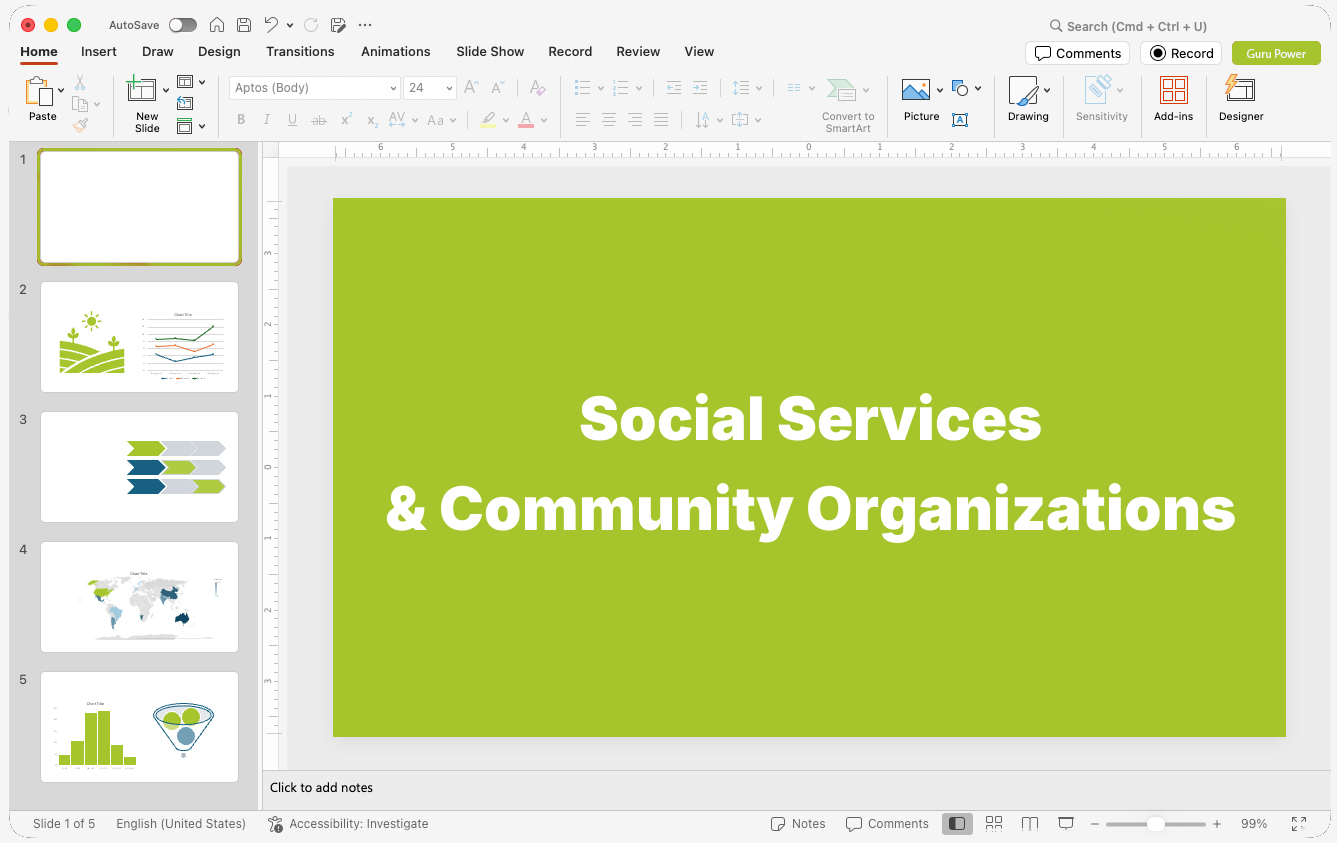
When Social Services & Community Organizations Decision-Makers Need Strategic Presentations Addressing Business Outcomes
Social Services & Community Organizations Presentation Design is the strategic restructuring and professional visual development of slide decks to effectively communicate program outcomes, fiscal management, and operational efficiency to government agencies, philanthropic foundations, and institutional boards.
Presentation Gurus acts as a dedicated design partner for Social Assistance providers, non-profit human services networks, and municipal community service agencies. Our team builds high-stakes executive slide deck deliverables tailored to strict sector governance. We design comprehensive human services agency annual reports, targeted community development pitch decks, and structured government grant application presentations that withstand rigorous board scrutiny. Whether your organization requires a refined PowerPoint template for recurring quarterly board reviews or a tailored Google Slides deck for regional grant reviews, we transform complex operational workflows into clean, persuasive visuals. Every presentation is engineered to align with institutional funding requirements, clear compliance mandates, and outcome-oriented community impact benchmarks.
Why Social Services & Community Organizations Presentations Need Professional Presentation Design
Social Assistance entities often struggle to articulate operational metrics and multi-program impact to conservative oversight boards. Standard bulleted slides fail to communicate complex community intervention outcomes, leading to delayed grant awards, reduced donor confidence, and stagnant budget allocations. Strategy-led design restructures qualitative human stories and quantitative outcome data into structured, decision-ready executive visual assets. The market requires clear, objective narratives that isolate return on investment, compliance controls, and service expansion capabilities. This addresses the core decision-making criteria of government agency directors, private foundation trustees, and municipal program monitors. By combining structured financial reporting with clear impact frameworks, organizations eliminate visual friction and build trust. The data shows that structured visual communication accelerates board alignment and secures long-term institutional funding commitments.
How Working With Us Works
From First Conversation To Finished Deck
Company
Meet JR, our founder. Fortune 500s, SMBs, startups — he’s built presentations for all of them with his team for the past 30 years, and he’s ready to build yours.
Service
Find your fit. We match the right service and scope to your audience, your goals, and your deadline, from 24-hour service to a 15-day turnaround.
Cost
Know the number upfront. Transparent, flat pricing before we start — no surprises, no hidden hours. All from $49 per slide.
Get Started
Tell us about your presentation project. It will take two minutes and we’ll get back to you on our next business day.












14 Essential Presentation Types for Social Services & Community Organizations
Social Assistance Program Funding Pitch-Deck
Primary Audience: Philanthropic foundation trustees and major private donors..
Purpose: Secure multi-year grant funding for community programs..
Description: This Social Assistance Pitch-Deck outlines program scope, target demographics, and projected intervention outcomes. The narrative moves from verified local community needs to administrative budget requirements. Clear visual financial slides establish fiscal responsibility and operational stability.
Human Services Annual Impact Presentation
Primary Audience: Board of directors, municipal partners, and community stakeholders..
Purpose: Report yearly client outcomes, financial health, and operational achievements..
Description: This Human Services Presentation synthesizes twelve months of case outcomes and fiscal management data into executive summary Slides. The deck highlights program enrollment trends, staff allocation efficiency, and grant fund utilization. Standardized visual layouts maintain organizational credibility across all reporting sections.
Community Support Government Grant Slide-Deck
Primary Audience: State and federal public welfare grant review panels..
Purpose: Demonstrate full regulatory compliance and secure public sector grant allocations..
Description: This Community Support Slide-Deck details regulatory alignment, program workflows, and measurable community success metrics. Visual process diagrams outline participant intake, service delivery, and outcome tracking protocols. The structural design aligns directly with statutory evaluation criteria.
Civic Organizations Strategic Expansion PowerPoint
Primary Audience: Internal executive leadership and regional expansion committees..
Purpose: Approve capital expenditure and site expansion into adjacent municipalities..
Description: This Civic Organizations PowerPoint evaluates regional demographic demand, facility acquisition costs, and staffing models. Geographic map Slides highlight service gaps in target expansion zones. Financial projections isolate operational sustainability timelines for the executive board.
Public Welfare Groups Operational Oversight Deck
Primary Audience: Municipal oversight boards and city council subcommittees..
Purpose: Maintain municipal service contracts and report public fund compliance..
Description: This Public Welfare Groups Slide-Deck provides a transparent review of contract execution, response times, and client service volume. Structured tables compare contract performance targets against actual monthly service deliverables. Clear data charts address operational questions before public review hearings.
Non-Profit Agencies Board Quarterly Review Slides
Primary Audience: Board members and executive leadership..
Purpose: Align leadership on current quarter financial performance and program capacity..
Description: This Non-Profit Agencies PowerPoint deck summarizes operational cash flow, fundraising revenue against targets, and active caseload metrics. Dashboard-style Slides allow board members to assess institutional risks quickly. The deck establishes clear action items for upcoming operational initiatives.
Charitable Foundations End-of-Year Donor Pitch-Deck
Primary Audience: High-net-worth individual donors and corporate philanthropy officers..
Purpose: Drive major donor contributions during end-of-year capital campaigns..
Description: This Charitable Foundations Pitch-Deck illustrates community interventions alongside verifiable economic return data. Strategic infographics demonstrate how targeted contributions translate directly into program expansion and client assistance. Visual layouts emphasize organizational transparency and low overhead ratios.
Social Assistance Community Partnership Presentation
Primary Audience: Local healthcare systems, school districts, and housing authorities..
Purpose: Establish formal cross-agency referral agreements and joint programs..
Description: This Social Assistance Presentation outlines collaborative service integration models and client referral workflows. Structured operational Slides clarify roles, data-sharing protocols, and joint accountability metrics. The deck demonstrates the operational efficiency gained through multi-agency partnerships.
Human Services Workforce & Staffing Slide-Deck
Primary Audience: Internal human resources leadership and legislative budget committees..
Purpose: Secure funding allocations for staff retention and caseload reduction..
Description: This Human Services Slide-Deck analyzes case manager retention rates, average client caseloads, and service quality impacts. Visual charts contrast staffing levels with regional demand growth to justify wage adjustments. The presentation establishes clear connection points between staff stability and client outcomes.
Community Support Crisis Intervention Deck
Primary Audience: Emergency management officials and municipal public safety directors..
Purpose: Integrate community assistance response protocols into local emergency planning..
Description: This Community Support Pitch-Deck outlines rapid-deployment capabilities, temporary shelter coordination, and disaster relief workflows. Visual mapping Slides define operational staging areas and resource distribution channels. The deck proves organizational readiness for emergency agency integration.
Civic Organizations Capital Campaign PowerPoint
Primary Audience: Institutional investors, bank lending officers, and foundation trustees..
Purpose: Secure financing for new community center facility construction..
Description: This Civic Organizations PowerPoint presents the financial business case, construction timeline, and expanded service capacity for a new facility. Detailed architectural rendering Slides combine with debt service coverage projections to establish viability. The deck addresses lender risk criteria through conservative operating estimates.
Public Welfare Groups Program Evaluation Slides
Primary Audience: External academic evaluators and institutional grant monitors..
Purpose: Validate evidence-based practice compliance and program efficacy..
Description: This Public Welfare Groups presentation details longitudinal research data, client outcome tracking, and methodology adherence. Statistical Slides break down participant control groups and measurable behavior metrics. The structured presentation validates operational efficacy for continued research funding.
Non-Profit Agencies Volunteer Engagement Slide-Deck
Primary Audience: Corporate social responsibility partners and community volunteer leaders..
Purpose: Scale corporate volunteer participation and secure matching corporate gifts..
Description: This Non-Profit Agencies Slide-Deck highlights volunteer contribution hours, skill-matching opportunities, and community impact. Clean visual layouts showcase corporate partner involvement metrics and ongoing project needs. The presentation establishes structured pathways for corporate community involvement.
Social Assistance Legislative Advocacy Presentation
Primary Audience: State legislators, budget staffers, and policy aides..
Purpose: Educate policymakers on community welfare needs prior to legislative sessions..
Description: This Social Assistance Presentation frames policy recommendations through verifiable regional human service data and cost-benefit analysis. Concise trend Slides illustrate how early intervention funding reduces downstream municipal emergency spending. The deck provides lawmakers with clear, defensible facts for committee hearings.
Your PowerPoint, Google Slide and KeyNote Strategy, Story and Design Professionals
Presentation Gurus provides end-to-end design, visual storytelling, and brand consistency for community support organizations presenting to modern institutional stakeholders. We eliminate dense text blocks, reformatted tables, and inconsistent iconography, replacing them with institutional-grade visual structures. Our designers translate complex intake data, geographical coverage maps, and fiscal allocation breakdowns into standalone graphics that highlight operational efficiency. Every slide deck complies with your organization's brand identity guidelines while maximizing clarity for executive decision-makers. Protect your program's funding pipeline with a professional presentation deck built for results. Contact Presentation Gurus today to schedule an initial consultation and review your upcoming pitch deck requirements.
Ready ToGet Started?
Questions & Answers
Social Services & Community Organizations Presentations FAQs
Can you adapt standard human services agency data into clear slide formats?
Yes. We regularly convert complex case management statistics, regional demographic maps, and public grant fund allocations into clear visual slides. Our team restructures raw data tables into modern data visualizations that highlight key operational results for foundation trustees and municipal monitors.
Will our team receive the fully editable source file?
Yes. Unlike graphic designers who deliver flat PDFs or JPEGs, Presentation Gurus delivers the native, fully editable presentation file (.pptx, .key, etc.) so your team can make last-minute text edits on the fly, or update the presentation later as details change.
We have sensitive business information. Can you work under an NDA?
Virtually all of our client work is done under an NDA. We have a basic NDA included with our presentation work order, plus an enhanced, expanded non-disclosure agreement available whenever a project calls for it.
Does our industry need a Presentation or a Pitch Deck?
The terms are frequently used interchangeably, but they serve different strategic purposes. A pitch deck is a highly visual, persuasive tool designed to secure a strategic commitment or investment. A standard presentation is an informative, detailed document structured to align stakeholders and share data.
How does the collaboration process work?
Everything happens online. Every meeting is a Microsoft Teams call or similar virtual environment where we can share desktops and information in real time. Revision meetings and discovery calls are always scheduled in the morning, so by noon we can begin work on tasks for the next revision meeting.
What turn-around time is typical for a major government grant presentation deck?
Standard full-deck design projects typically take 10 to 15 business days, including structure alignment, visual formatting, and review rounds. Expedited schedules are available for time-sensitive public agency deadlines, ensuring grant compliance visual assets are finalized prior to review dates.
How long does it take to get a presentation designed?
If your team needs a complete presentation by 9:00 AM the next day, we can meet that deadline. Most projects take 10 – 15 days, providing we have all the information. Pricing is also based on slide complexity and speed — a basic slide deck with a 15-day delivery costs much less than a premium slide deck delivered the next morning.
How do you handle visual design for sensitive social assistance outcomes?
We maintain a clinical, objective visual tone that respects client privacy while presenting hard program metrics. Data points are organized using clean charts, structured outcome tables, and clear infographics rather than graphic imagery or sensationalized content. This addresses board expectations for professional, dignified reporting.
What does Social Services & Community Organizations Presentations presentation design cost?
Pricing is simple and clear. A basic slide design or redesign begins at $49 per slide. Premium presentation design, which includes copywriting and basic storytelling, starts at $79 per slide. Custom presentations involving strategy, copywriting and custom graphics are quoted based on your specifications. See complete pricing details here.
How do you ensure brand consistency across large community support organization decks?
We build centralized master PowerPoint templates and Google Slides layouts containing locked typography, standardized color palettes, and clear component libraries. This structure ensures that diverse internal departments produce consistent, compliant slides for all public and board-level presentations.
Presentation Gurus' research identifies 14 locations with active Social Services & Community Organizations operations, including Washington, DC, New York, NY, and Chicago, IL.
Human services and community advocacy groups rely on clear communication to coordinate public aid, manage grant funding, and mobilize regional resources. In Washington, DC, national human services associations and major international advocacy non-profits regularly engage federal funding agencies. To the north, New York, NY anchors national human welfare charities, massive municipal social assistance networks, and influential philanthropic foundations. Nearby, teams in Philadelphia, PA draw on a dense network of historic human service agencies and charitable trusts, while Baltimore, MD centers on urban human service agencies and public health groups addressing immediate local needs.
Institutional philanthropy and community care networks also shape civic life across the Midwest and Northeast. Academic research and family service agencies work together in Boston, MA, supported by established philanthropic funds. In Pittsburgh, PA, regional foundations fund broad community development and neighborhood social assistance initiatives. Moving west, Chicago, IL functions as a central hub for regional charitable trusts and large social services endowment funds. Similarly, Minneapolis, MN features a high per-capita concentration of corporate philanthropic foundations and community assistance endowments that back large-scale social service agencies.
Across the South and West, community assistance organizations address rapid regional growth and specialized public welfare challenges. In Atlanta, GA, regional networks collaborate with national public health non-profits and civil social welfare funds. Organizations in Austin, TX drive social innovation initiatives alongside state public assistance offices and regional foundations. Further west, Denver, CO serves as an administrative and operational center for mountain-state community foundations and western human service agencies.
On the Pacific Coast, supportive housing initiatives and technology-driven solutions define community aid. Agencies in Los Angeles, CA coordinate large-scale supportive housing projects and regional public welfare campaigns funded by major foundation networks. In San Francisco, CA, urban community groups join forces with social assistance technology non-profits, while Seattle, WA hosts major global philanthropic foundations, supportive housing coalitions, and regional community assistance providers.
These human services networks often coordinate closely with neighboring sectors to achieve lasting community outcomes. Many teams partner with Non-Profit Organizations (NPOs) & NGOs and Trade Associations & Industry Coalitions to align policy priorities and public funding. Educational outreach ties them directly to Higher Education Institutions (Universities & Colleges) and K-12 School Districts & Private Schools for local family programs. Workforce integration links community groups with Vocational & Technical Training Centers as well as Corporate Training & Executive Education providers. In addition, social assistance leaders frequently reference research from Scientific Research Institutes & National Labs and coordinate specialized community transition support with Defense & Military Organizations.